
/Assets/arrow-facing-left--black-01.svg)
/Assets/navigation-global--close-symbol-black-01-1.svg)

/Assets/Icon%20Library/social/facebook-logo.svg)

/Assets/Icon%20Library/social/instagram-logo.svg)
/Assets/Icon%20Library/social/youtube-logo.svg)





You want to produce more content, and you want to use AI to do it. But you don’t want your content to sound like AI.
Good.
If your content sounds automated, it usually reads automated, too, and your buyers feel that immediately.
Generic content is a problem when companies use AI for marketing today. It protects the company from discomfort, but it doesn't actually help your customer feel understood and advocated for.
So how do you use tools like ChatGPT or Claude to help you create efficiency in your content marketing strategy, but not lose your voice?
Treat AI like a world-class assistant. Someone who can help you think, structure, and write in your voice.
Note: We coach clients on how to do this using the Endless Customers System™. We believe transparent, disruptive content can help make you the most known and trusted brand in your market. We wrote this article to help you get there whether you decide to work with us or not.
The real reason AI content “sounds like AI”
When “AI-sounding” content falls flat, it usually lacks substance.
The information is all there, but it doesn’t feel lived-in. It doesn’t carry a point of view. It doesn’t include specific experiences, real objections, real customer language, or the little details that prove you’ve actually done the work.
It just pulls information from what's already available online.
That’s the same reason outsourced content often falls flat. When someone doesn’t sit in your sales calls, doesn’t hear your buyers’ fears, and hasn’t lived your customers’ challenges, the content becomes surface-level, even if it’s well-written.
AI works the same way.
If you don’t feed it your thinking and your stories, it will default to what’s most common, most general, and most “safe.”
And safe is forgettable.
Below, we'll give you 6 steps to create amazing content while using AI for efficiency.
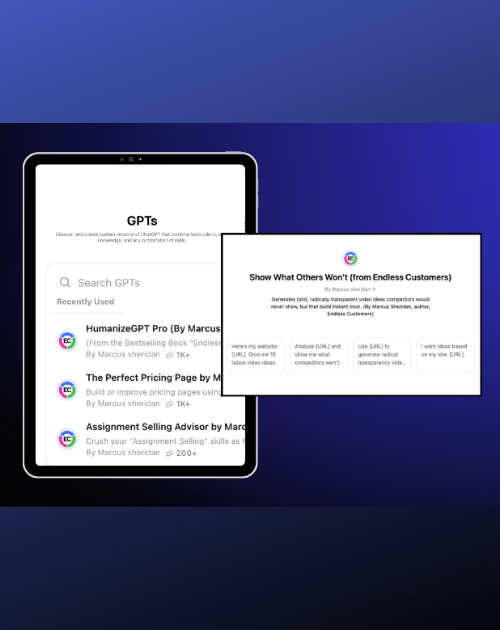
FREE RESOURCE
Endless Customers GPTs
We’ve built a collection of custom GPTs designed to help you sell smarter, write faster, and build a brand buyers actually trust. Each one is tailored to the Endless Customers philosophy so you can know you're getting all the best practices.
Step 1: Stop treating AI like a one-shot content generator
The biggest mistake we see is when people treat ChatGPT like a one-shot content generator.
Yes, AI can write a pretty thorough article from a simple prompt.
The problem is what it’s pulling from. Most of the time, it’s drawing on the most common patterns and ideas across the internet. So the output tends to sound like the internet: polished, plausible, and generic.
And generic content rarely stands out. It doesn’t get remembered, it doesn’t get trusted, and it’s less likely to get found by the right people in the first place.
AI works best when it acts like a ghostwriter, a journalist, or an interviewer sitting in the room with you, drawing out what you know and shaping it into something publishable.
That means you don’t start by saying, “Write me an article about X.”
You start by saying, “Here’s what I’m trying to produce. Help me think, structure, and clarify this, and ask me any questions that are helpful.”
Step 2: Give AI a role to play
Before you ask it to create anything, tell it who it is and how it should behave.
We recommend roles like:
-
World-class copywriter
-
Investigative interviewer
-
Journalist/editor
Then give it the boundaries:
-
Audience
-
Tone
-
POV ("I" vs "We")
-
Required Depth
Here’s a prompt you can steal and reuse:
You are a world-class interviewer and B2B content editor.
Goal: Help me write a practical article for [audience] about [topic].
Rules:
Use our brand voice: [insert brand voice here]
Ask me any questions you need before writing.
Start by proposing an outline. Then interview me to fill it in.
Make sure the final draft includes my first-hand examples and specific stories.
Step 3: Build the outline together
Start with the outline every time, even if you feel tempted to jump straight to a draft. The outline is the fastest way to confirm the tool understands what you’re trying to say before you invest time in a full article.
Think of it as a quick alignment check. If the structure is right, the writing gets easier. If the structure is wrong, you want to catch that early, while it’s still simple to adjust.
Ask for an outline, then review it like an editor and ask for revisions.
That usually looks like this:
-
“I want to include this section.”
-
“Add a subsection about X.”
-
“That section is redundant.”
-
“How can we include something around X?”
Before you move on, add one line that keeps the tool from filling gaps with assumptions: “Ask me any questions you need to get a better output.”
When AI has permission to interview you, it stops guessing and starts pulling the details that make your content feel real. That’s where your voice shows up, and where the draft starts to earn trust instead of sounding generic.
Step 4: Have AI interview you
Once the outline is solid, go back and tell the AI:
“Use this outline to interview me. I want a full conversation.”

If you’re a subject matter expert, do this with voice prompting whenever possible.
Let it ask questions like a journalist would, and answer like you would in a real conversation with a customer. When you relax and get into flow, you naturally use the phrases, opinions, and examples that make your brand sound like a real human.
Step 5: Add first-hand stories into every piece
This is the most important step, and it’s where most teams miss.
At IMPACT, we push our clients to include a story or lived experience in every piece of content. Something internal (company), external (customer), or personal (leadership). Something AI couldn’t invent.
Ask AI to pull these out of you with targeted prompts:
- “Tell me about a time this went wrong.”
- “What’s a customer objection you hear weekly?”
- “What’s the moment you realized this mattered?”
- “What do competitors get wrong about this?”
- “What would you say if an attendee asked you this at a trade show?”
The fastest way to make content feel human is to make it specific.
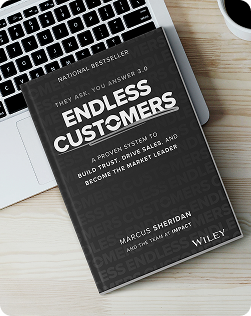
FREE BOOK PREVIEW
Endless Customers Special Preview Edition
Get a taste of the book that brings you a proven system to build trust, drive sales, and become the market leader. This special preview edition has select chapters and The Four Pillars of a Known and Trusted Brand, resources to accelerate your success, and more.
Step 6: Draft the article, then protect your voice
Once you have the outline and the interview notes, ask AI to draft the piece using that material. The goal is a draft that sounds like your team wrote it on a good day, using your phrasing, your examples, and your point of view. That only happens when you give it clear instructions and then edit the output.
Start by telling the tool exactly what to prioritize in the draft:
-
“Maintain my voice and phrasing as much as possible.”
-
“Use the exact language from my answers when it’s strong.”
-
“Avoid generic intros and filler.”
Then do a human pass before you publish. Rewrite any sections that still didn't come off like they're really from you.
A few things you can ask yourself while reading through the draft include:
-
Would our sales team actually say these sentences out loud?
-
Are there real examples, or only concepts?
-
Are we answering the uncomfortable questions buyers actually ask?
-
Does this have a clear point of view, or does it sound like everyone else?
-
Could a competitor copy and paste this and still sound credible?
AI should help you scale your truth, and your team should own the voice behind it.
Common questions about using AI while still sounding human
Q: Can I use AI to write a first draft?
Yes, if you’ve done an outline and personal interview first. Without your inputs, the first draft will be generic.
Q: How do I keep AI from sounding too polished or fake?
Paste a few examples of your best-performing content and tell AI to match that style while preserving your exact phrasing whenever it’s strong. That combination, clear voice guidance plus real language from you, is what keeps the output human.
Q: Is this approach still worth it if we’re busy?
This is for busy teams. It’s a fast way to turn what your experts already know into content that builds trust and supports sales.
Build your strategy with the Endless Customers System™
Using AI can protect your tone, style, and point of view while helping you scale them. The key is treating it like a collaborator and editor, then anchoring every draft in what makes your company credible: your real experiences, your real customers, and the way you actually speak when you’re helping someone make a decision.
That’s also why this fits so naturally inside the Endless Customers System™. When you commit to answering real buyer questions with clarity, stories, and transparency, AI becomes a force multiplier, not a shortcut. It helps you produce more of the content your buyers need to trust you, choose you, and stay with you.
If you want help putting this into a repeatable workflow, our Endless Customers Coaching Program is designed to help you build a content system that sounds like you, supports sales, and earns trust at scale.

Written By
In late 2009, Sheridan started his sales, marketing, and personal development blog—The Sales Lion. Before merging with IMPACT, he grew its brand to be synonymous with Inbound and Content Marketing excellence. Today, Marcus is an international keynote speaker known for his unique ability to excite, engage and motivate live audiences. He also works with hundreds of businesses, helping them to become the most trusted voice in their industry.
In late 2009, Sheridan started his sales, marketing, and personal development blog—The Sales Lion. Before merging with IMPACT, he grew its brand to be synonymous with Inbound and Content Marketing excellence. Today, Marcus is an international keynote speaker known for his unique ability to excite, engage and motivate live audiences. He also works with hundreds of businesses, helping them to become the most trusted voice in their industry.
/Assets/Icon%20Library/social/linkedin-logo.svg)
Share
/Assets/Icon%20Library/social/x%20corp.svg)
/Assets/Icon%20Library/social/mail-to.svg)
/Assets/base/Learning%20Center%20Resource%20Category%20Icons/Website%20link.svg)
NEED HELP WITH AI FOR MARKETING?
If you’re looking to take control of your sales and marketing with a proven system built for the age of AI, IMPACT can help. We can guide you on how to control your growth, stop relying on agencies, and become the most known and trusted brand in your market.
NEED HELP WITH AI FOR MARKETING?
If you’re looking to take control of your sales and marketing with a proven system built for the age of AI, IMPACT can help. We can guide you on how to control your growth, stop relying on agencies, and become the most known and trusted brand in your market.