
/Assets/arrow-facing-left--black-01.svg)
/Assets/navigation-global--close-symbol-black-01-1.svg)
/Assets/Icon%20Library/social/facebook-logo.svg)

/Assets/Icon%20Library/social/instagram-logo.svg)
/Assets/Icon%20Library/social/youtube-logo.svg)






Most business owners assume that if their website looks professional and their Google reviews are decent, they're in good shape online.
That was true a few years ago. It's not anymore.
AI tools like ChatGPT, Perplexity, Google's AI Overviews, and Gemini are quickly becoming the first stop for a growing number of buyers. They're not just answering questions. They're making recommendations.
When someone asks, "Who's the best [your service] in [your city]?" or "What's the most trusted [your product category]?" AI is deciding whether your business shows up or doesn't.
At IMPACT, we coach businesses to help them become the most know, trusted, and recommended brand in their market through the Endless Customers System™. Right now, that work increasingly means understanding a new layer of credibility: AI trust signals.
These trust signals are the specific factors AI systems use to evaluate whether your business is credible, authoritative, and worth recommending.
At Endless Customers Live 2026 in Chicago, Marcus Sheridan revealed 19 trust signals AI models look for when deciding which companies to recommend. In this article, we break down each one and what you need to do to make sure you show up.
What Are AI Trust Signals?
AI trust signals are the criteria that AI-powered search and recommendation tools use to evaluate whether a business is reliable, authoritative, and worth surfacing to buyers.
Unlike traditional SEO, which focuses primarily on keywords and backlinks, AI trust signals reflect a broader evaluation of your entire digital presence: your content, your transparency, your reputation, and your technical infrastructure.
The important thing to understand is this: while these signals help you get recommended by AI, they also help real humans find and experience your business in a more positive way.
Almost everything that earns AI's trust also earns human buyers' trust, like:
- Publishing honest pricing information
- Having a robust body of educational content
- Maintaining consistent business information across platforms
All of these things make you more credible and useful to real people. So, don’t start to panic. Optimizing for AI and optimizing for your human buyers aren’t so different.
The 19 signals below fall into four categories: Technical Foundations, Content and Expertise, Transparency and Credibility, and Reputation and Visibility.
Don’t try to tackle everything at once. Prioritize what can be done quickly and easily, and what might require more time or technical expertise.
Want to measure your current AI visibility? Check out Marcus Sheridan's tool AITrustSignals for a brand health check and insights into your performance on major AI platforms (plus actionable insights to boost your overall score).
Group 1: Technical Foundations
These three signals are table stakes. AI won’t be able to identify you properly if any of these are missing. Address them first.
1. Verified NAP Consistency
NAP stands for Name, Address, and Phone number. When your business information matches exactly across your website, Google Business Profile, directories, and social platforms, AI systems can confidently identify your business as a single verified entity.
Even minor inconsistencies, like "St." on one profile and "Street" on another, introduce doubt. AI interprets that doubt as a credibility gap.
What to Do: Run a quick search for your business name and compare the Name, Address, and Phone Number across your top five directory listings. Fix any discrepancies.
2. Website Security (HTTPS)
If your website doesn't run on HTTPS, browsers label it "Not Secure," and AI systems treat it as a low-trust source. This isn't just marketing; it's a baseline credibility requirement.
What to Do: Copy and paste your website address into a document to show the full address (or click it twice in the search bar). You should see “HTTPS”, not “HTTP”. If it’s missing or shows “Not Secure,” contact your developer to install an SSL certificate. This is a one-time fix that typically takes less than a day.


3. Advanced Schema Markup
Schema is structured data embedded in your website code that tells search engines and AI systems exactly what your content means. Think of it as a label on the outside of your content.
A pricing page with schema markup tells AI it's a pricing page. An FAQ page with schema markup tells AI the questions and answers are directly citable. The more clearly structured your data, the more confidently AI can surface your content.
What to Do: This one will take more time to implement. Using tools like ChatGPT, Claude, and technicalSEO.com, your team can start creating schema for some pages, but you may want a developer for larger projects. You can use tools like schema.org or Google’s Rich Results to validate what schema is visible on your website for AI and search engines.
Group 2: Content and Expertise Signals
Content is where many businesses either build or lose their AI credibility. The good news is that if you're already committed to answering your buyers' real questions honestly and thoroughly, you're ahead of most of your competition
4. On-Page Content Richness
Rich content goes further than thin content. It answers follow-up questions, addresses buyer concerns, includes real examples, and uses specific data. A service page that's three paragraphs long and ends in a contact form isn't rich; it's a placeholder. AI systems favor pages that fully answer a question, not ones that tease an answer and require a buyer to call to learn the rest.
Don’t mistake broad, generic, or lengthy content for topic depth. Shorter content can be more “rich” in the eyes of humans and search engines. It’s more about the quality of the content. Make sure that the content on every page has a purpose and adds value. That’s how you create rich content.
What to Do: Pull up your top three service or product pages and ask: Does this page fully answer every question a buyer would ask before contacting us? If not, add real depth by addressing things like costs, concerns, comparisons, and outcomes, not just features.
5. Answer-Focused Semantic Structure
This means writing content so that individual paragraphs, headings, and FAQ answers can stand alone as direct responses to specific buyer questions. To make it easier for AI to extract and cite your content, use headers structured as questions with opening sentences that answer those questions directly, and FAQ-formatted sections. If an AI can pull your first paragraph and use it as a complete answer without additional context, you've done it right.
What (Not) to Do: Don’t go rewrite all of your content in the form of a question. Remember, a balance has to exist so that your content is readable for humans, SEO, and AI. What you can do is take a few top-performing articles and change headings where it makes sense to have a question instead, and make sure the following paragraph confidently and completely answers the question. Track to see if your article gets more traffic.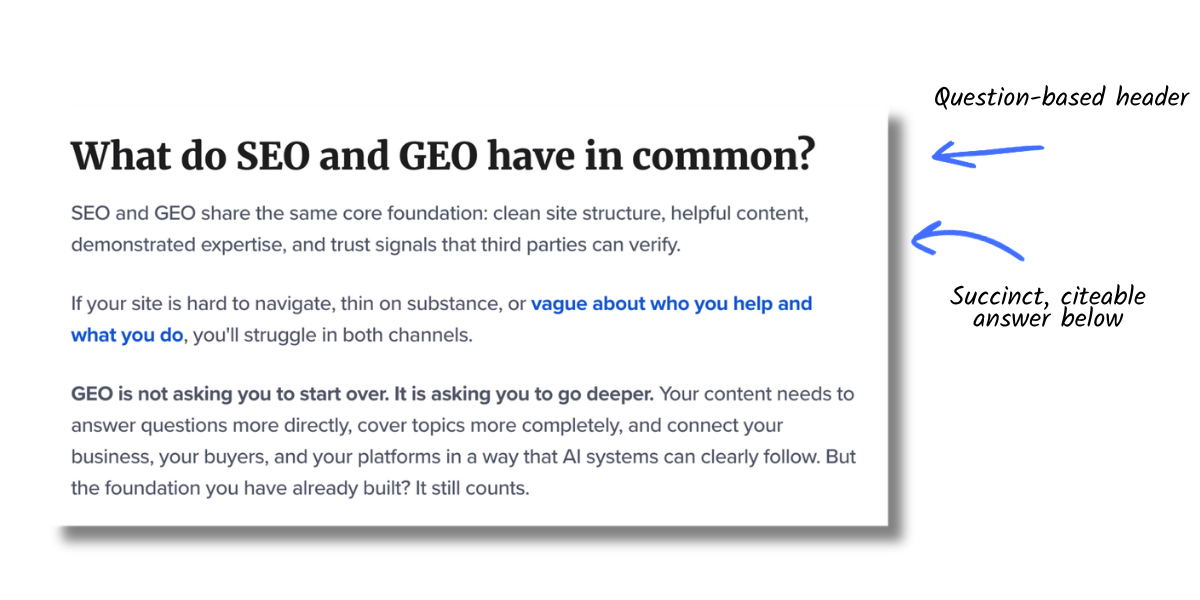
6. Educational Content Hub (Learning Center)
A learning center is a sustained body of articles, videos, and resources that covers a topic area deeply over time. AI systems recognize businesses with robust educational content as genuine subject matter authorities.
An HVAC company with 60 articles covering common buyer questions will almost always surface over a competitor with five. Don’t choose quantity over quality, however. You’ve got to write content around the questions people are actually searching for.
Free Assessment
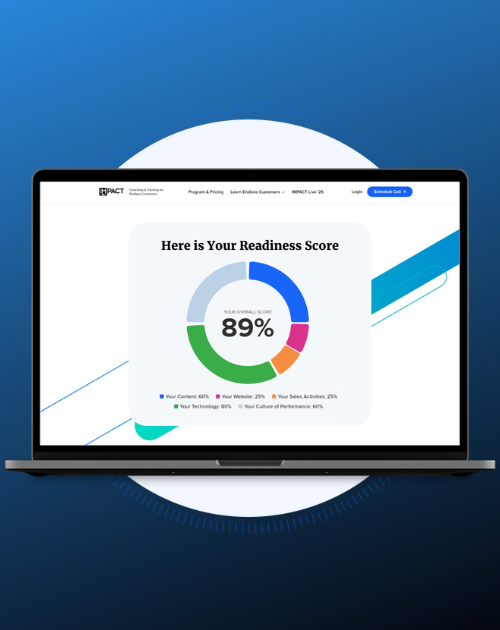
Free Marketing Assessment: Where do you stand?
AI is changing how buyers find businesses, and most companies are dangerously underprepared. Take this free assessment and find out if yours is at risk of becoming invisible to your buyers.
7. Content Surface Area
Content surface area is the total volume of relevant, indexed content your business has on the web. More content means more opportunities to appear in AI-generated responses. This doesn't mean publishing anything and everything. It means being thorough about covering the topics your buyers actually search for. Gaps in your content could be gaps in your visibility.
What to Do: Audit your current content library. Search "site:yourdomain.com" in Google to see how many pages you have indexed, or dive into Google Search Console for more insights. If the number is lower than you expected, start filling gaps systematically around the topics your buyers search for most.
8. Content Freshness
AI systems and buyers both favor current information. Pages with visible "Last Updated" dates, regularly refreshed pricing content, and up-to-date FAQs signal that your business is active and your information is reliable. Stale content signals a neglected digital presence.
What to Do: Add a visible "Last Updated" date to your top-performing pages and refresh the content to match (Don’t just add a new date). Start with your pricing page and any year-specific articles. Those are the highest-value freshness signals for AI.
9. Authoritative Outbound Citations
Linking to credible external sources like industry research, government data, and established publications signals that your claims are grounded in evidence, not opinion. Most businesses avoid linking away from their site, which is exactly the wrong instinct. Citing reputable sources increases your credibility with both AI systems and human readers.
What to Do: On your next three articles or service pages, link to at least one credible external source that backs up a key claim. Make it a standard part of your publishing checklist going forward.
Group 3: Transparency and Credibility Signals
These five signals reflect how open and accountable your business is about how you operate. AI systems are increasingly sophisticated in evaluating whether a business is genuinely trustworthy rather than simply talking about being trustworthy.
10. On-Page Pricing and Fee Transparency
Publishing honest pricing information (cost ranges, what affects price, what's included) is one of the highest-impact signals on this list. Buyers want to know what they're going to pay before they reach out, and AI systems are beginning to prioritize businesses that provide this clearly.
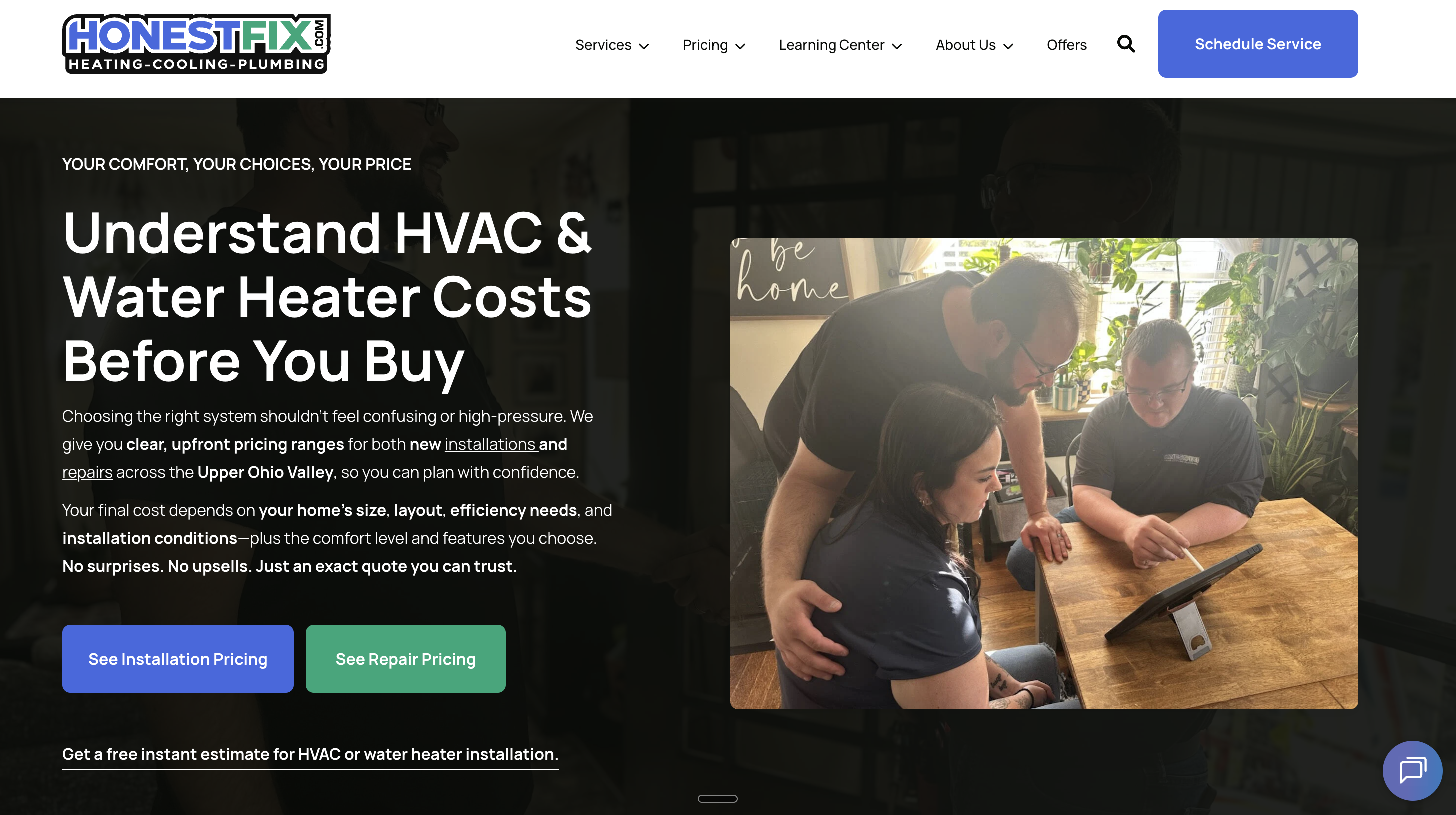
Honest Fix, an HVAC company in the upper Ohio Valley, built a pricing page that breaks down installation costs by system type, explains pricing factors, includes a pricing FAQ, and offers an instant estimate calculator. That kind of transparency doesn't just help AI. It's exactly what real buyers are looking for.
What to Do: If your pricing page says "contact us for a quote," rewrite it. At minimum, publish cost ranges, explain what drives the price up or down, and answer the pricing questions buyers ask before they ever call you.

11. Accuracy of Claims
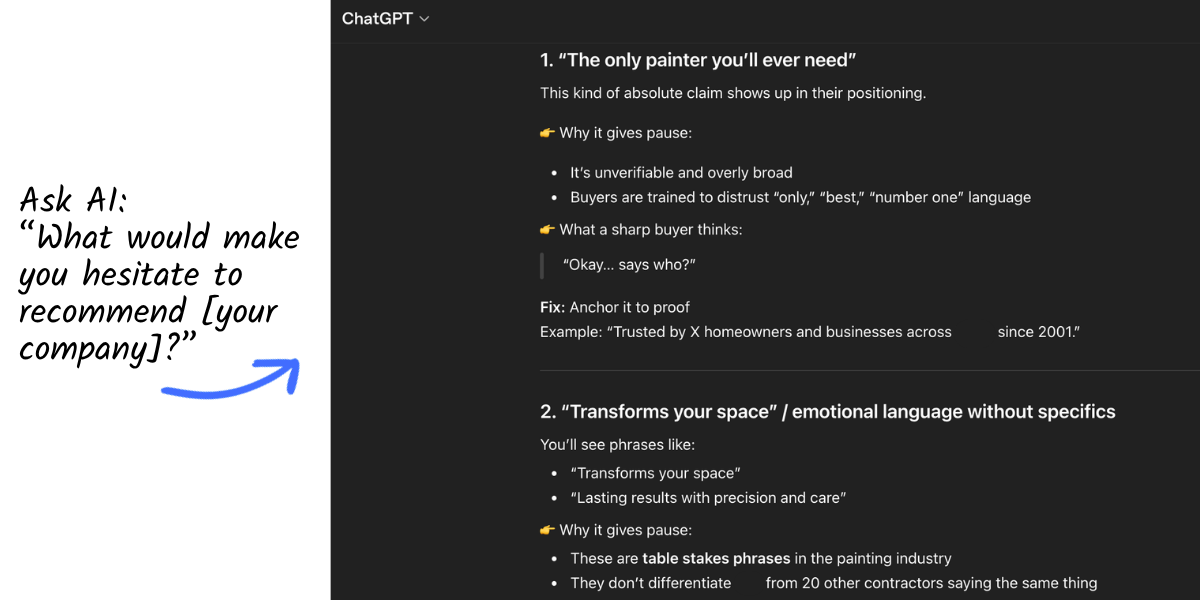
AI can cross-reference your claims against known data. Vague statistics, unverifiable promises, and factually questionable content will erode your credibility over time.
Be specific. Cite your sources. Say what you can actually prove.
What to Do: Audit your homepage and top service pages for vague language like "industry-leading" or unsourced statistics. Replace them with specific, verifiable facts and link to the source.
12. On-Page Contact and About Depth
A detailed About page and complete contact information (team names, physical address, phone number, and a real email address) signal that a real, accountable business is behind the content. Shallow or missing contact information is a credibility gap for both AI systems and buyers.
What to Do: Open your About and contact pages right now. If they don't include real names, photos, a physical address, and a direct phone number, make a plan to update them as soon as possible.
13. Policy and Ethics Transparency
Privacy policies, service guarantees, cancellation terms, and return policies tell AI systems and buyers that your business operates with accountability. This matters especially in industries where buyers are making significant financial decisions. If a buyer can't find your policies (on their own or by asking AI), they'll find a competitor whose policies they can read.
What to Do: Make sure your privacy policy, service terms, and any guarantees are findable within one click from your homepage (probably in your footer). If buyers have to hunt for them, so does AI. The good news is that AI can be a great tool for writing up these pages so you can have them published in no time at all.
14. Brand Values
Publishing your company's values, mission, and what you stand for, and making it visible on your website, gives AI systems a clearer picture of who you are. Companies with specific, articulated values are more citable than companies with generic messaging. "We're passionate about delivering excellence" doesn't tell AI anything useful. "We publish our pricing because buyers deserve to make informed decisions" does.
What to Do: Write one paragraph that explains not just what your company does, but why you do it differently in specific, concrete terms. Publish it on your About page.
Group 4: Reputation and Visibility Signals
These five signals reflect how your business appears to the outside world: on review platforms, in industry recognition, and in search results. AI systems don't evaluate your business in isolation. They aggregate how others see you.
15. Public Review Score and Volume
AI tools are building what researchers call a "reputation graph," a composite evaluation that factors in your average review rating, total review volume, how recent your reviews are, and how you respond to negative feedback. And this isn’t just on Google. AI is able to pull in reviews and conversations about your brand from every platform, all at once.
A 4.8 rating with 200 reviews is a substantially stronger signal than a 5.0 with 12. Volume, recency, and how you handle negative reviews all play a part when AI is evaluating your online reputation.
What to Do: Check your current review count and average rating on Google and other review platforms, then build a simple system for asking customers to leave a review right after a positive experience. You can help drive the narrative by creating a reviews page on your website and using review schema to make them easy to source for AI.
16. Case Studies and Testimonial Presence
Third-party review platforms matter, but so does what appears on your own site. Case studies and testimonials that name specific clients, describe specific outcomes, and explain the before-and-after of working with you are significantly more credible than generic praise. AI systems and buyers are both looking for proof, not promises.
What to Do: Identify your three best client outcomes and turn each into a short case study on your site: who the client was, what problem they faced, what you did, and what changed.
17. Author and Team Pages
AI systems increasingly favor content written by identifiable people with demonstrated expertise. Author pages (with names, photos, roles, credentials, and links to their published work and even LinkedIn profiles, when appropriate) signal that real, accountable humans are behind your content. Anonymous content is a weaker trust signal than content with a name and a face attached to it. Take a look at this great example of a team page from Berry Insurance below.
What to Do: Create a dedicated page for each person who publishes content on your site, with their name, photo, role, areas of expertise, and links to what they've written. Make sure every article byline links back to it.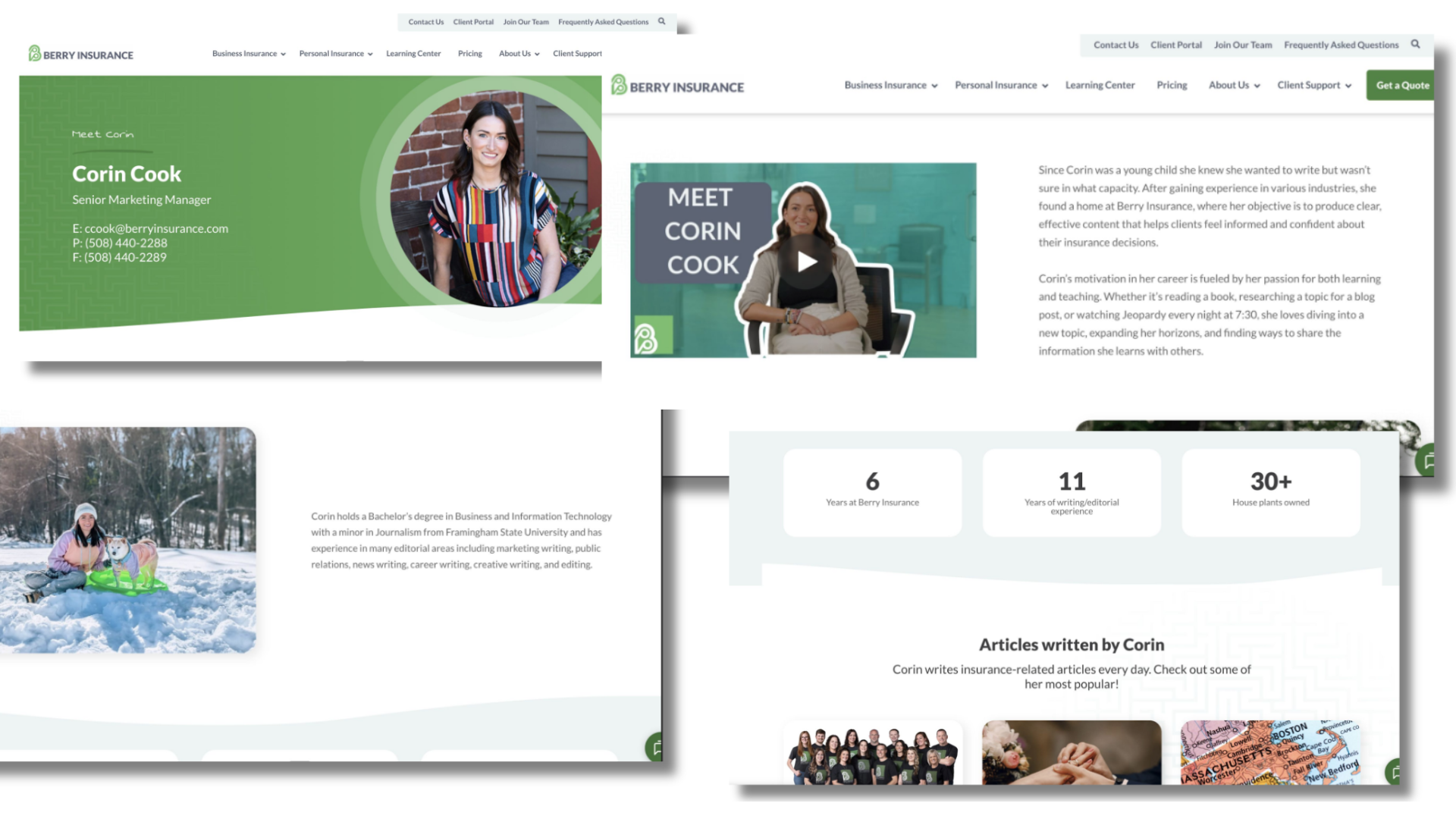
18. Industry Awards and Recognition
Third-party recognition from credible industry organizations signals that your expertise has been evaluated by sources outside your own website. AI systems interpret external recognition as proof of your authority claims. We know it’s not always fun or convenient to seek out these types of awards, but demonstrating that others in your field have reviewed your work and found it worth recognizing is truly valuable.
What to Do: Identify two or three credible organizations in your space that offer awards or certifications your business legitimately qualifies for. Apply for and publish any recognition you receive prominently on your site.
19. Google Page 1 Rankings
AI systems don't ignore organic search performance. If you already rank on page one of Google for relevant queries, that visibility functions as an additional trust signal: it tells AI that others have already determined your content is authoritative and useful.
Strong SEO and strong AEO (answer engine optimization) reinforce each other.
What to Do: Search the five questions your buyers ask most often and note where you rank. If you're not on page one for any of them, that's your SEO priority list because AI and buyers are both reading those same results.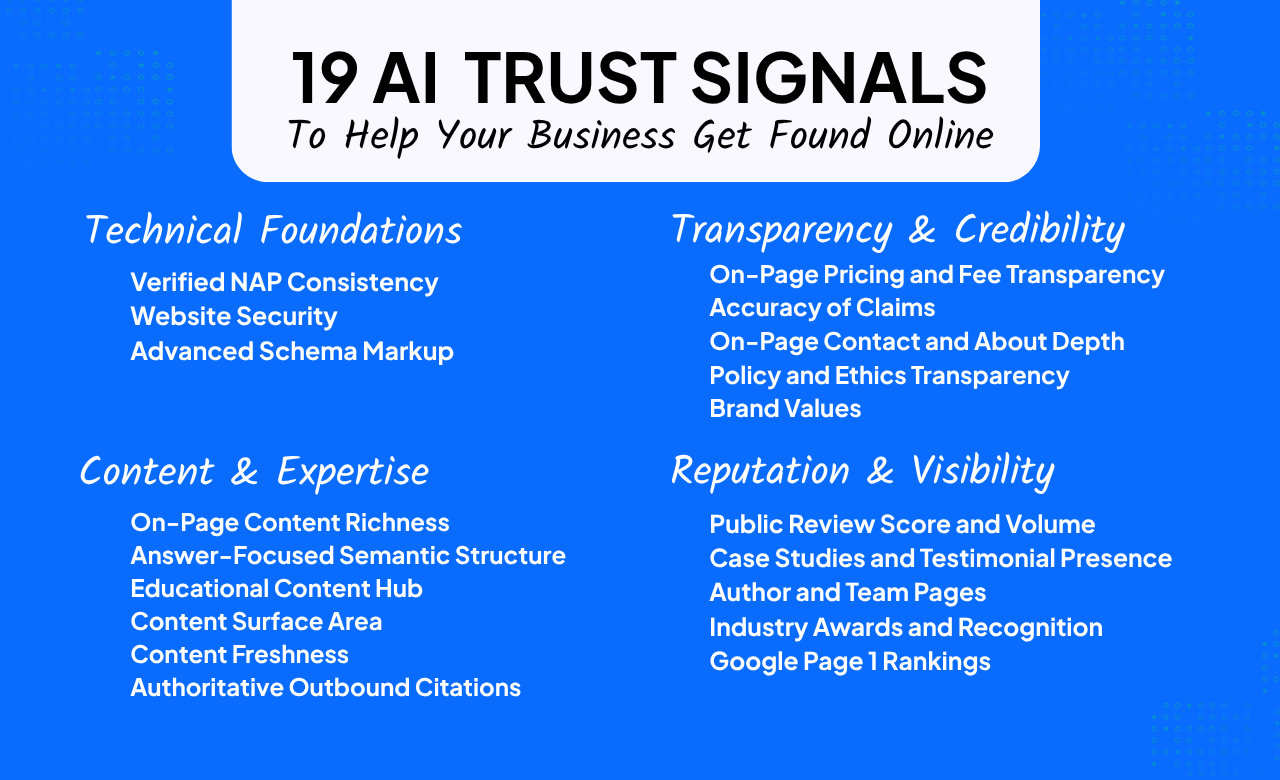
So, Where Should You Start?
Not all 19 of these signals carry equal weight, and trying to address all of them at once is the fastest way to make meaningful progress on none of them.
For most businesses, the best starting point is an honest audit: which signals do you already get right, and where are the obvious gaps? The technical foundations (NAP consistency, HTTPS, and schema) are quick wins that can take a few hours. Content and transparency signals take longer, but they compound. An educational content hub built this year will keep earning AI's trust in three years.
The most common mistake we see is businesses optimizing for AI at the expense of their human buyers by writing content that's structured for extraction but exhausting to actually read.
These signals don't ask you to choose. They ask you to become genuinely more helpful, more transparent, and more credible to the people you serve. Do that well, and AI will take notice.
At IMPACT, the Endless Customers System™ gives business owners a structured path through this work, building the content, transparency, and digital presence that earns trust from both buyers and the AI tools they increasingly rely on.
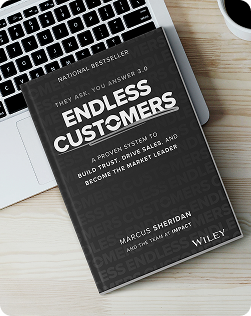
Check out the preview edition of Endless Customers™ to learn the framework that will help your business continue to show up for customers wherever they search.
FREE BOOK PREVIEW
Endless Customers Special Preview Edition
Get a taste of the book that brings you a proven system to build trust, drive sales, and become the market leader. This special preview edition has select chapters and The Four Pillars of a Known and Trusted Brand, resources to accelerate your success, and more.

Written By
Bob Ruffolo founded IMPACT in 2009 and has led it as CEO ever since. What started as a simple web design company has grown into a business coaching and training company that helps leaders and their teams get better at sales, marketing, communication, and leadership. IMPACT has been a HubSpot partner since 2011, one of HubSpot's first, and today is a HubSpot Diamond Solutions Partner, twice named HubSpot Partner of the Year and a four-time Inc. 5000 honoree (2018 to 2021). Bob himself has been recognized as a 40 Under 40 winner and named to Glassdoor's Best CEO for Small Businesses list. Bob is the co-creator of the Endless Customers System with Marcus Sheridan, the methodology behind IMPACT's coaching, the USA Today bestselling book, the Endless Customers podcast, and the annual Endless Customers Live conference. It teaches companies to build marketing and sales capability in-house rather than outsourcing it indefinitely. In recent years Bob has led IMPACT's shift to an AI-first company and become a go-to voice for leaders trying to understand what AI means for marketing, sales, and the workforce.
Bob Ruffolo founded IMPACT in 2009 and has led it as CEO ever since. What started as a simple web design company has grown into a business coaching and training company that helps leaders and their teams get better at sales, marketing, communication, and leadership. IMPACT has been a HubSpot partner since 2011, one of HubSpot's first, and today is a HubSpot Diamond Solutions Partner, twice named HubSpot Partner of the Year and a four-time Inc. 5000 honoree (2018 to 2021). Bob himself has been recognized as a 40 Under 40 winner and named to Glassdoor's Best CEO for Small Businesses list. Bob is the co-creator of the Endless Customers System with Marcus Sheridan, the methodology behind IMPACT's coaching, the USA Today bestselling book, the Endless Customers podcast, and the annual Endless Customers Live conference. It teaches companies to build marketing and sales capability in-house rather than outsourcing it indefinitely. In recent years Bob has led IMPACT's shift to an AI-first company and become a go-to voice for leaders trying to understand what AI means for marketing, sales, and the workforce.
/Assets/Icon%20Library/social/linkedin-logo.svg)
Share
/Assets/Icon%20Library/social/x%20corp.svg)
/Assets/Icon%20Library/social/facebook-logo.svg)
/Assets/Icon%20Library/social/mail-to.svg)
/Assets/base/Learning%20Center%20Resource%20Category%20Icons/Website%20link.svg)
NEED HELP WITH AI FOR MARKETING?
If you’re looking to take control of your sales and marketing with a proven system built for the age of AI, IMPACT can help. We can guide you on how to control your growth, stop relying on agencies, and become the most known and trusted brand in your market.
NEED HELP WITH AI FOR MARKETING?
If you’re looking to take control of your sales and marketing with a proven system built for the age of AI, IMPACT can help. We can guide you on how to control your growth, stop relying on agencies, and become the most known and trusted brand in your market.