
/Assets/arrow-facing-left--black-01.svg)
/Assets/navigation-global--close-symbol-black-01-1.svg)

/Assets/Icon%20Library/social/facebook-logo.svg)

/Assets/Icon%20Library/social/instagram-logo.svg)
/Assets/Icon%20Library/social/youtube-logo.svg)




You can have steady website traffic and still struggle with inconsistent leads.
If marketing looks active on your website, but sales opportunities are sporadic and unpredictable, it’s time to take a deeper look at what’s telling them to stay or go.
In many organizations, this tension can be traced back to something foundational, but sometimes overlooked: brand messaging.
The way your company communicates who you serve, what problem you solve, and why you’re different directly shapes how buyers interpret your website. When that messaging lacks clarity, your website copy can unintentionally create friction.
Brand messaging is a core component of website strategy. Your design, conversion paths, and calls to action all depend on the clarity of the message underneath them. Yes, even a great-looking website can kill conversions with bad messaging.
At IMPACT, brand messaging isn't just a marketing exercise. It's the foundation of everything we help businesses build with the Endless Customers System™. We've seen firsthand what happens when it's right, and when it isn't.
In this article, we’ll look at how messaging influences lead consistency, how to evaluate whether your website copy is supporting or undermining your strategy, and what steps you can take to strengthen it.
What's the Difference Between Brand Messaging and Website Copywriting?
Brand messaging defines what your company stands for and who it serves.
Website copywriting is how that message shows up on your website.
Oftentimes, businesses talk about themselves first on their website. They focus on “WE” language in an effort to sound impressive as quickly as possible, hoping to convince website visitors to stick around.
The challenge is that buyers don’t arrive at your site asking, “Who are you?” They arrive asking, “How can you solve my problem?”
When your brand messaging is clear, your website should answer that question immediately. It should define who your company serves, the problem it solves, and the outcome the buyer can expect. Every headline, subheading, and call to action should reinforce that message.
This is best described within the StoryBrand Framework. Simply put: The goal of your website should be to help your buyer see themselves as the hero of their buying journey, position your business as the helpful guide along the way, and your service/product as the tool that helps them win.
Examples of How to Improve Your Brand Messaging on Your Website
| Company-Focused Language | Buyer-Focused Alternatives |
| "We are a full-service IT solutions provider." | "Reliable IT support that keeps your team productive." |
| "Our innovative platform leverages advanced technology." | "Simplify your workflow without unnecessary complexity." |
| "We offer comprehensive financial planning services." | "Protect your future with a clear financial plan." |
| "Our award-winning team delivers exceptional service." | "Responsive support when you need it the most." |
What Unclear Messaging Looks Like on a Website
When the underlying messaging is unfocused, website copy tends to default to:
-
Describing the company in broad, generic terms
-
Listing services without context or prioritization
-
Leading with features instead of outcomes
-
Assuming the visitor already understands the value
You won’t see it directly, but this causes friction. Buyers have to work harder to understand what's relevant. Some will just leave, while others move forward with unclear expectations.
A 5-Minute Messaging Check for Your Homepage
You do not need a full redesign to evaluate whether your brand messaging and website copy are working. In most cases, your homepage will reveal the issue quickly.
Open your site as if you have never seen it before. Then ask yourself a few simple questions.
Within five seconds, is it clear who this company is for?
A new visitor should immediately understand the type of buyer you serve. If the headline could apply to almost any company or person in your industry, you’re lacking clarity.
Is the primary problem clearly stated?
Strong messaging names the challenge your buyer is facing. If your homepage describes services without anchoring them to a specific pain point, visitors must connect the dots themselves.
Is your differentiation visible without scrolling?
Buyers compare options quickly. If what makes you different is buried deep on the page, you risk blending into the noise.
Is the next step obvious and specific?
A clear call to action should communicate what happens next. Vague language creates hesitation. Specific language builds confidence.
If answering these questions was a struggle, the issue is rarely the design of your website. More often, your messaging is what needs to be improved.
Free Assessment
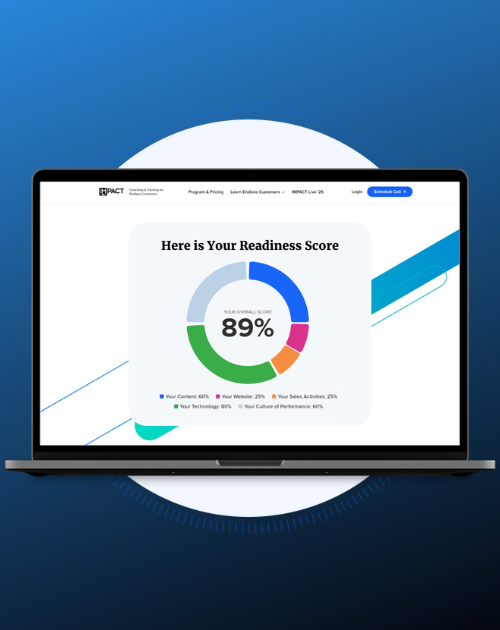
Free Marketing Assessment: Where do you stand?
AI is changing how buyers find businesses, and most companies are dangerously underprepared. Take this free assessment and find out if yours is at risk of becoming invisible to your buyers.
See it in action
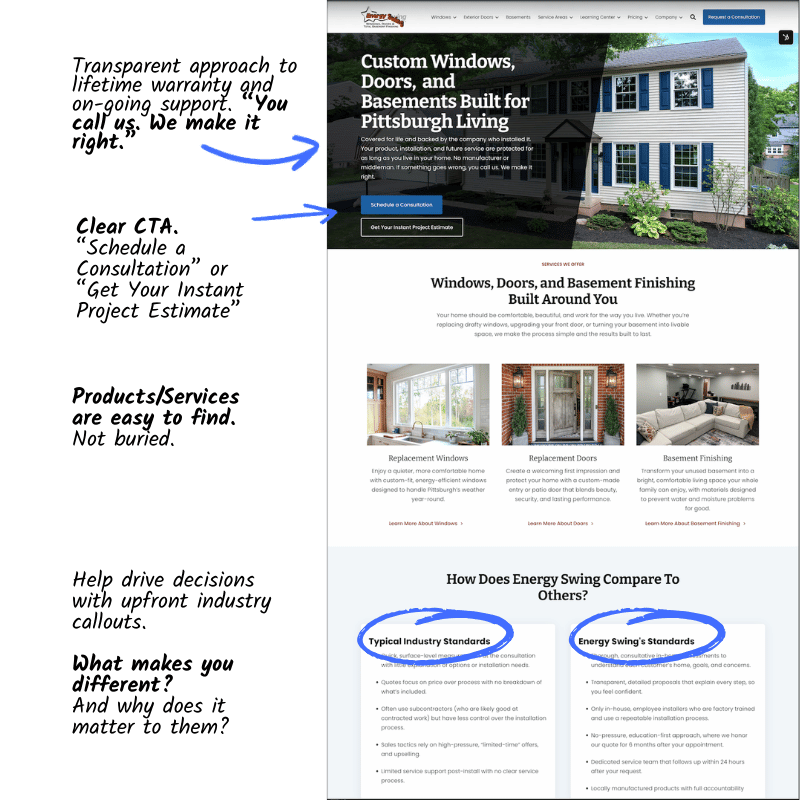
Let’s take a look at an A/B test that Energy Swing Windows ran on their homepage.
The Goal:
During this homepage update, Energy Swing wanted to stake their claim in their industry as a true differentiator. Their test looked like this:
-
Version A: Regular homepage. Already a solid start with clear messaging and great user experience. Outlines services, warranty, and reviews quickly and easily.
-
Version B: One significant change: They added a module near the top of the page that compared out they operated vs. the industry standard.
The Plan:
Track whether or not a comparison snapshot of “us vs. the industry” could help drive decisions and increase conversions.
The Results:
Version B was a clear winner. The homepage with the comparison module saw:
-
20-25% reduction in bounce rate
-
Even with 5x less traffic than the A version, the B version converted 5x as many new contacts
-
Increased time on page by approximately 30 seconds
These results aren’t because of a massive website update, but simple, clear changes in messaging that connect with Energy Swing’s ideal customer. By addressing the customer question, "What makes you different than the other guys?" right out of the gate, Energy Swing was able to drive decision-making when it mattered.
Website Messaging Beyond the Homepage
If your homepage’s job is to gain trust, clarity, and attention, your service pages should move buyers toward a purchase decision.
Site visitors move deeper into your site, evaluating risk, fit, and return. Your core product and service pages must answer the questions that matter at that stage.
Strong core pages typically do five things well:
-
Define the specific problem being solved. Generic descriptions force buyers to translate relevance on their own.
-
Clarify who the service is for and who it is not for. When you describe the right fit clearly, you naturally filter out the wrong one. This kind of transparency quickly builds trust and confidence.
-
Explain how the solution works. Clear steps reduce uncertainty and perceived risk.
-
Connect the service to measurable outcomes. Messaging should articulate results, not just features.
-
Make the next step feel clear and safe. When prospects get to the point where they are ready to hand over their contact information, messaging is essential. Outline what happens next in clear terms.
Consistent messaging across your website continues to build trust and confidence for your customers, guiding them naturally to the next step
Why Buyers Hesitate at the Point of Conversion
Even when your homepage and service pages are clear, hesitation often appears at the final step. You’re attracting the website traffic, but completed form fills to talk to sales, book a demo, or make purchases just aren’t happening like they should.
This usually means that the message gets lost on the conversion page, where you should be bringing the message home.
Common friction points include:
- The page talks about offers, processes, or services that aren’t mentioned anywhere else on your website (or suddenly mentions a specific service area that wasn’t clear beforehand).
- The form asks for contact information without explaining why it’s needed.
- The call to action feels vague or high-risk.
- There is no clear explanation of what happens after submission. How long until they hear from you? Are they going to get spammed with calls and emails?
Strong messaging at the point of conversion does three things:
- Reinforces the problem you solve.
- Restates the outcome they are pursuing.
- Clearly explains what will happen next.
When that level of clarity exists, conversions increase, not because of design tweaks, but because uncertainty is reduced.
The Business Impact of Clear Messaging
Clear messaging does not just improve website performance and conversions. It changes the quality of the conversations entering your sales pipeline.
When buyers immediately understand who you serve and what problem you solve, they move forward being well educated about your product or service. Now, sales conversations begin further along because expectations are aligned before the first call.
That alignment has measurable effects.
Lead quality becomes more consistent. The right prospects recognize themselves quickly, while poor-fit buyers opt out earlier. Your sales team can spend less time educating and more time closing real opportunities.
Sales cycles often shorten. When your value and differentiation are visible from the start, prospects don’t need to be convinced. At this stage, they are evaluating fit, not trying to understand what you do.
Strong positioning protects margins. When your value is clear, buyers compare impact and fit rather than looking for the lowest price.
None of this happens because you have the best-looking website in your market. It happens when you have the most clarity with your message. Clarity creates confidence, and confident buyers convert.
Clear Messaging is a Strategic Advantage
If your website traffic is steady but your leads feel inconsistent, the issue may not be visibility. It may be clarity.
So before you invest in another website redesign, take a hard look at your messaging first. The clearest message in your market is one of the most durable competitive advantages you can build.
If you want hands-on help getting there, the Endless Customers™ Coaching Program works directly with your team to clarify your message and turn it into a system that consistently produces better buyers.
Not ready for coaching yet? Start with our guide on building a brand buyers trust.

Written By
Mary Brown is Lead Website Strategist at IMPACT, where she helps companies plan, build, and improve websites they can run themselves. Mary has worked on websites for more than 11 years. Before joining IMPACT, she spent nearly five years at another agency leading website strategy and running every part of inbound marketing as its Director of Inbound. At IMPACT, she has led 50+ website projects, and she works with many more clients on improving sites they already have through data, testing, and ongoing optimization. Most of her clients are in construction and home services, including roofing, window, and bath and exterior remodeling companies. She also works closely with IT and managed services providers, hospitals and healthcare organizations, and accounting and financial services firms. The moment Mary loves most comes after launch, when a client who once felt handcuffed by their website starts logging in, making changes, and asking sharp questions about their own data. For her, a site succeeds when the client feels like they own it. When she’s not working, you can usually find Mary spending time outside with her husband Greg and son Julian. Together with their Czech Shepard, Magnus, they usually spend weekends hiking the forests and mountains of New England.
Mary Brown is Lead Website Strategist at IMPACT, where she helps companies plan, build, and improve websites they can run themselves. Mary has worked on websites for more than 11 years. Before joining IMPACT, she spent nearly five years at another agency leading website strategy and running every part of inbound marketing as its Director of Inbound. At IMPACT, she has led 50+ website projects, and she works with many more clients on improving sites they already have through data, testing, and ongoing optimization. Most of her clients are in construction and home services, including roofing, window, and bath and exterior remodeling companies. She also works closely with IT and managed services providers, hospitals and healthcare organizations, and accounting and financial services firms. The moment Mary loves most comes after launch, when a client who once felt handcuffed by their website starts logging in, making changes, and asking sharp questions about their own data. For her, a site succeeds when the client feels like they own it. When she’s not working, you can usually find Mary spending time outside with her husband Greg and son Julian. Together with their Czech Shepard, Magnus, they usually spend weekends hiking the forests and mountains of New England.
/Assets/Icon%20Library/social/linkedin-logo.svg)
Share
/Assets/Icon%20Library/social/x%20corp.svg)
/Assets/Icon%20Library/social/mail-to.svg)
/Assets/base/Learning%20Center%20Resource%20Category%20Icons/Website%20link.svg)
READY TO IMPLEMENT ENDLESS CUSTOMERS™ IN YOUR BUSINESS?
You’ve learned the philosophy. Now it’s time to put it into action. Our coaches will help you apply the Endless Customers System™ to your sales and marketing so you can build trust faster, close deals sooner, and create a steady flow of new customers.
READY TO IMPLEMENT ENDLESS CUSTOMERS™ IN YOUR BUSINESS?
You’ve learned the philosophy. Now it’s time to put it into action. Our coaches will help you apply the Endless Customers System™ to your sales and marketing so you can build trust faster, close deals sooner, and create a steady flow of new customers.