
/Assets/arrow-facing-left--black-01.svg)
/Assets/navigation-global--close-symbol-black-01-1.svg)
/Assets/base/Close.svg)

/Assets/Icon%20Library/social/facebook-logo.svg)

/Assets/Icon%20Library/social/instagram-logo.svg)
/Assets/Icon%20Library/social/youtube-logo.svg)






If you’re the CFO, 'great new ideas' are familiar.
And now your CEO and leadership team have come to you and said, “We need to invest in Endless Customers.” 
You hear: more headcount, content production, video, sales training, website work, HubSpot cleanup, coaching. It sounds like marketing spend.
Your question is the right one:
Is this just another branding initiative dressed up with new language — or does it actually increase the value of the company?
Let’s be clear about what we’re really talking about.
Endless Customers (our framework for building an in-house marketing and sales engine that earns buyer trust at scale) is not a costly, one-off campaign. It’s an operating system that removes owner risk, turns revenue into something predictable, and makes the business safer to acquire.
It’s how you move from “we close deals because our founder is persuasive” to “we close deals because our system works.” That shift directly affects valuation multiple, not just top-line revenue.
At IMPACT, we help companies build in-house marketing and sales engines that attract, educate, and close well-fit buyers using the Endless Customers System™, which is designed to make you the most known and trusted voice in your space.
This guide is written for you, the CFO.
We’re going to show you why Endless Customers is a smart investment: it reduces risk, creates transferability, protects margin, and builds repeatable revenue. You’ll see how to use it to scale in a way that makes the company more attractive to a buyer, increases perceived safety, and ultimately supports a higher valuation multiple.
Why Valuation Is Not Just About Revenue (It’s About Risk)
When buyers look at your company, they don’t just look at EBITDA. They look at how fragile that EBITDA is.
Two roofing companies illustrate this.
Company A posted $10M in revenue and $2.5M EBITDA.
Company B posted $12M in revenue and $3M in EBITDA.
In theory, Company B should command the higher number.
That’s not what happened.
After diligence, Company A was offered $20M. Company B was offered $12M. The $8M gap wasn’t a math error. It was risk.
Company B’s sales and marketing function lived in the owner’s head. Company A had built a system that ran without the owner. Buyers put real money on that difference.
This is what buyers are really pricing in:
- Owner Dependency: Is the founder the rainmaker? If yes, the buyer sees fragility, not durability.
- Concentration Risk: Is 70–80% of revenue tied to one customer, one salesperson, or one offer? If yes, the multiple quickly drops.
For companies under ~$30M, owner dependency is usually the number one value killer in diligence (right next to concentration risk). You can be profitable and still be unattractive if everything depends on one person’s relationships.
This is why Endless Customers matters to you. The entire purpose of the system is to make demand generation, sales, delivery, and customer education transferable, so the company looks safer to own.
Know What Your Company Is Actually Worth Today
Most leadership teams guess their valuation. Most are off by millions. You can’t improve what you haven’t measured.
Yes, valuation starts with EBITDA. But buyers apply a multiple to that EBITDA, and that multiple is not arbitrary. According to ValueBuilder, there are 8 Key Drivers of company value, and they influence that multiple:
- Financial Performance — your history of revenue, profit, margins, and clean financial reporting.
- Growth Potential — how fast (and realistically) the business can grow from here.
- The Switzerland Structure — independence from any one customer, employee, or supplier.
- The Valuation Teeter‑Totter — how efficiently you manage working capital and cash (less reliance on outside financing).
- Recurring Revenue — the percentage of automatic, contract-based revenue you can count on.
- Monopoly of Control — differentiation and control of your niche (your ability to set the rules and protect margin).
- Customer Satisfaction — likelihood to repurchase and refer (NPS, retention, expansion).
- Hub & Spoke — how dependent the business is on the owner or a few key people.
If you’re weak in any of those areas, that’s where your ROI is hiding. That’s where investment (including Endless Customers work) returns the most long-term value.
Build a Business That Can Run Without The Owner
A company that needs the owner to function is not a company. It’s a job. Buyers don’t buy jobs. They buy systems.
One of the first things an acquirer will ask is: “What happens if you (the owner) disappear for 90 days?” Can the company keep selling, delivering, collecting, and growing? If the honest answer is “no,” valuation suffers no matter how strong the P&L looks.
This is usually where sub-$30M companies get stuck. The owner has hired leaders they like, but the owner is still quietly filling their gaps. They’ve accidentally created a “cult of personality,” not an executive team.
To fix this, you need:
- Real ownership of finance, sales, marketing, delivery, operations.
- Leaders who can run their areas without the founder acting as the backstop.
- A structure where the owner behaves like a true visionary (future-facing, opportunity-focused), while an integrator (often a president or COO) runs the day-to-day.
When you get there, buyers stop seeing a “charismatic founder” story and start seeing an asset that can operate independently. That’s when multiples move.
'Planning for the future' is what Truist calls one of the main factors in helping your business increase in value. This is one of the best ways to do that.
Systemize Sales So It’s Repeatable, Transferable, and Scalable
If your current reality is “our owner is the closer,” that’s a valuation penalty.
Sales needs to run on process, not personality. That means a defined, staged, milestone-based sales process where every deal is trackable and forecastable.
Standardizing offers, pricing, and proposals is part of this. When pricing lives in spreadsheets on one person’s desktop and every proposal is custom, you’re not building an asset. You’re building chaos. When offers are defined and pricing logic is documented, any competent rep can step in and sell. That’s what acquirers want to see.
If you want to learn more about how to optimize your sales process, check out our resource: Sales Process Optimization | 8 Proven Sales Moves for 2026
Assignment Selling: Shortening Sales Cycles
Assignment Selling is the practice of giving buyers specific educational content at key stages of the sales process. It's used before calls, between calls, and before contract. Think “Here’s exactly how this works, here’s what it costs, here are the downsides you should know about.”
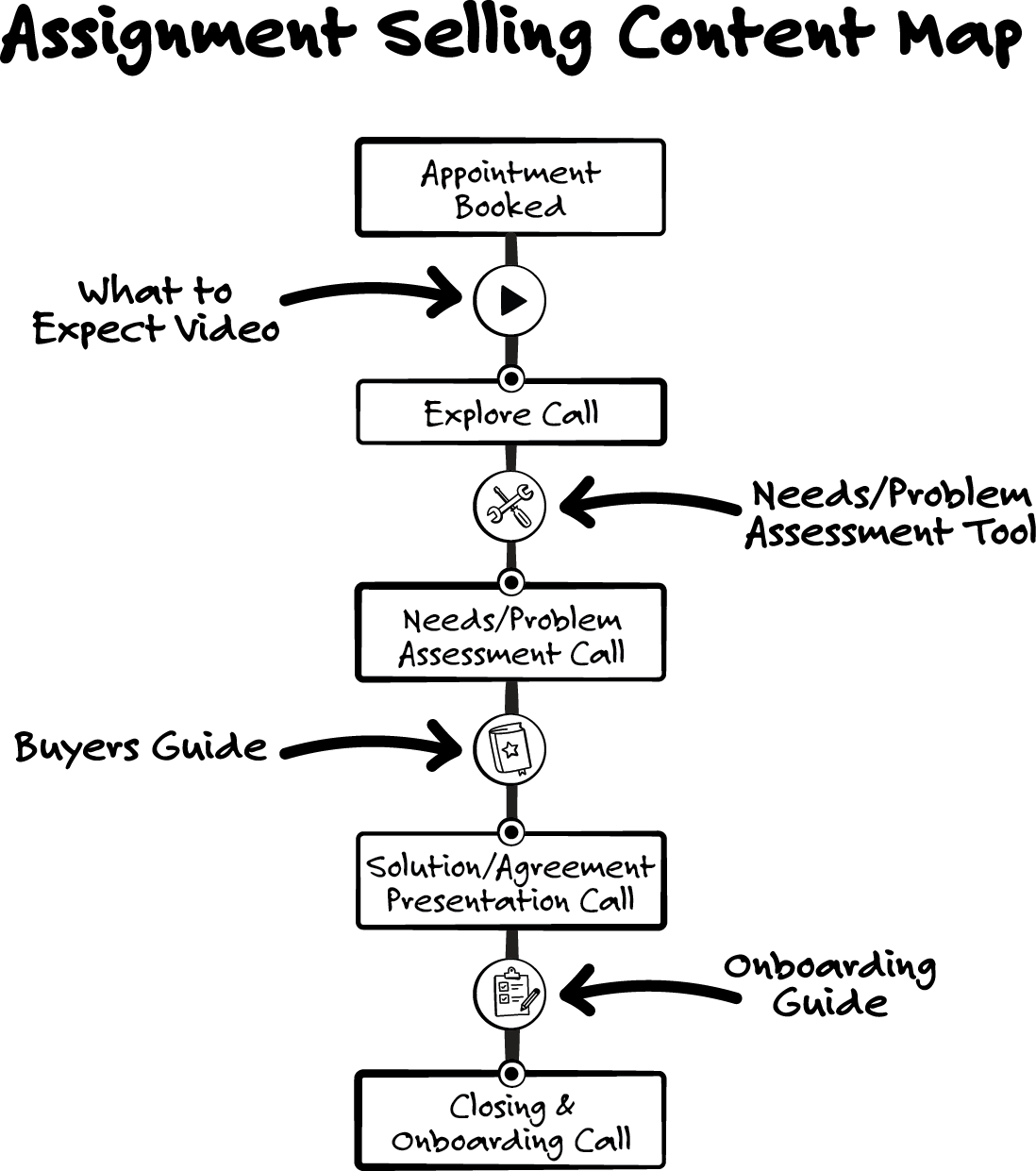
This does three things that matter to you:
- It qualifies buyers earlier. Sales stops burning time on people who were never going to buy.
- It speeds up deals. Calls become “final questions,” not 101-level education.
- It lowers CAC. The sales team is spending fewer hours per closed deal.
If one salesperson (or your founder) is currently the rainmaker, the sequence is simple: Document the process. Write the playbook. Build the content. Then hire and train reps to follow it.
That’s how you turn “our founder is amazing in the room” into “our sales engine works even if leadership turns over.”
If you want to go deeper into Assignment Selling, check out our resource: What is 'Assignment Selling'? Using Content to Close Deals Faster
Build a Marketing Engine That Doesn’t Rely on Your Personal Network
Referrals are not a strategy. Founder relationships are not scalable. Buyers know this.
What buyers will pay more for is predictable, inbound demand. Demand that keeps coming in even if the founder stops posting on LinkedIn or taking calls from buddies in the industry.
From a CFO lens, here’s why this matters:
A strong content engine is a financial asset, even though it won’t show up on your balance sheet. It creates a steady flow of educated opportunities that’s independent of the owner’s personal involvement. That means the pipeline survives a leadership change, which makes the company safer to buy.
When we talk about “investing in content,” we’re not talking about fluffy blog posts. We’re talking about building a body of work (articles, videos, tools) that answers the questions buyers are already asking so they come to you first, trusting you before they ever talk to sales.
To do this in-house, you eventually need two dedicated seats:
- Content Manager: Owns the publishing cadence, creates clarity, interviews subject matter experts, and gets the truth out of your team’s heads and onto the site where buyers can see it.
- Videographer: Captures proof, process, pricing explanations, and visual walkthroughs so buyers feel like they’ve already met you before the first call.
Those seats are not “extra marketing hires.” They are the infrastructure that makes your demand generation transferable to the next owner.
To go deeper check out our resources:
Use Content to Lower Customer Acquisition Cost (CAC) and Protect Margin
The right kind of content lowers CAC.
The most profitable companies publish openly on what we call The Big Five:
- Cost & Price: Everyone wants to know what they can expect to pay. They also want to understand what constitutes “value.” Such behavior is universal amongst all buyers.
- Problems: A desire to buy something is often accompanied by fears and worries. What are the drawbacks? How could this purchase go wrong?
- Versus & Comparisons: As humans, we love to compare. It’s how we make informed decisions, stacking one option against another to find the best solution for our needs.
- Reviews: Buyers want the good, the bad, and the ugly. And, importantly, they want to know who a product or service is and is not a good fit for.
- Best in Class: Everyone searches for the “best,” “most,” “top,” or whatever extreme they can find. Even if they don’t end up choosing the top-rated option, they want to clearly understand all the possibilities available to them.
These are the exact questions buyers research before they’re willing to talk to sales. When you’re the one answering, you win trust first.
This does two things you care about:
- It filters out bad-fit prospects before they ever hit your calendar.
- It helps good-fit prospects close faster, with less price pressure, because they already understand value.
It also builds what we’d call a digital moat. A competitor can copy your pricing sheet in a day. They can't copy years of published clarity, video proof, behind-the-scenes process walkthroughs, and honest “here’s where we’re not a fit” content.
That moat is extremely difficult to replicate, which is exactly what a buyer wants to see.
And looking forward: AI is already shaping how buyers research vendors. If your content is consistently the source that AI models surface, you get disproportionate visibility and more at-bats without additional spend. Buyers see that as future upside, and they price it in.
To go deeper, check out our resource: Digital Marketing Strategy | How to Succeed in 2026. This will show you how to align leadership, publish definitive content and video, measure what actually moves revenue, and run it on a simple 90-day rhythm.
Prove That New Sales Talent Can Ramp
If “only Joe can sell this,” that’s not impressive in diligence. That’s terrifying.
Acquirers want evidence that new reps can get productive within 60–90 days. Not “someday,” not “after a year of shadowing,” but inside one quarter.
To prove this, you need:
- A real onboarding path.
- Playbooks, not unwritten rules.
- A library of videos, FAQs, objection handlers, and scope templates that are all documented and accessible.
Then you show the numbers:
“Here’s Rep A at 30/60/90 days. Here’s Rep B. Here’s what they closed. Here’s margin.” That is credibility. That is de-risking. That is valuation.
Compare that to: “We just hired a rockstar.” Buyers don’t pay a premium for heroics. They pay a premium for systems that can make average talent good.
Get Your Data Infrastructure in Order Before Diligence Exposes You
Deals fall apart in diligence, not in the intro call.
If you can’t produce basic numbers quickly (pipeline, close rate, CAC, deal velocity, retention) buyers assume you don’t actually have control.
When buyers have to guess, they assume the worst case, and then the worst case gets priced in.
This is why your CRM matters so much. Your CRM should be a single source of truth for customer interactions, not a graveyard of partial notes and memory. When set up correctly, it shows operational discipline, supports margin protection, and proves repeatability.
Strong CRM discipline also sets you up for the next era of automation and AI-driven forecasting. If your data is clean, you’re building an engine that can be optimized, automated, and scaled. If it’s not, you’re selling a black box.
Your job here, as CFO, is to insist on:
- Clean pipeline reporting.
- Consistent data hygiene and training.
- Dashboards the whole leadership team actually uses.
- No “we can’t pull that number” moments.
If you use HubSpot as your CRM and need some help, check out our resource: HubSpot Training for Sales and Marketing Teams. This shows how we can help your team learn adoption, daily workflows, and create the reports leaders need so sales and marketing actually use the platform.
Make Your Business Easier to Buy
Your endgame is not just “be profitable.” Your endgame is “increase business valuation and be easy to buy.”
That means packaging the company so a buyer can step in with minimal transition chaos. Clear positioning. Clear offer structure. Clear pricing logic. Documented delivery. Consistent margins. Predictable recurring demand.
When you can show all of that, what you’re really saying to an acquirer is, “You’re not buying my hustle. You’re buying the machine.” That’s when you earn a better multiple on the same EBITDA.
Frequently Asked Questions
How do you increase business valuation if you want to sell?
Lower buyer risk and make revenue more predictable. That means reducing owner dependency, documenting your sales process, building recurring or repeatable demand, and cleaning up your data so diligence is easy. Endless Customers helps you do all four.
Why should a CFO care about Endless Customers?
Because it turns “marketing spend” into valuation work. When sales and demand gen are transferable, acquirers see less risk and will pay more for the same EBITDA.
How long before we begin to see return on our Endless Customers investment?
You can see early wins fast if sales uses the content right away (for example, sending pricing or value videos to stalled deals). That alone can move opportunities in days. Bigger gains (more qualified opportunities, better close rates, lower CAC) typically build over 3–12 months as you publish consistently, become the trusted source in your market, and start showing up where buyers are already looking. Over 12–24 months, the ROI compounds as you win more of the deals you should already be in.
The CFO’s Next Move
If you take nothing else from this, take this: Endless Customers is not “more marketing.” It is the work of making the business transferable. It’s how you de-risk the revenue engine, prove repeatability, and raise the multiple an acquirer will put on your EBITDA.
Here is a simple, CFO‑friendly way to lean in — four steps focused on learning and applying Endless Customers:
- Learn the model. Start with an overview of the Endless Customers System™ and the Four Pillars of Trust. Map each pillar directly to valuation levers: risk reduction, transferability, margin protection, and repeatability.
- Diagnose with data. Complete the Endless Customers Scorecard with your leadership team. Use it to baseline strengths and expose owner‑dependency, concentration risk, and gaps tied to the 8 Key Drivers of Company Value.
- Study the core plays. Go deeper on the programs that most affect valuation: The Big Five (especially pricing transparency), Assignment Selling, standardized sales process, and proof‑driven video marketing. Identify one or two plays to pilot immediately.
- Plan your first 90 days. Implement Endless Customers and hold an Alignment Day or Planning Session. Define the roles (Content Manager, Videographer), set a publishing cadence, tie content to the sales process, and stand up dashboards that track CAC, time‑to‑close, and margin.
Do this work now and two good things happen.
You raise your multiple even if you never sell.
And if you do eventually decide to sell, you’re not scrambling to manufacture value. You’ve already built it.

Written By
Bob Ruffolo founded IMPACT in 2009 and has led it as CEO ever since. What started as a simple web design company has grown into a business coaching and training company that helps leaders and their teams get better at sales, marketing, communication, and leadership. IMPACT has been a HubSpot partner since 2011, one of HubSpot's first, and today is a HubSpot Diamond Solutions Partner, twice named HubSpot Partner of the Year and a four-time Inc. 5000 honoree (2018 to 2021). Bob himself has been recognized as a 40 Under 40 winner and named to Glassdoor's Best CEO for Small Businesses list. Bob is the co-creator of the Endless Customers System with Marcus Sheridan, the methodology behind IMPACT's coaching, the USA Today bestselling book, the Endless Customers podcast, and the annual Endless Customers Live conference. It teaches companies to build marketing and sales capability in-house rather than outsourcing it indefinitely. In recent years Bob has led IMPACT's shift to an AI-first company and become a go-to voice for leaders trying to understand what AI means for marketing, sales, and the workforce.
Bob Ruffolo founded IMPACT in 2009 and has led it as CEO ever since. What started as a simple web design company has grown into a business coaching and training company that helps leaders and their teams get better at sales, marketing, communication, and leadership. IMPACT has been a HubSpot partner since 2011, one of HubSpot's first, and today is a HubSpot Diamond Solutions Partner, twice named HubSpot Partner of the Year and a four-time Inc. 5000 honoree (2018 to 2021). Bob himself has been recognized as a 40 Under 40 winner and named to Glassdoor's Best CEO for Small Businesses list. Bob is the co-creator of the Endless Customers System with Marcus Sheridan, the methodology behind IMPACT's coaching, the USA Today bestselling book, the Endless Customers podcast, and the annual Endless Customers Live conference. It teaches companies to build marketing and sales capability in-house rather than outsourcing it indefinitely. In recent years Bob has led IMPACT's shift to an AI-first company and become a go-to voice for leaders trying to understand what AI means for marketing, sales, and the workforce.
/Assets/Icon%20Library/social/linkedin-logo.svg)
Implementing Endless Customers
Share
/Assets/Icon%20Library/social/x%20corp.svg)
/Assets/Icon%20Library/social/mail-to.svg)
/Assets/base/Learning%20Center%20Resource%20Category%20Icons/Website%20link.svg)
READY TO IMPLEMENT ENDLESS CUSTOMERS™ IN YOUR BUSINESS?
You’ve learned the philosophy. Now it’s time to put it into action. Our coaches will help you apply the Endless Customers System™ to your sales and marketing so you can build trust faster, close deals sooner, and create a steady flow of new customers.
READY TO IMPLEMENT ENDLESS CUSTOMERS™ IN YOUR BUSINESS?
You’ve learned the philosophy. Now it’s time to put it into action. Our coaches will help you apply the Endless Customers System™ to your sales and marketing so you can build trust faster, close deals sooner, and create a steady flow of new customers.