
/Assets/arrow-facing-left--black-01.svg)
/Assets/navigation-global--close-symbol-black-01-1.svg)
/Assets/Icon%20Library/social/facebook-logo.svg)

/Assets/Icon%20Library/social/instagram-logo.svg)
/Assets/Icon%20Library/social/youtube-logo.svg)





There are three realities we see when it comes to CRMs:
-
It doesn’t exist, and your team is operating out of spreadsheets and inbox threads.
-
It technically exists, but no one uses it.
-
You’ve outgrown it and need something more capable
No matter which scenario your company is in, it’s costing you time, money, and visibility into how revenue actually happens.
The best CRM in 2026 isn’t the one with the most features. It’s the one your team will consistently use, that solves the problems your business has today, and that can scale with you over the next several years.
Several platforms dominate the market right now: HubSpot, Salesforce, GoHighLevel, Zoho, Pipedrive, and ServiceTitan. Each serves a different type of business.
In this guide, you’ll get an honest evaluation of how these platforms compare, what questions to answer before choosing one, and what to expect if you decide to switch.
What to Look for in Any CRM Before You Start Comparing Platforms
At IMPACT, we regularly help businesses evaluate and implement CRM systems as part of the Endless Customers System™.
Learn More: The Endless Customers System ™ teaches businesses how to build an in-house marketing and sales engine that consistently attracts, educates, and converts their ideal buyers, and become the most known, trusted, and recommended brand in their market.
In that work, we see the same pattern repeatedly: companies either choose a CRM that their team never fully adopts, or they select a platform that can’t grow with them as their marketing and sales strategies evolve.
Both groups tend to make the same mistake: evaluating features before evaluating fit.
There are three questions worth answering before you look at a single platform:
1. What problem are you actually trying to solve?
Not "what features do we want,” but what is actually broken in how you manage prospects, customers, and data right now? That answer narrows your search considerably. A CRM that solves your specific gap is worth far more than one with an impressive feature list.
2. Who owns the rollout?
CRMs fail when there's no internal owner or champion. If nobody is accountable for making sure the team adopts it and uses it correctly, it's going to struggle to gain traction. According to McKinsey, up to 70% of technology implementations fail at the organizational level. The software almost never fails. Adoption does.
This means you need to name the person who owns the CRM before you sign anything. Not a committee. One person. And you need a rollout plan with accountability milestones before you go live.
3. What is your team's capacity for change?
In reality, sometimes it's the tools and tech, sometimes it's old dogs that don't know all the new tricks. Ease of use matters more than most executives admit when they're shopping for a new CRM.
A CRM that your most resistant sales rep can pick up in two weeks is worth more than a feature-rich platform that nobody fully adopts. If your sales team hits quota using what they've always done, they won’t be excited to learn something new.
The right CRM makes the transition as short and painless as possible.
Now that you know what you're looking for, here are the top CRMs on the market for businesses just like yours.
Free Assessment
Free Marketing Assessment: Where do you stand?
AI is changing how buyers find businesses, and most companies are dangerously underprepared. Take this free assessment and find out if yours is at risk of becoming invisible to your buyers.
Transparency Notice: IMPACT is an Elite HubSpot Solutions Partner. That means we earn revenue when clients purchase or upgrade HubSpot. Our team works in HubSpot every single day, and we recommend it consistently because of its well-rounded capabilities and ease of use. However, our team members have extensive experience and currently work in a variety of CRMs. We share our honest feedback on each of those below.
HubSpot: Best Overall CRM for Growing Companies
HubSpot is our top pick and not just because IMPACT is an Elite HubSpot Solutions Partner. It's because no other CRM on the market today can do what HubSpot does at its core, and we've evaluated every significant competitor to check.
HubSpot's biggest differentiator isn't a feature, it’s architecture. Most CRMs start as sales tools and bolt on a marketing component later. This usually happens through the acquisition of another company, with the two systems duct-taped together in the backend.
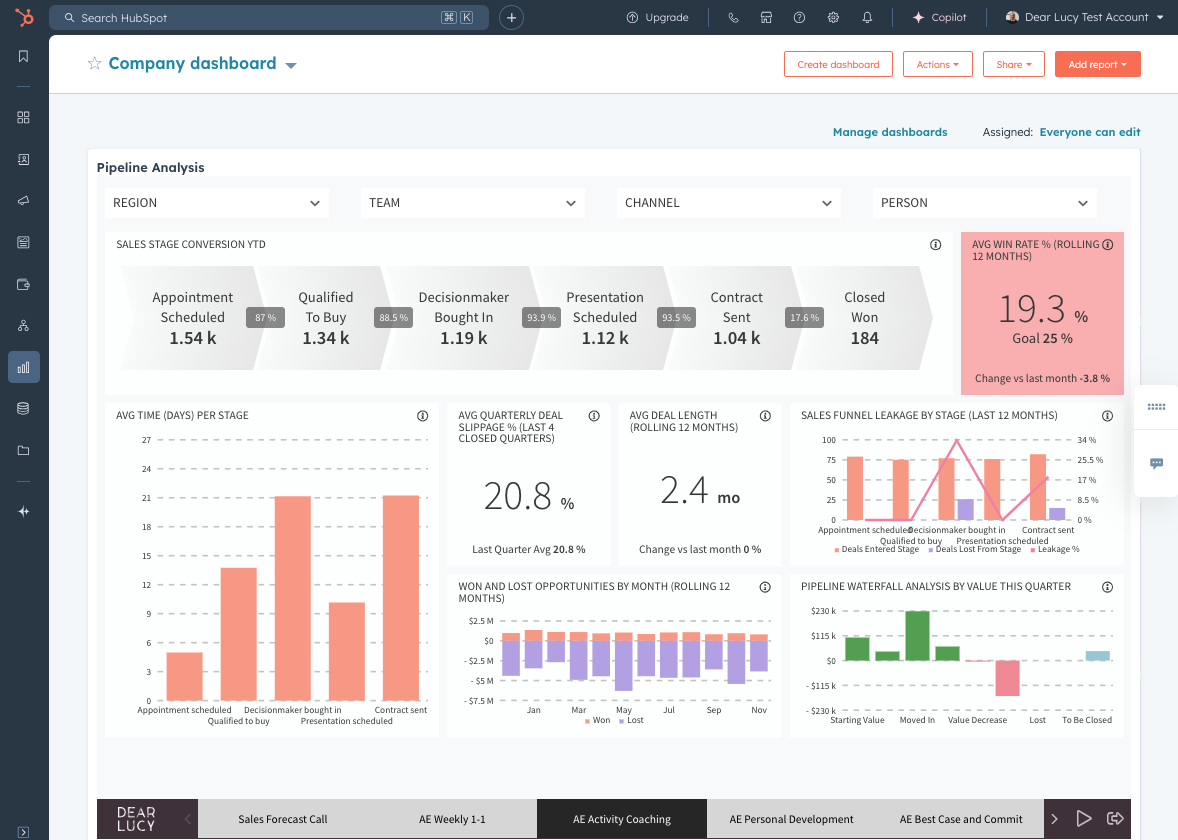 HubSpot was built as a marketing platform at its core, with sales, customer service, and operations tools built natively on top of that foundation. They all share the same data model. They were built by the same developers.
What that means in practice: You can draw an unbroken line from the first time an anonymous visitor lands on your website all the way through a closed deal and into customer service interactions.
Every touchpoint lives in one shared hub. And that attribution, knowing with confidence that a piece of content your team published six months ago contributed to a deal that closed today, is something IMPACT's trainers have yet to find in another platform.
For companies implementing the Endless Customers™ system, where content is a core growth driver and tying that content to revenue is non-negotiable, native attribution is critical. HubSpot is the only platform that makes it possible out of the box.
Where HubSpot Falls Short
Full transparency (because that's what this guide is for), HubSpot has real limitations you should know before you buy:
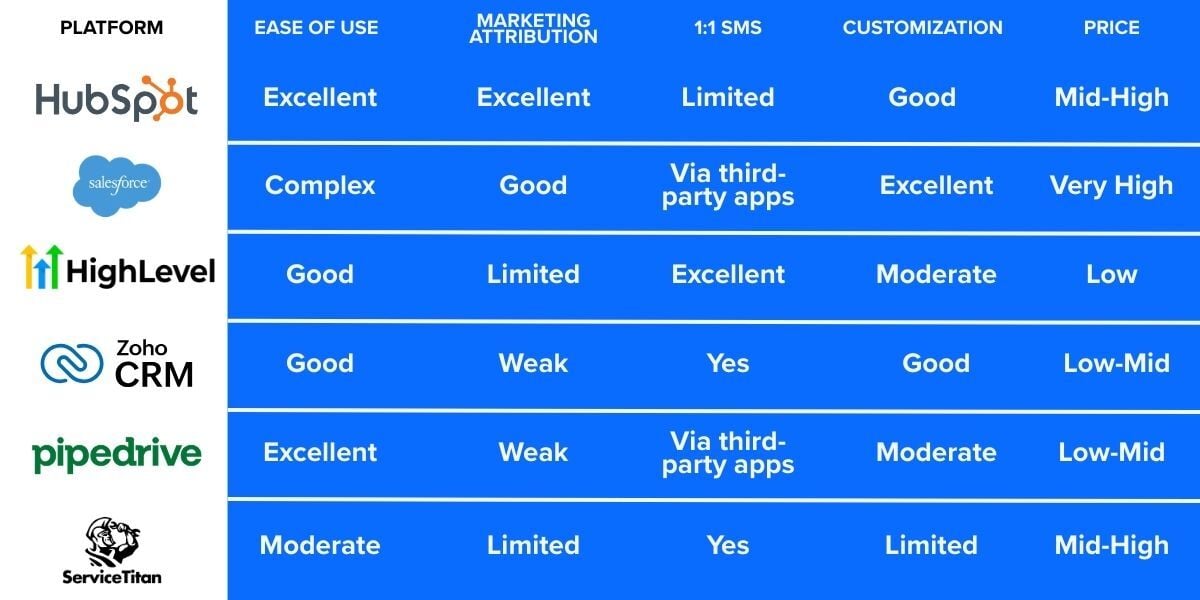
- One-to-one SMS texting: HubSpot has marketing SMS, but not the conversational, rep-to-prospect text messaging that field sales teams depend on. If your sales rep needs to text a homeowner before a roof inspection, HubSpot isn't the answer for that today.
- Not endlessly customizable: For large enterprise organizations that need developer-level customization and granular business-specific configurations, HubSpot may hit a ceiling.
- Team scheduling: If you need a universal calendar to manage field team availability and route inbound calls to the right person, HubSpot doesn't do this well.
- E-commerce and inventory management: HubSpot will integrate with platforms like Shopify, but it's not a native solution for inventory-driven businesses.
- Cost: HubSpot is not the cheapest option. It's also not the most expensive. But price comes up in almost every initial conversation. The counterpoint: when you look at what it actually costs to acquire a customer relative to HubSpot's price, the math typically works out faster than expected.
| Best for | Mid-market companies ($5M–$100M) focused on marketing-driven growth and in-house operations, especially those implementing the Endless Customers System™ |
| Budget tier | Mid to high |
| Not a great fit for | Companies relying heavily on 1:1 SMS, large enterprises with complex customization requirements, or e-commerce/inventory businesses |
Salesforce: Best for Large Enterprises With the Resources to Support It
Salesforce is the category leader. It's been around the longest, it's the most widely deployed enterprise CRM in the world, and it has earned that position. It can do practically anything. If you can imagine it, Salesforce can probably be built to support it.
But with that power comes great responsibility for your team, plus a high-cost licensing fee. Salesforce requires dedicated expert staff in-house, or you’ll end up paying for software your people don’t even use because it’s just too complicated.
That complexity is by design. The more deeply your organization builds Salesforce out, the more dependent you become on whoever understands the backend. If your Salesforce administrator leaves, you're either rebuilding from scratch with a new hire or paying an agency to come in and reverse-engineer what your previous person built.
For mid-market companies, that dependency is a serious consideration. You're either outsourcing Salesforce management to a premium agency or insourcing a fully dedicated CRM architect at a high salary. For smaller teams trying to own their technology in-house, that's a tough overhead to justify.
One more thing worth knowing: Salesforce's marketing component (originally Pardot, now rebranded as AgentForce Marketing) was an acquisition. It wasn't built natively alongside Salesforce's sales CRM. It was bolted on. The integration works, but it's a meaningfully different experience from HubSpot, where every hub was built by the same team on the same foundation.
| Best for | Large enterprises (200+ employees) with dedicated Salesforce admin staff, complex sales processes, or organizations where Salesforce is already deeply embedded. |
| Budget tier | High to very high |
| Not a great fit for | Small and mid-market companies that want to own CRM operations in-house without dedicated expert support |
GoHighLevel: Best Budget-Friendly Option for Smaller Businesses
GoHighLevel is the platform that keeps coming up when smaller companies comparison-shop against HubSpot. It's significantly less expensive, and it bundles in a decent suite of tools, including one notable capability that HubSpot doesn't handle well natively: one-to-one SMS texting.
For a company that has never had a CRM before and needs to decide where to start, GoHighLevel is worth considering. It delivers around 60–70% of HubSpot's functionality at a fraction of the cost. For basic marketing tools, lead management, and text communication, it holds its own.
The limitations show up as you scale. GoHighLevel's reporting is limited, and its automation capabilities aren't as sophisticated. The tracking depth isn't there for companies that need serious attribution data. And it's more marketing-focused than sales-focused, which means the sales team experience isn't as strong as the marketing side.
The biggest risk: thinking you can start here and migrate easily later. A CRM implementation is not a light lift. The companies IMPACT works with who've gone through it once are not eager to do it again. If you're choosing GoHighLevel because it's cheaper to get started, factor in the real cost in time, staff disruption, and data cleanup of switching platforms in two years.
| Best for | Very small companies (under $3M revenue) that need a CRM entry point, value SMS texting, and have basic reporting needs |
| Budget tier | Low (approximately $97–$297/month) |
| Not a fit for | Companies with marketing attribution needs, growing sales teams, or anyone expecting to scale significantly in 2–3 years |
Notable Mentions: Zoho, Pipedrive, and ServiceTitan
Not every company fits neatly into the three-platform conversation above. Here are three platforms that come up regularly when IMPACT evaluates CRM options with clients.
Zoho
Zoho is a capable toolset at a lower price point than HubSpot. It covers a wide range of functions, and it's investing heavily in AI to differentiate itself in the market. The consistent problem: reporting. Zoho collects data reasonably well, but surfacing clean ROI attribution (knowing with confidence what marketing is producing) is a challenge. If that kind of reporting matters to your business, Zoho comes up short in practice.
Pipedrive
Pipedrive is a clean, intuitive sales CRM. If you want something with HubSpot-level ease of use but don't need the full marketing suite, Pipedrive is worth a look. It integrates well with third-party tools. Where it falls apart is on the marketing side and in reporting depth. It's a solid tool for managing a sales pipeline, but not a full-funnel platform.
ServiceTitan
ServiceTitan is purpose-built for home services, field service, and trades companies, and it shows. The dispatch and customer service functionality is designed specifically for businesses where someone needs to schedule a technician, track a job, and invoice a customer. HubSpot can't match it on those specifics.
The major caveat: ServiceTitan deliberately does not open its API to third-party integrations. By design, it wants to be your entire system. That's fine until you need it to do something it wasn't built for.
For trades companies on the Endless Customers™ Journey, ServiceTitan and HubSpot often come up as a paired conversation, ServiceTitan for operations, HubSpot for marketing and revenue attribution.
What to Expect When You Switch CRMs
If you're switching to a new CRM, the first thing to expect is that your sales team might be unhappy.
The good news: most major CRMs have functional parity on the things that matter most. You can usually find an apples-to-apples match for any workflow you have in Salesforce and replicate it in HubSpot, or vice versa.
Ease of use is the variable most executives underestimate when they're evaluating platforms. A CRM that your team fights for a year is not saving you money. It's costing you in lost data, missed follow-ups, and sales rep frustration. Prioritize ease of adoption as seriously as you prioritize any other feature.
A few things to plan for as you go into a CRM switch:
- Expect data cleanup to take longer than you think. Most companies don't realize how messy their data is until they have to move it. Build that time into your timeline before you go live.
- Invest in continuing education. A one-day onboarding session doesn't create lasting habits. Build in recurring reinforcement, especially in the first 90 days.
- Name one person as the CRM owner before you sign anything. Not a committee. One person who is accountable for adoption, data quality, and ongoing optimization.
- Plan to stay for 3+ years. Switching CRMs is expensive in dollars, time, and organizational energy. Choose a platform that can meet your needs today and grow with you. Not one you'll need to replace in 18 months.
What Makes a CRM Actually Stick for a Growing Team
The best CRM isn’t the one with the most features. It’s the one your team will actually use.
For most growing companies, that means choosing a platform that connects marketing activity, sales conversations, and customer data in one place without requiring a team of developers to manage it.
When your CRM clearly shows how marketing turns into revenue, it stops being just a tool.
It becomes the system that drives how your business grows.
The “right technology” is one of the five components of Endless Customers. At IMPACT, these are exactly the type of decisions our coaches help businesses navigate every day as part of the Endless Customers System™. Our goal is to help companies build marketing and sales operations they can own and scale internally.
Frequently Asked Questions About Choosing a CRM
What is the best CRM for a small to mid-size business in 2026?
For small businesses under $3M in revenue, GoHighLevel is a reasonable entry point. It covers basic lead management, marketing tools, and one-to-one SMS texting at a low monthly cost. If you expect to grow beyond that threshold in the next two to three years, HubSpot is worth the higher upfront investment to avoid a costly platform migration later.
How long does it typically take to switch CRMs?
A realistic CRM migration takes three to six months from decision to full adoption, depending on how messy your existing data is and how large your team is. Data cleanup alone is almost always longer than companies expect. Budget time for training, a parallel-run period, and at least 90 days of active reinforcement before you consider the switch complete.
Is HubSpot worth the cost for a company under $5M in revenue?
It depends on your growth trajectory. If you are actively investing in content marketing, building a sales process, and want to track what is actually driving revenue, HubSpot pays for itself faster than most business owners expect. If you just need a contact database and basic pipeline visibility, a lower-cost option may be sufficient for now.
What is the difference between HubSpot and Salesforce for a mid-market company?
HubSpot is built as a single, natively integrated platform that connects marketing, sales, and service data without requiring developer support to maintain. Salesforce is more customizable but depends heavily on dedicated admin expertise to operate effectively. For mid-market companies that want to own their CRM operations in-house, HubSpot is typically the better fit.
What happens to my data when I switch CRMs?
Your data can be migrated, but it requires planning. Most CRMs allow you to export contacts, deals, and activity history as CSV files. The challenge is data quality. Most companies discover duplicate records, incomplete fields, and inconsistent formatting during migration. A thorough data audit before you move anything will save significant time and prevent bad data from following you into the new platform.
Related Reading

Written By
Jessica Palmeri is Director of HubSpot Training at IMPACT, where she helps companies drive day-to-day HubSpot adoption by teaching their teams to use the tools well. Jessica has been a HubSpot Certified Trainer since 2019 and has run more than 1,000 HubSpot training sessions since then. She follows a teach-a-team-to-fish approach because she's seen that lasting user adoption comes from training people to understand the tools they use every day. Her clients are most often in professional services, finance and accounting, home services, construction, and manufacturing. On a typical day, Jessica works inside clients' HubSpot portals, acts as the system administrator for IMPACT's own portal, and helps colleagues troubleshoot HubSpot issues. She also meets with people at HubSpot corporate to stay current on product development and where the platform is headed. One of her best-documented wins is Kaplan, whose HubSpot training success story IMPACT featured in a video at IMPACT Live in April 2024. Jessica speaks online and in person at webinars, workshops, small group trainings, and podcasts. Her topics include train-the-trainer adoption models and training sales and customer service teams to use HubSpot.
Jessica Palmeri is Director of HubSpot Training at IMPACT, where she helps companies drive day-to-day HubSpot adoption by teaching their teams to use the tools well. Jessica has been a HubSpot Certified Trainer since 2019 and has run more than 1,000 HubSpot training sessions since then. She follows a teach-a-team-to-fish approach because she's seen that lasting user adoption comes from training people to understand the tools they use every day. Her clients are most often in professional services, finance and accounting, home services, construction, and manufacturing. On a typical day, Jessica works inside clients' HubSpot portals, acts as the system administrator for IMPACT's own portal, and helps colleagues troubleshoot HubSpot issues. She also meets with people at HubSpot corporate to stay current on product development and where the platform is headed. One of her best-documented wins is Kaplan, whose HubSpot training success story IMPACT featured in a video at IMPACT Live in April 2024. Jessica speaks online and in person at webinars, workshops, small group trainings, and podcasts. Her topics include train-the-trainer adoption models and training sales and customer service teams to use HubSpot.
/Assets/Icon%20Library/social/linkedin-logo.svg)
Share
/Assets/Icon%20Library/social/x%20corp.svg)
/Assets/Icon%20Library/social/facebook-logo.svg)
/Assets/Icon%20Library/social/mail-to.svg)
/Assets/base/Learning%20Center%20Resource%20Category%20Icons/Website%20link.svg)
NEED HELP THRIVING WITH HUBSPOT?
If you’re looking optimized your sales and marketing using HubSpot, IMPACT can help. We’ll help audit your current stack, guide you to a firm foundation, and train your team to drive real results.
NEED HELP THRIVING WITH HUBSPOT?
If you’re looking optimized your sales and marketing using HubSpot, IMPACT can help. We’ll help audit your current stack, guide you to a firm foundation, and train your team to drive real results.