
/Assets/arrow-facing-left--black-01.svg)
/Assets/navigation-global--close-symbol-black-01-1.svg)
/Assets/base/Close.svg)

/Assets/Icon%20Library/social/facebook-logo.svg)

/Assets/Icon%20Library/social/instagram-logo.svg)
/Assets/Icon%20Library/social/youtube-logo.svg)





For the past two decades, getting found online meant one thing: ranking on Google. And thus began the evolution of Search Engine Optimization (SEO). SEO has been a core strategy for any business wanting to attract customers online.
But search behavior is shifting fast.
You might already see a change in your website traffic and leads, and you can’t quite explain it. A growing number of your buyers no longer click through links on the search engine results page. They type a question into ChatGPT, Gemini, or Perplexity, get a synthesized answer, and move on. Sometimes they never visit a website at all.
Now everyone is talking about Generative Engine Optimization (GEO). You may also hear it called AEO, LLMO, or AI SEO. All those different names have people asking the same question: how do you make sure your business shows up when a buyer asks an AI instead of Google?
At IMPACT, we coach businesses every day who are wrestling with exactly that. Is GEO replacing SEO? Do we have to start over? What does this mean for our content marketing strategy? Why can we not tell if we are even showing up anymore? It can feel overwhelming when technology moves so quickly, and you’re afraid of being left behind.
In this article, we will cover what makes SEO and GEO different, where the strategies you already know still apply, and what you can do this week to start building better AI search visibility.
What is the difference between SEO and GEO?
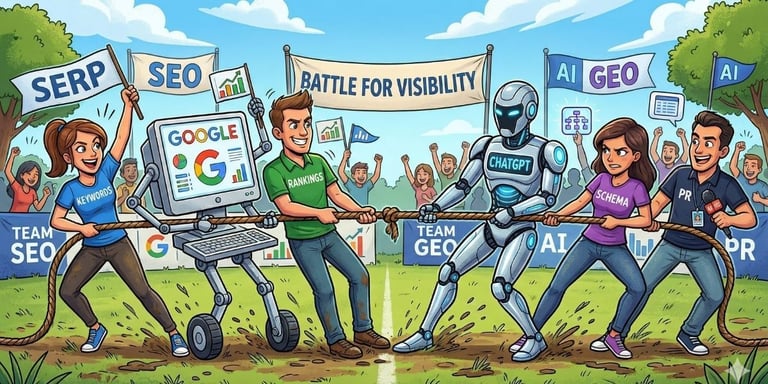
SEO helps your website rank on Google. GEO helps your business get cited in the answers AI tools generate when someone asks a question. For both, your goal is the same: get found by buyers. But each is its own game.
In SEO, you’re competing for a position on a list. In GEO, there is no consistent list. Tools like ChatGPT, Perplexity, and Google’s AI Overviews synthesize a response from sources they consider credible. They either mention your business or they don’t.
Think of it this way:
SEO is earning the best storefront on a busy street. GEO is becoming that business that the tour guide recommends whenever someone asks, “Where should I go?”
What do SEO and GEO have in common?
SEO and GEO share the same core foundation: clean site structure, helpful content, demonstrated expertise, and trust signals that third parties can verify.
If your site is hard to navigate, thin on substance, or vague about who you help and what you do, you'll struggle in both channels.
GEO is not asking you to start over. It is asking you to go deeper. Your content needs to answer questions more directly, cover topics more completely, and connect your business, your buyers, and your platforms in a way that AI systems can clearly follow. But the foundation you have already built? It still counts.
This is the foundation of the Endless Customers System™, which we coach and train businesses to implement at the highest level at IMPACT. The businesses that answer the questions their buyers are actually asking, like pricing, problems, comparisons, and honest reviews, build the kind of trust that earns citations in both Google and AI search. Even if the channel has changed, the principle has not.
The simplest test for whether a piece of content is ready for both:
Is this genuinely helpful? Is this something people actually care about and are searching for? Did you present it in a way that is digestible and complete?
If the answer is yes, you are most of the way there.
Comparison Chart for SEO vs. GEO
| SEO | GEO | Shared | |
| Goal | Rank on a list in Google search results | Get cited in an AI-generated answer | Get found by buyers doing research |
| How visibility works | Positions on ranked results page | Mentioned or excluded from a synthesized response | Both reward authority and relevance |
| Content approach | Keyword-rich, optimized for search intent | Direct answers, question-format structure, conversational language | Helpful, specific, expert, and trustworthy content |
| Technical signals | Keywords, backlinks, page speed, meta tags | Schema markup, entity graph, E-E-A-T, connected platforms | Clean site structure, crawlability, NAP consistency |
| Who you're optimizing for | Search engine crawlers | AI systems | Human readers - content must still be readable |
| Competition | Compete for position, ranking is a zero-sum game | No fixed position, AI either includes you or it doesn't | Both favor business with genuine topical authority and positive online sentiment |
| Maturity | Established, well-funded competitors are hard to unseat | Emerging, playing is field still relatively level | Both reward consistent investment (content freshness) |
| Measurement | Google Search Console, rankings, organic traffic | No single reliable tool yet for tracking, but some can give insights | Look at conversion quality, lead education, and brand mentions |
Does GEO affect every business, or just certain industries?
GEO will eventually affect every business significantly (if it hasn’t already), but the wave is hitting in stages. Which stage you’re in depends almost entirely on how tech-savvy your buyers are.
The first businesses to feel the pressure are the ones whose customers are already comfortable searching in AI tools. That means SaaS companies, B2B services, financial services, and tech companies. If your buyer is sophisticated and tech-forward, there's a real chance they're already asking ChatGPT about your product, service, or industry before they've ever heard your name. If you're not in those answers, a competitor probably is.
Home services, construction, and B2C companies whose customers skew older have more time, but less than you'd think, to lead their industry in the best GEO strategies. McKinsey's 2025 research found that a majority of baby boomers have already adopted AI-powered search. While the shift is generational, it's also accelerating at a rapid rate.
Brands that don't adapt risk losing anywhere from 20 to 50 percent of their traditional search traffic, according to the same research. The question isn't whether AI search will reach your customers. It's whether you'll have built something worth citing by the time it does.
Maybe you’re old enough to remember this:
Apple stock went public in 1980 at $22 a share. There's a running joke among investors that if you'd bought it then, you could have retired by 2000.
Right now, GEO is at a similar inflection point. The cost of getting into AI results is low. The playing field is genuinely level in a way SEO hasn't been for years. But every day that changes. The businesses building their GEO foundation now are “buying that stock early.”
How do you actually improve your GEO? (And does it hurt your SEO?)
The tactics that improve your GEO visibility most reliably are the same ones that strengthen your SEO: cleaner structure, clearer trust signals, and content that directly answers the questions your buyers are asking.
Here’s a deeper dive into what that looks like in practice:
Shore up your E-E-A-T signals
E-E-A-T stands for Experience, Expertise, Authoritativeness, and Trustworthiness. It has always been a factor in how Google evaluates content for search rankings. GEO takes it further. AI systems are trying to determine whether your business is a credible source worth citing in an answer in a more sophisticated way, and they pull that signal from more places than Google ever did.
Start here:
- Real author pages and bios for every person publishing content on your site. This could link to LinkedIn profiles or any credentials/certifications, and it should showcase their experience.
- Bylines on every article that link to the author pages. Don’t say “published by the team.”
- An About page that names real people, not just the company.
- Educational content that answers real buyer questions.
- Google reviews posted and/or linked throughout your website.
- Consistent NAP (name, address, phone number) across every directory and platform your business appears on.
Add schema markup
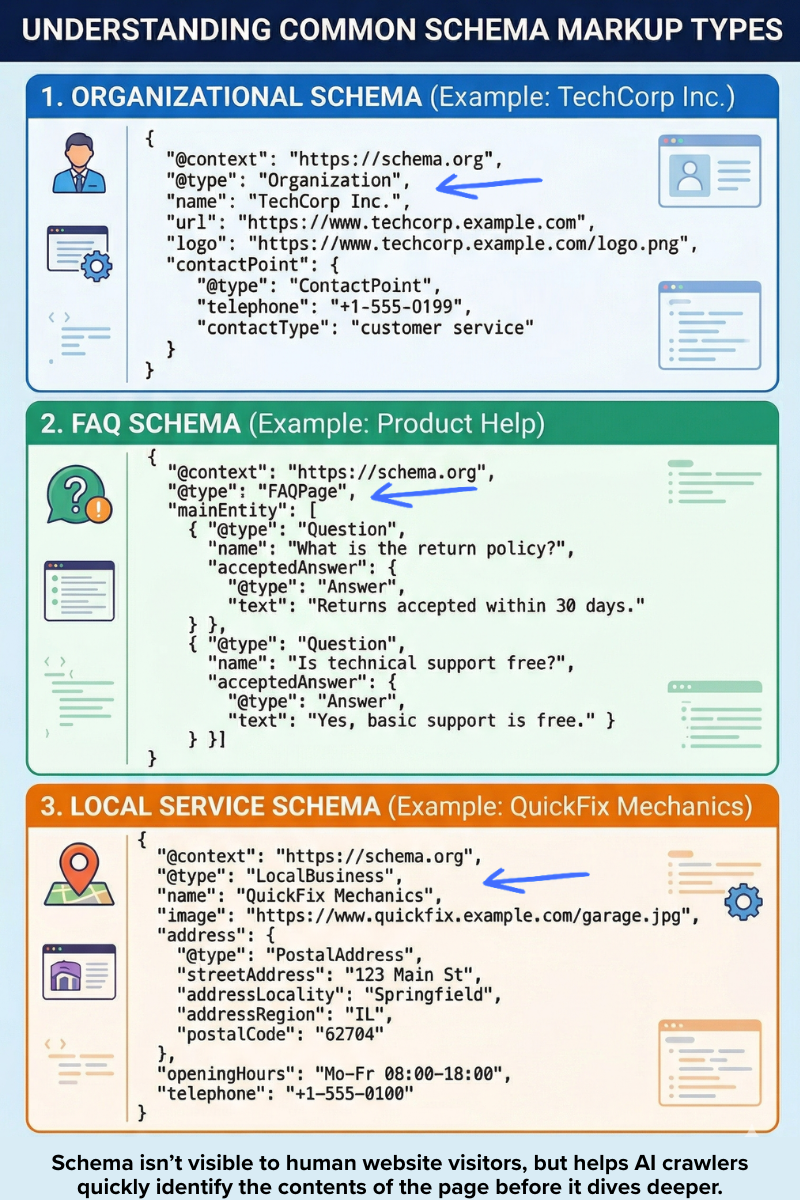
Schema is structured code that tells both search engines and AI systems exactly what your content is and how to categorize it. Think of it as a label on the outside of a box. Without it, Google and AI tools have to guess what's inside. With it, they know immediately.
You have probably noticed when searching Google that some results include FAQ dropdowns or “People Also Ask” options directly in the results page. Schema is what makes those features possible for SEO, and it works the same way for AI systems trying to decide whether your content is worth citing.
Start with FAQ schema on your blog posts that answer questions and organizational schema on your homepage. Add local schema if you have physical locations. You do not need to implement everything at once. Just tackle your key pages and highest-performing blogs first. The benefit compounds over time, and every addition helps both channels simultaneously.
Pro Tip: You can use AI tools like Technical SEO, Claude, and ChatGPT to write the schema for you and schema.org to validate if it’s correct. You don’t necessarily need a web developer to start adding schema to your site.
Build your entity graph
This one gets overlooked, and it matters for both SEO and GEO. Every platform your business is on (your website, Google Business Profile, LinkedIn, YouTube, Facebook) needs to link to your website. And your website needs to link back to them. Your phone number, address, and business name should be identical everywhere they appear.
AI systems build a picture of who you are from dozens of sources. If those sources contradict each other or do not connect back to you clearly, you become harder to cite with confidence. Search engines use the same signals to verify your business is legitimate. Cleaning this up genuinely helps both channels at the same time.
Reframe your headings and answer directly underneath them
In traditional SEO, keyword-rich headings helped search engines understand what a page was about. In GEO, question-format headings with a direct answer in the first sentence are what AI systems pull from when building a response. The two goals are not in conflict. In some cases, you can tackle both. (Check the headers in this article, for example).
Try this test:
Take your five best-performing articles. Where you have a statement heading, convert it to a question. Then make sure the very first sentence under that heading directly answers it. You keep the keyword signal for SEO, and you add the extractable answer structure for GEO.
Human readers benefit too. Skim-readers use headings and first sentences to decide whether a section is worth reading.
Add FAQ sections with your brand name in the answers
FAQ sections with proper schema markup are one of the highest-value additions you can make for both channels. For SEO, they increase your eligibility for People Also Ask features. For GEO, AI systems frequently pull FAQ answers verbatim when building responses.
The Endless Customers System™ is built on this exact idea: the business that answers the most questions, most honestly, becomes the most trusted voice in its market. FAQ sections are one of the most direct ways to put that principle to work for both SEO and GEO at the same time.
Consider this: If your brand name is in the answer, it travels with the citation. A question like "What does [Company] charge for X?" answered with "At [Company], pricing for X starts at..." gets your name in the AI's response even when the question itself does not include it. Write your FAQ answers as if the AI is going to copy and paste them directly, because sometimes it will.
Free Assessment
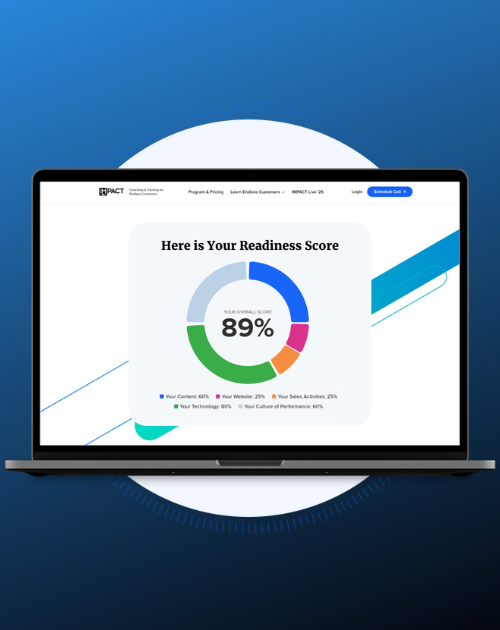
Free Marketing Assessment: Where do you stand?
AI is changing how buyers find businesses, and most companies are dangerously underprepared. Take this free assessment and find out if yours is at risk of becoming invisible to your buyers.
What are the biggest mistakes businesses make with GEO?
The most common mistakes businesses make with GEO are treating it as a separate strategy from SEO, rewriting content that is already working, and optimizing for AI systems at the expense of the human reader.
Let’s look at how you can avoid these mistakes and build a GEO strategy that makes sense.
Treating GEO and SEO as separate content strategies
They share the same foundation. Building for one while ignoring the other almost always weakens both. You do not need two content strategies. You need one content strategy that serves machines and humans in the same motion.
Rewriting well-ranking articles from scratch
If an article is already ranking well organically, gutting it to make it more GEO-friendly is a real risk. Layering in FAQ sections, updating headings, and adding schema are additive changes. A full rewrite might improve your GEO signals while tanking the organic ranking that is already working. Add carefully. Do not rebuild what is not broken.
Optimizing for AI and forgetting the human on the other end
At some point, a real person is going to click through to your page. If you have stripped out everything that makes content readable in favor of AI signals, what are they going to find? Awkward structure, robotic language, and a page that feels like it was written for a machine. The click still happens. Make sure the experience on the other side of it is worth their time.
Spending money on tracking tools before fixing the fundamentals
There is no AI equivalent of Google Search Console yet. The tools that exist, including Otterly, Am I on AI, and SEMrush's AI tracking, all return different numbers for the same company.
Our best suggestion if you want more data on how you’re ranking on AI? Look for free versions of the several tracking tools out there and compile the answers. While the results will be different, you can evaluate what insights make sense for you to tackle as part of your marketing strategy.
Invest in the things that actually drive visibility: schema, entity cleanup, content depth, and E-E-A-T signals.
Waiting for the dust to settle
Even though the terminology is evolving and best practices are still being figured out, there’s no good reason to wait. Start thinking like a scientist and experiment. Pick five articles and add FAQ sections. Pick five others and add schema. Change the heading formats on five more. Watch what happens. The businesses that will be hardest to compete with in five years are the ones running experiments right now.
Getting Found in AI Search Starts with What You Already Have
Odds are that the buyers in your market are already using AI tools to research, compare, and make decisions. The businesses showing up in those answers are not necessarily the biggest or the most established. They are the ones who started building earlier while everyone else watched and waited.
You don’t need to have the perfect strategy in place. Start by searching your own company in ChatGPT today. Let the gaps tell you where to focus first.
The Endless Customers System™ is a proven framework that helps businesses become the most known, trusted, and recommended brand in their market by teaching them to answer the questions their buyers are already asking, wherever they're asking them.
Download a free preview of Endless Customers and start building the content that gets your business found, cited, and chosen.
FREE BOOK PREVIEW
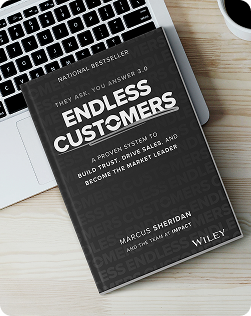
Endless Customers Special Preview Edition
Get a taste of the book that brings you a proven system to build trust, drive sales, and become the market leader. This special preview edition has select chapters and The Four Pillars of a Known and Trusted Brand, resources to accelerate your success, and more.

Written By
Mandy York combines her experience as an award-winning educator and thriving business owner to help others take creative and actionable steps toward their content and video marketing goals. Her greatest strengths lie in her ability to foster relationships, seek common ground and provide real-world insight. After obtaining her Master's degree in Leadership in 2018, she moved to the quiet, rural home she shares with her son and her dog Bo.
Mandy York combines her experience as an award-winning educator and thriving business owner to help others take creative and actionable steps toward their content and video marketing goals. Her greatest strengths lie in her ability to foster relationships, seek common ground and provide real-world insight. After obtaining her Master's degree in Leadership in 2018, she moved to the quiet, rural home she shares with her son and her dog Bo.
/Assets/Icon%20Library/social/linkedin-logo.svg)
Share
/Assets/Icon%20Library/social/x%20corp.svg)
/Assets/Icon%20Library/social/mail-to.svg)
/Assets/base/Learning%20Center%20Resource%20Category%20Icons/Website%20link.svg)
NEED HELP WITH CONTENT MARKETING?
If you’re looking to take control of your sales and marketing using content as a key driver, IMPACT can help. We can guide you on how to build your internal team, stop relying on agencies, and become the most known and trusted brand in your market.
NEED HELP WITH CONTENT MARKETING?
If you’re looking to take control of your sales and marketing using content as a key driver, IMPACT can help. We can guide you on how to build your internal team, stop relying on agencies, and become the most known and trusted brand in your market.