
/Assets/arrow-facing-left--black-01.svg)
/Assets/navigation-global--close-symbol-black-01-1.svg)

/Assets/Icon%20Library/social/facebook-logo.svg)

/Assets/Icon%20Library/social/instagram-logo.svg)
/Assets/Icon%20Library/social/youtube-logo.svg)





Right now, someone is asking an AI platform to recommend a business like yours.
They didn't do hours of searching Google. They didn't ask a friend. They typed a question into ChatGPT, Gemini, or Perplexity, and they're waiting for a name. What they get back depends almost entirely on what AI has already decided it knows about your business.
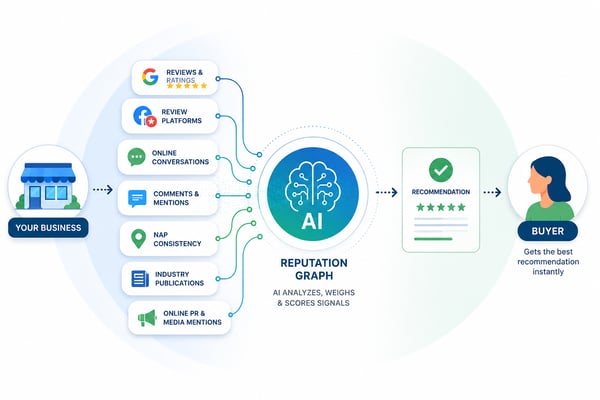
AI is forming an opinion about your reputation every day. It reads your reviews, scans for mentions of your business in local news, industry publications, and community forums, checks whether your name, address, and phone number are consistent across every platform you appear on, and notes the patterns in how customers describe their experience with you.
It makes its assessment quietly, without your input, and buyers act on it. And if you’re watching how AI affects your marketing metrics, you know the impact is significant.
At IMPACT, we've been tracking this shift closely with clients across the country. What we covered at Endless Customers Live in Chicago earlier this year makes clear that AI is evaluating your business across every digital surface where your reputation lives. Your reviews, your mentions, your citations, and your consistency across platforms all feed into a single picture that AI uses to decide whether to recommend you.
We're calling this the reputation graph. It works a lot like digital PR. And if you're not actively managing it, you're leaving AI’s interpretation (and therefore, your buyers’) of your business up to chance.
What is the reputation graph, and why is AI using it to filter businesses?
A reputation graph is a weighted scoring model that AI and large language models build for your business using every signal it can find about your online reputation. Your star ratings, total review volume, recency, and the recurring themes in what customers write. How consistently your business information appears across directories, citations, and platforms.
It looks for whether credible outside sources like local publications, industry blogs, or community forums mention you at all. It is not a single number. It is a comprehensive profile of your online credibility that AI uses to decide whether recommending you is a safe bet.
Marcus Sheridan put it this way:
"A reputation graph is essentially if you had the ability to spend the next year studying all about one company, reading every review that's been written about them, and learning the details, the ins and outs of everything everybody has ever said about them. That's what's going to happen with AI, and it's going, of course, to produce it in seconds."
So, what does that mean for your business?
You can have a great website, years of content investment, and a consistent publishing strategy, and still lose to a competitor with a better online reputation.
While great content can be cited or increase online visibility, the reputation graph is what determines if your business shows up in crucial conversations where users are looking for recommendations. 
What review signals does AI weigh most heavily?
There are at least four factors that carry the most weight in how AI evaluates your business:
-
Your average star rating
-
Total volume of reviews
-
How recently those reviews were posted
-
How you respond to negative reviews
A low score or performance in any one of these areas creates uncertainty, and AI defaults to recommending businesses that give it fewer reasons to hesitate.
Volume matters as much as score. A business with 12 five-star reviews looks far less credible to AI than a competitor with 200 reviews averaging 4.6 stars.
Recency carries equal weight. A review profile that hasn't seen new activity in six months signals inactivity. As Marcus described it, AI doesn't want to feel like it's recognizing a dead company. Satisfied customers need to be asked consistently, or your profile goes stale.
Finally, how you respond to negative reviews can make all the difference. Leaving them unchecked or with a generic response doesn’t give AI or humans a reason to believe that your company did anything concrete about it.
How AI weighs customer reviews
| Signal | Strong Profile | Weak Profile |
| Average Rating | 4.5+ across multiple platforms | Below 4.0 or inconsistent |
| Review Volume | 50+ and growing | Under 20 or stagnant |
| Recency | New reviews on a consistent basis (may vary by industry) | Last review 6+ months ago |
| Response Behavior | Specific, honest replies | No responses or generic templates |
What kinds of review red flags will get your business filtered out by AI?
AI doesn't just average your ratings. It reads the language customers use and scans for patterns across your reviews. Businesses with recurring themes that signal safety concerns, liability, or broken trust get quietly filtered out of AI recommendations, even when their overall rating looks acceptable.
The themes that carry the most weight as red flags:
-
"Unlicensed" or "unsafe"
-
"Ghosted" or "did not finish the job"
-
"Hidden fees" or "wrong diagnosis"
-
"Damaged property" or "fraudulent"
These are liability signals. An AI making a recommendation is making a trust endorsement, and it will not endorse a company where these phrases form a pattern. A handful of complaints using that language, consistently, can suppress your visibility.
If those themes are appearing in your reviews right now, they need to be addressed, both operationally and in how you respond publicly.
Knowing what AI penalizes is useful because it tells you exactly what to fix.
Low volume is addressable.
Recency improves the moment you build asking into your process.
Negative themes lose their weight when you respond with specificity and honesty.
And all of that effort compounds when you give AI one clear place to find your best evidence.
That's what a review page does.
What is a review page, and how does it improve your AI visibility?
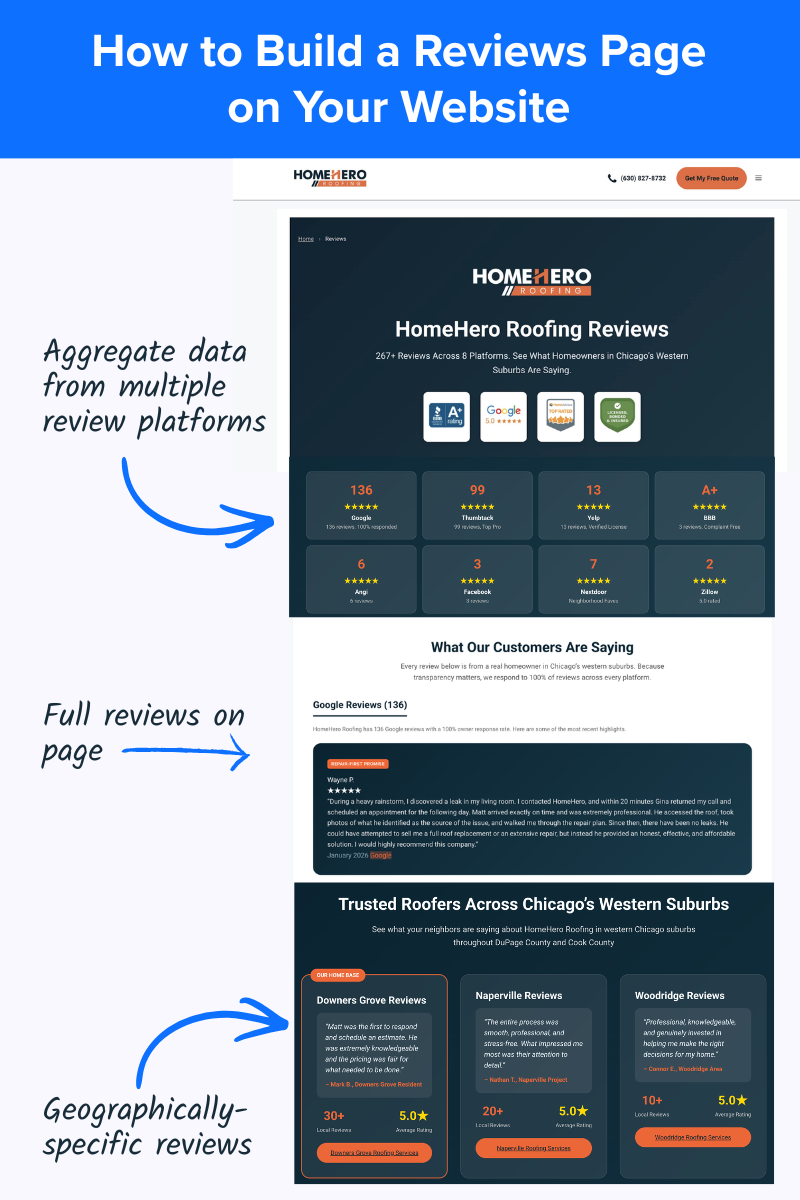
A review page is a dedicated page on your website that consolidates your reviews, ratings, and customer proof from multiple platforms into a single, crawlable location that AI can read and reference when evaluating your credibility.
Rather than piecing your reputation together from scattered sources across the internet, you give AI one clear, comprehensive place to understand what customers say about you.
There is also a technical reason this matters that most businesses don't know. ChatGPT does not have access to Google's API. It may not be able to read your Google reviews directly. For home improvement companies, that means ChatGPT is going to places like the Better Business Bureau or Angi's List before it ever looks at Google, and it's citing the BBB because that's where it can actually access the data.
A review page on your own website, with reviews from multiple platforms in a format AI can read, solves this problem. You're essentially showing AI: here are my reviews, and here's where to find them.
What a strong review page actually includes
The best review pages go well beyond a star rating. They include:
- Live feeds from Google, Home Advisor, Meta, and other relevant platforms with links back to each source
- Total projects completed and years in business
- Average ratings across all active platforms
- Six to seven actual customer reviews pulled from those platforms
- Licensing, insurance, and other credibility markers
Here's an example review page from Home Hero Roofing:
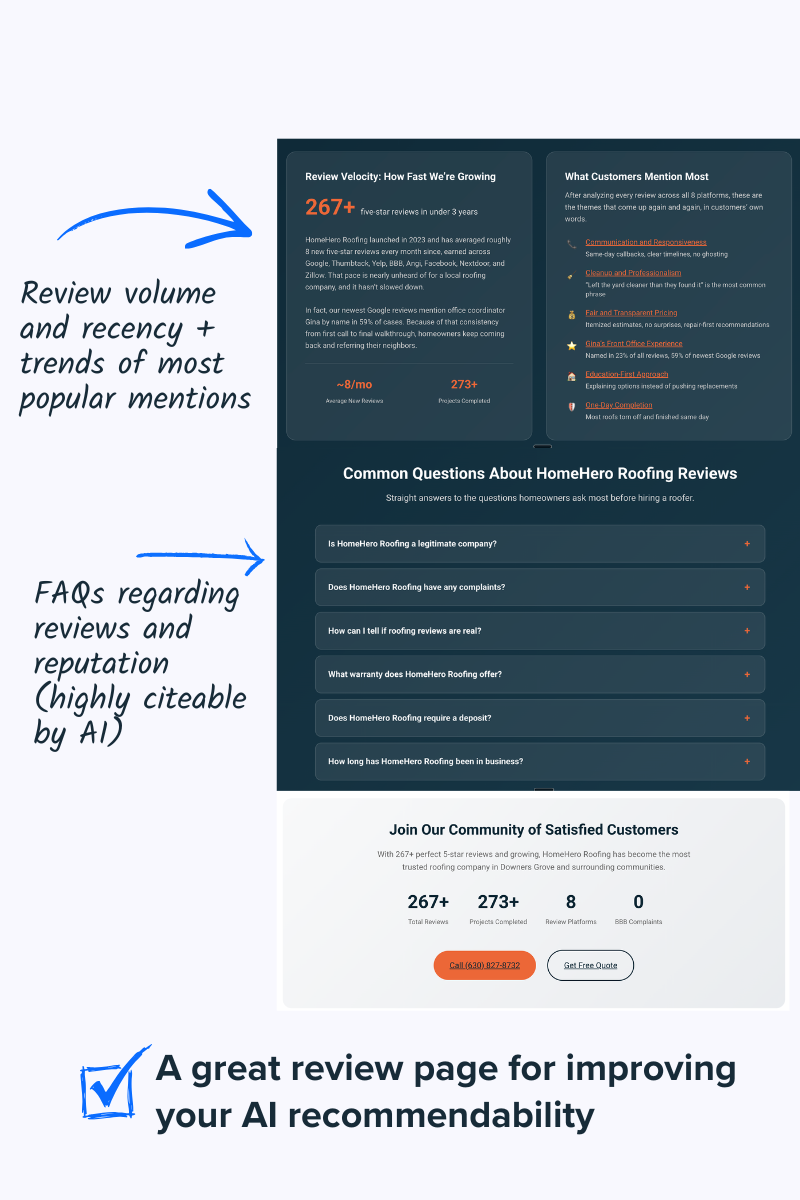
When AI is constructing your reputation graph, a well-built review page does more than reduce uncertainty. It actively advocates for your business. It puts your best proof in one place where AI can find it, read it, and use it to make the case for recommending you.
For a business with strong reviews scattered across multiple platforms, this page can be the difference between being invisible and first recommended.
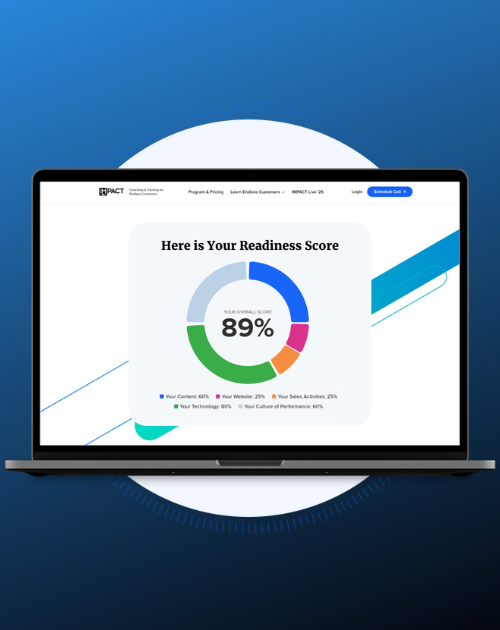
Free Assessment
Free Marketing Assessment: Where do you stand?
AI is changing how buyers find businesses, and most companies are dangerously underprepared. Take this free assessment and find out if yours is at risk of becoming invisible to your buyers.
What else is AI using to evaluate your business beyond reviews?
Reviews are the most visible and controllable part of your reputation graph, but they aren't the only part. AI is pulling signals from every corner of your digital presence, and some of the most influential ones have nothing to do with star ratings.
Authority signals from third-party sources
When a local news outlet covers your business, when an industry blog references your work, or when a city guide lists you as a recommended provider, AI reads those mentions as trust endorsements. They signal that credible outside sources have independently validated what you say about yourself.
A business that shows up in reputable third-party sources looks fundamentally different to AI than one that only exists on its own website and review profiles.
This is the digital equivalent of traditional PR. A quote in a trade publication, a feature in a local business journal, industry certifications, a mention in a neighborhood forum or a relevant Reddit thread — all of it feeds your reputation graph. It doesn't need to be national coverage.
For most mid-market businesses, consistent presence in local and industry-specific sources carries more weight than occasional mentions in broader publications.
NAP consistency across every platform
NAP stands for name, address, and phone number, and it is one of the most underestimated signals in how AI evaluates your business. When AI encounters your business name across multiple platforms, it cross-references the details.
If your address is listed differently on Google, your website, Yelp, and your Chamber of Commerce directory, those inconsistencies create doubt. AI hesitates to recommend a business when the basic facts about that business don't agree.
The fix is straightforward but requires a deliberate audit. Every directory listing, every citation, every platform where your business name appears needs to reflect the same information. That includes platforms you may have set up years ago and forgotten.
A stale listing with an old address or a disconnected phone number could be actively working against your reputation graph right now.
Social mentions and community presence
AI is also paying attention to how your business shows up in social conversations and community spaces. This doesn't mean you need a massive social following. It means that when someone mentions your business in a Facebook group, a neighborhood forum, or a relevant Reddit thread, those organic mentions contribute to the picture AI is building about you.
The businesses that show up consistently in these spaces, answering questions, being referenced by community members, appearing in local conversations, build a layer of social proof that review platforms alone can't provide.
You don't manufacture this kind of presence. You earn it by being genuinely useful and visible in the spaces where your buyers already are.
How do you actively manage and strengthen your reputation graph?
Managing your reputation graph means treating digital PR with the same seriousness you give any other part of your public presence. Your online sentiment is your reputation. AI is reading every word of it, and the patterns it finds shape whether buyers ever see your name.
Three practices make the biggest difference.
Ask for Reviews Every Time
Most satisfied customers will not leave a review without a prompt. The businesses leading in review volume and recency have built the ask into their delivery process and follow-up sequence. A post-project email, a text at completion, a note on the invoice. Consistency is what builds volume, and volume is what builds credibility.
Genuinely Respond to Everything
The standard "We're so sorry you had this problem, please call this number" response no longer works. Marcus Sheridan was very direct about this:
"You can no longer just respond with the classic 'We're so sorry you had this problem. Please call this number.' AI will actually ding you for that because what AI wants is real answers to specific issues at hand.
If you messed up, you might just want to say, 'Yes, we did mess this up. We are very sorry. Here's the system we've since implemented to make sure it doesn't happen again.' That's going to mitigate the ding so much more than hiding from it."
One of our clients, Trailstone Insurance, took this further than most businesses are willing to go. After receiving a one-star review, they created a full YouTube video addressing the complaint directly, being open about what went wrong, what they did right, and exactly how they fixed it.
That is the second pillar of the Endless Customers System™ in action: showing what others in your space aren't willing to show. AI notices this pattern. A track record of honest, accountable responses is a strong positive signal in your reputation graph, and it's the kind of brand behavior that earns buyer confidence long before anyone picks up the phone.
Show Up on Every Platform That Matters
Look beyond Google for what the internet has to say about you. Home services buyers check Home Advisor and Angi. B2B buyers might reference Google, Reddit, and industry-specific directories. A strong reputation that only shows up on one platform leaves AI with an incomplete picture of who you are.
Go straight to the source and ask for recommendations. Ask ChatGPT or Gemini:
1. What were the exact parameters you used to recommend these companies?
2. What were the exact parameters that caused you to not choose (name of) company?
This might be some of the most valuable insight into where you need to start.
Build Your Authority Outside Your Own Platforms
Reviews tell AI what customers think of you. Third-party mentions tell AI that the broader world has noticed you exist. Both are important.
Pursue citations in city guides, local business journals, industry blogs, and association directories relevant to your market. A brief mention in a credible source still registers as an authority signal.
And audit every place your business name appears online to confirm your NAP, your name, address, and phone number, is identical across Google, Yelp, your website, and every directory listing. To AI, a minor inconsistency looks like a contradiction, and contradictions create hesitation.
What Mistakes Are Quietly Costing You AI Recommendations?
Waiting for a problem before paying attention to reviews. By the time a pattern of negative themes has formed, the damage is already in progress. Treat review management as a proactive practice, not a damage-control reflex.
Assuming your star rating tells the whole story. Volume and recency matter as much as the score. A 4.2 average from 15 reviews tells AI almost nothing. A thin review profile creates uncertainty, and uncertainty costs you recommendations.
Leaving negative reviews unanswered. Ignoring a one-star review doesn't make it less visible to AI. Responding professionally, even to an unfair complaint, is an active trust signal for AI and for every prospective buyer reading that thread.
Building a review page once and walking away. A static page loses value quickly. Integrate a live feed so your page always reflects your current reputation and gives AI fresh data to work with.
Treating your reputation graph as a reviews-only problem. Your star rating is the most visible signal, but AI is also reading third-party mentions, scanning for NAP consistency across directories, and noting whether credible outside sources reference your business at all. A perfect review profile sitting on top of inconsistent business listings and zero third-party citations is still an incomplete reputation graph. Manage the whole picture.
Your Reputation Graph Is Being Built Right Now, With or Without You
Here's the thing about a reputation graph: it compounds. Every review you earn, every honest response you write, every third-party mention you accumulate, every directory listing you keep consistent, all of it builds into the profile AI uses when a buyer asks for a recommendation. And unlike a paid campaign, you own it.
No one can outspend you out of a reputation you've genuinely built.
Right now, most of your competitors are leaving their reputation graph entirely to chance. In an AI-first world, strong work only speaks for itself if AI can find it, read it, and trust it. The businesses that build deliberately now will be the default recommendation in their market before their competitors realize the rules have changed.
The Endless Customers System™ is built around exactly this kind of strategic trust-building. It gives business owners a proven framework for becoming the most known, trusted, and recommended brand in their market, using strategies across content, digital presence, and visibility that compound over time.
Check out the free preview edition of Endless Customers to see just what this framework can do for your business.

Written By
Bob Ruffolo founded IMPACT in 2009 and has led it as CEO ever since. What started as a simple web design company has grown into a business coaching and training company that helps leaders and their teams get better at sales, marketing, communication, and leadership. IMPACT has been a HubSpot partner since 2011, one of HubSpot's first, and today is a HubSpot Diamond Solutions Partner, twice named HubSpot Partner of the Year and a four-time Inc. 5000 honoree (2018 to 2021). Bob himself has been recognized as a 40 Under 40 winner and named to Glassdoor's Best CEO for Small Businesses list. Bob is the co-creator of the Endless Customers System with Marcus Sheridan, the methodology behind IMPACT's coaching, the USA Today bestselling book, the Endless Customers podcast, and the annual Endless Customers Live conference. It teaches companies to build marketing and sales capability in-house rather than outsourcing it indefinitely. In recent years Bob has led IMPACT's shift to an AI-first company and become a go-to voice for leaders trying to understand what AI means for marketing, sales, and the workforce.
Bob Ruffolo founded IMPACT in 2009 and has led it as CEO ever since. What started as a simple web design company has grown into a business coaching and training company that helps leaders and their teams get better at sales, marketing, communication, and leadership. IMPACT has been a HubSpot partner since 2011, one of HubSpot's first, and today is a HubSpot Diamond Solutions Partner, twice named HubSpot Partner of the Year and a four-time Inc. 5000 honoree (2018 to 2021). Bob himself has been recognized as a 40 Under 40 winner and named to Glassdoor's Best CEO for Small Businesses list. Bob is the co-creator of the Endless Customers System with Marcus Sheridan, the methodology behind IMPACT's coaching, the USA Today bestselling book, the Endless Customers podcast, and the annual Endless Customers Live conference. It teaches companies to build marketing and sales capability in-house rather than outsourcing it indefinitely. In recent years Bob has led IMPACT's shift to an AI-first company and become a go-to voice for leaders trying to understand what AI means for marketing, sales, and the workforce.
/Assets/Icon%20Library/social/linkedin-logo.svg)
Share
/Assets/Icon%20Library/social/x%20corp.svg)
/Assets/Icon%20Library/social/mail-to.svg)
/Assets/base/Learning%20Center%20Resource%20Category%20Icons/Website%20link.svg)
NEED HELP WITH AI FOR MARKETING?
If you’re looking to take control of your sales and marketing with a proven system built for the age of AI, IMPACT can help. We can guide you on how to control your growth, stop relying on agencies, and become the most known and trusted brand in your market.
NEED HELP WITH AI FOR MARKETING?
If you’re looking to take control of your sales and marketing with a proven system built for the age of AI, IMPACT can help. We can guide you on how to control your growth, stop relying on agencies, and become the most known and trusted brand in your market.