
/Assets/arrow-facing-left--black-01.svg)
/Assets/navigation-global--close-symbol-black-01-1.svg)

/Assets/base/Close.svg)


/Assets/Icon%20Library/social/facebook-logo.svg)

/Assets/Icon%20Library/social/instagram-logo.svg)
/Assets/Icon%20Library/social/youtube-logo.svg)





You already know you should be doing video. You’ve probably known for a while.
But it keeps getting pushed.
Maybe it feels like one more thing your team doesn’t have time for.
Maybe no one wants to be on camera.
Maybe you’re not convinced it will actually drive revenue.
For most CEOs, the hesitation isn’t about whether video works. It’s about what it takes to actually do it: equipment and time. Who is going to own it? And what do we say on camera?
And in a business where everything already feels urgent, video becomes the thing that’s always important, but never immediate.
When the reality is that video could be driving more organic website traffic, more brand awareness, better AI visibility, improving conversions, increasing close rates, and giving you a clear competitive advantage over teams ignoring video. Something that is that impactful on business performance shouldn’t be a low priority.
At IMPACT, we've helped hundreds of businesses build video marketing strategies from the ground up as part of the Endless Customers System™. These don’t need to be costly, high-production videos. Just real humans connecting with their buyers in a genuine, authentic way to build trust and close deals faster.
Video has quickly become the baseline for any business building a modern digital marketing strategy. From social media content and your website to the sales process, video is driving better results than ever before.
Here are seven reasons why you need a video marketing strategy and how to get started as soon as this week.
Reason 1: Video builds the kind of trust written content can't
A well-written article answers a question. Video answers the question and lets the audience evaluate the person giving the answer.
When a prospect is deciding who to trust, they’re looking for more than answers. They’re trying to decide who feels credible and who is the expert.
And if your competitors are showing up on video while your team stays behind text, that decision often gets made before your sales team is ever involved.
Articles build authority, and video builds relationships. At scale, that's the difference between a visitor who leaves and one who buys.
Action item: Identify your top-performing written article. Plan a short talking-head video that covers the same topic and embed it in that article. Watch whether time-on-page and any conversions on that article improve over 60 days.
Reason 2: Video has leverage at every stage of the buyer journey, not just the top
Most business leaders assume video is a marketing play. Something for social media or brand awareness.
But where it often creates the most impact is deeper in the process, where deals slow down, go quiet, or stall completely.
Early in the buying process, YouTube and social platforms put you in front of prospects who haven't decided which company to work with yet. They're researching, comparing, and building trust without committing to anything. Video is a natural door opener there.
But video also does something in the sales process that email can't. Using specific video (and written) content between sales calls can give prospects something valuable information that can convince them far better than a text-based email.
Action item: Record a simple video talking through one of these topics. Determine at what stage of the conversation the information is the most relevant for prospects and send the video before they meet with a salesperson.
Reason 3: YouTube is increasingly a source for AI-generated answers
AI tools, including ChatGPT, are citing YouTube when generating responses to user questions. When someone prompts an AI to help them understand a specific problem, relevant YouTube videos are increasingly part of the source material.
That means companies with a library of useful, topic-specific videos have a real opportunity to show up in AI-assisted research, not just traditional search.
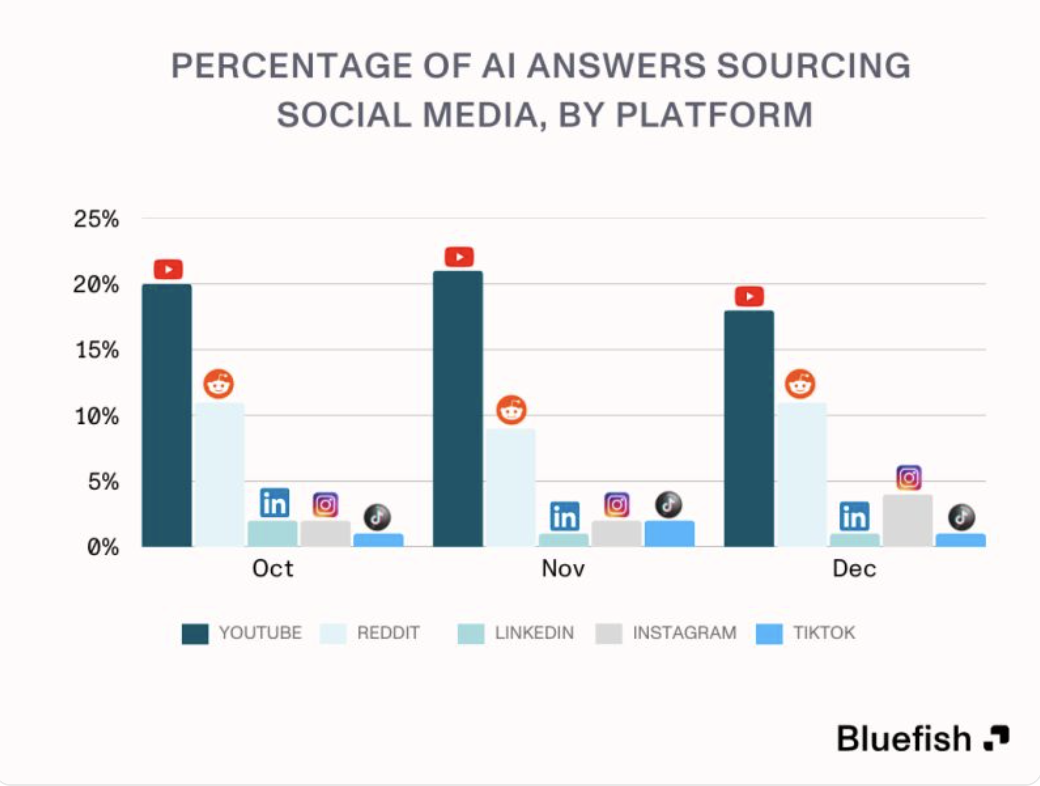
Most businesses haven't connected the dots between their YouTube content and their AI visibility yet. So, the companies that are building that library now are creating a compounding advantage. The ones waiting are falling further behind every month.
Action item: Search three questions your buyers commonly ask in ChatGPT, Gemini, or Perplexity.
Note what comes up. If your company isn't represented but your competitors are, you have a clear starting point for your first YouTube videos.
Tip: Use an incognito browser and not your own AI account. If the AI knows what company you work for, it may give you biased results.

Free Assessment
Free Marketing Assessment: Where do you stand?
AI is changing how buyers find businesses, and most companies are dangerously underprepared. Take this free assessment and find out if yours is at risk of becoming invisible to your buyers.
Reason 4: Video now shows up directly in Google Search Results
Traditional SEO still matters, even around video content. Video has become a legitimate SEO asset, and Google has built an entire infrastructure around surfacing it in search.
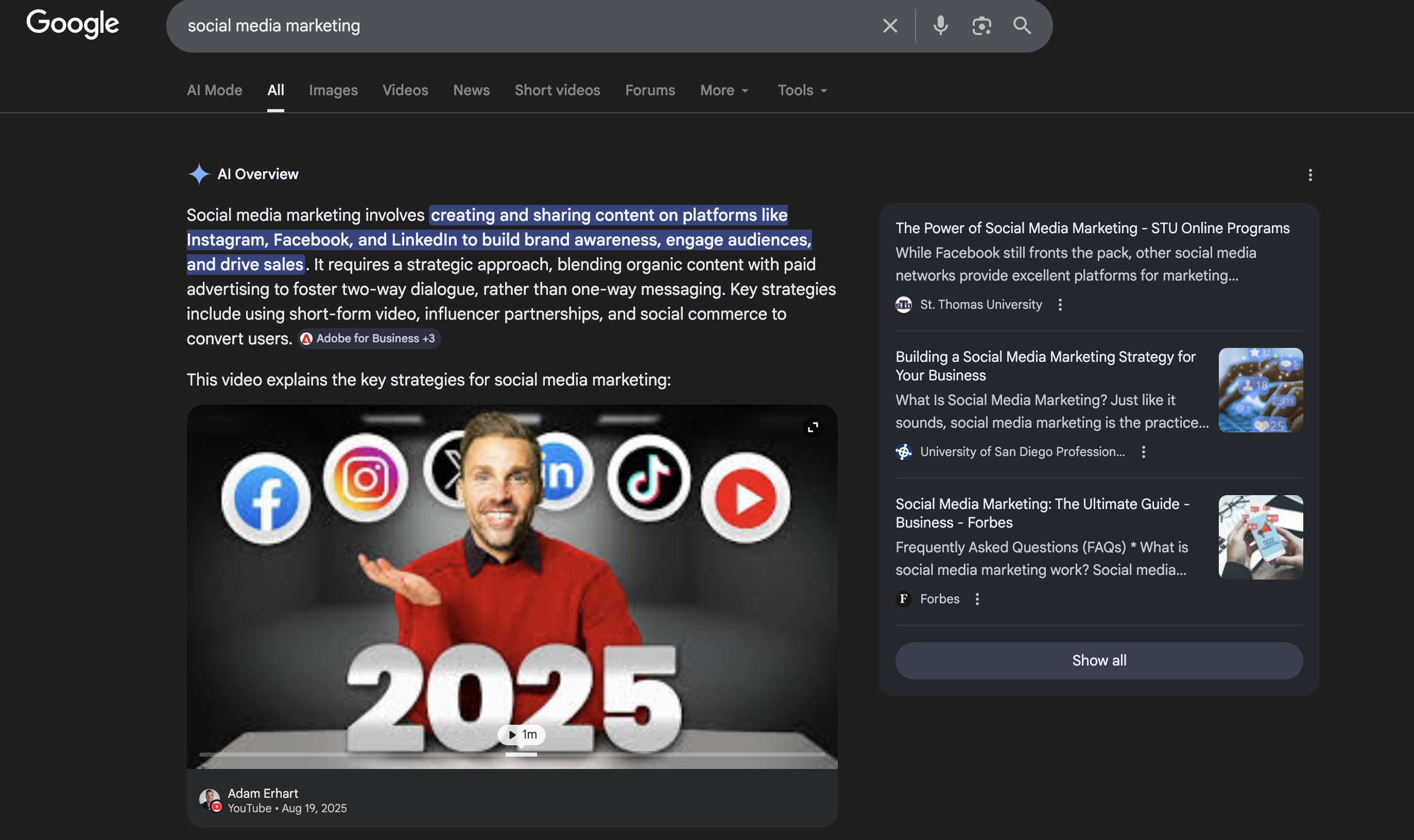
Google now displays video across standard search results. You’ll find a dedicated video tab and sometimes a short-form carousel in mobile search that pulls content directly from YouTube Shorts, Instagram Reels, and TikTok.
Your YouTube and short-form videos now go beyond competing for attention on social. It's competing for placement in the same search results your buyers are already using to research their next purchase.
What determines whether your video shows up comes down to a few things your team can control:
- Titles and descriptions that reflect how your buyers actually search
- Captions and transcripts that give Google indexable content from your audio
- Dedicated page for each video where it's the primary piece of content
Action item: Pick your top three buyer questions and record a short video answering each one. Before you publish, do the work most businesses skip: research how your buyers actually phrase those questions on YouTube and Google.
Use that language in your titles and descriptions, and add captions or a transcript so search engines can index your spoken content. Even better? Give each video its own dedicated page on your website where it's the main event. That combination is the foundation of a video SEO strategy most of your competitors haven't built yet.
Reason 5: Getting started costs far less than most CEOs think
The biggest myth in video marketing is that you need a professional crew, expensive equipment, and a three-month editing cycle before you can publish anything. That assumption keeps companies stuck while their competitors move.
Cell phone video, filmed and posted by people already on your team, can often outperform highly produced content because it feels genuine. Some of the most effective videos IMPACT clients have made required nothing more than someone hitting record on a phone and answering a question they get asked every week.
Here are three great examples from IMPACT clients on social media:
What videos should I create for my website specifically?
One of the best first videos you can create for your website is a landing page video. Around 90 seconds, where someone on your team explains what happens after a visitor fills out a form on your website.
Go over what to expect, what not to expect, and what comes next. It's a low-lift video with a measurable goal: if your landing page converts at 1% today, moving it to 3% with a single video is a real, trackable return.
Action item: Record a 90-second landing page video this week. No crew, no crazy script, no editing required. Put a face to the form and tell visitors exactly what happens next. Set a 30-day benchmark on your current conversion rate before and after.
Reason 6: Your sales team can use video to close deals faster
The most overlooked video opportunity for most companies is also the easiest to execute. After an initial sales conversation, instead of sending a follow-up email with a PDF attached, a salesperson records a short screen share walking through the proposal. What's included, what isn't, and answers to the questions the prospect is likely asking before they commit.
This type of video doesn’t necessarily require anyone to be on camera (but it helps). A salesperson can record their screen, walk through the numbers and the process out loud, and send it in under 20 minutes. It answers the questions a prospect's spouse or business partner will ask before a decision gets made, and it does it in a way a written quote simply cannot.
It's also one of the fastest ways to get a sales team bought into video. When a stalled deal closes because of a quick screen recording, their skepticism disappears quickly.
Action item: Have one salesperson send a video quote walkthrough on their next follow-up instead of a written email. Use a free tool like Loom or Vidyard. Compare the response rate to their last five email follow-ups.
Reason 7: You can tie revenue directly to your video marketing strategy
Most marketing objectives are hard to connect to actual revenue. Video, when used strategically, is one of the exceptions.
Think about how much time your sales team spends answering the same questions on every call, every appointment, every follow-up. The same objections, the same explanations, and the same process walkthrough are repeated dozens of times a month. Now imagine recording a single video that answers all of those questions upfront, sent to every prospect before that first conversation even happens.
IMPACT clients are doing this right now, and the results show up directly in their close rates. When prospects arrive at a sales conversation having already watched a video that introduces the salesperson, walks through the process, and answers their most common questions, they're warmer, more qualified, and significantly easier to close.
IMPACT coach Lindsey Auten breaks down exactly how this works, and how your sales team can implement it, in this episode of the Endless Customers™ podcast:
The businesses seeing the biggest returns from video aren't chasing views or viral moments. They're building a library of videos that do specific jobs at specific points in the buying process, and tracking whether those jobs get done inside their CRM.
Action item: Start logging video touchpoints in your CRM today. Every time a salesperson sends a video as part of their follow-up process, note it in the deal record. After 90 days, compare the close rates and deal velocity of video-touched opportunities against those without. Let the data make the case.
Do I need to hire a videographer?
Not right away, but you should start planning for one.
At IMPACT, we teach our clients that a videographer should be one of the first hires you should make when building your in-house marketing team. While you shouldn’t have to wait for a videographer to start making videos that support your sales and marketing strategy, an in-house videographer can take your production consistency and quality to the next level. It also alleviates the responsibility from other team members who have other priorities.
Almost everyone on your team should get comfortable with the idea of video marketing to a certain degree, but hiring a videographer is the next natural step for growing businesses.
How to Jumpstart Your Video Marketing Strategy
You don't need a perfect plan before you hit record for the first time.
What you need is a starting point. The steps above will get you there.
As part of the Endless Customers™ System, IMPACT coaches work with businesses to build out seven specific types of videos that are proven to drive marketing and sales results. Many of them, you've already been introduced to in this article.
Each one has a clear purpose, a clear audience, and a clear place in the buying process. Together, they form the foundation of a video marketing strategy that actually moves the needle.
But the framework only works if you start.
Pick one video from this article. Record it this week. It won't be perfect, and that's okay. The businesses that win with video didn’t wait until everything was polished. They started, learned, and kept going.
If you want to understand the full system behind building a business that becomes the most known, trusted, and recommended in its market, talk to an Endless Customers™ coach from the team at IMPACT.
Learn How to Make It Happen
The Endless Customers Coaching Program
If your marketing isn’t delivering and you’re ready for a proven, future-ready system built for the age of AI (one your team can run in-house) check out our coaching program.

Written By
Bob Ruffolo founded IMPACT in 2009 and has led it as CEO ever since. What started as a simple web design company has grown into a business coaching and training company that helps leaders and their teams get better at sales, marketing, communication, and leadership. IMPACT has been a HubSpot partner since 2011, one of HubSpot's first, and today is a HubSpot Diamond Solutions Partner, twice named HubSpot Partner of the Year and a four-time Inc. 5000 honoree (2018 to 2021). Bob himself has been recognized as a 40 Under 40 winner and named to Glassdoor's Best CEO for Small Businesses list. Bob is the co-creator of the Endless Customers System with Marcus Sheridan, the methodology behind IMPACT's coaching, the USA Today bestselling book, the Endless Customers podcast, and the annual Endless Customers Live conference. It teaches companies to build marketing and sales capability in-house rather than outsourcing it indefinitely. In recent years Bob has led IMPACT's shift to an AI-first company and become a go-to voice for leaders trying to understand what AI means for marketing, sales, and the workforce.
Bob Ruffolo founded IMPACT in 2009 and has led it as CEO ever since. What started as a simple web design company has grown into a business coaching and training company that helps leaders and their teams get better at sales, marketing, communication, and leadership. IMPACT has been a HubSpot partner since 2011, one of HubSpot's first, and today is a HubSpot Diamond Solutions Partner, twice named HubSpot Partner of the Year and a four-time Inc. 5000 honoree (2018 to 2021). Bob himself has been recognized as a 40 Under 40 winner and named to Glassdoor's Best CEO for Small Businesses list. Bob is the co-creator of the Endless Customers System with Marcus Sheridan, the methodology behind IMPACT's coaching, the USA Today bestselling book, the Endless Customers podcast, and the annual Endless Customers Live conference. It teaches companies to build marketing and sales capability in-house rather than outsourcing it indefinitely. In recent years Bob has led IMPACT's shift to an AI-first company and become a go-to voice for leaders trying to understand what AI means for marketing, sales, and the workforce.
/Assets/Icon%20Library/social/linkedin-logo.svg)
Share
/Assets/Icon%20Library/social/x%20corp.svg)
/Assets/Icon%20Library/social/mail-to.svg)
/Assets/base/Learning%20Center%20Resource%20Category%20Icons/Website%20link.svg)
NEED HELP WITH YOUR MARKETING STRATEGY?
If you’re looking to take control of your sales and marketing with a proven system built for the age of AI, IMPACT can help. We can guide you on how to control your growth, stop relying on agencies, and become the most known and trusted brand in your market.
NEED HELP WITH YOUR MARKETING STRATEGY?
If you’re looking to take control of your sales and marketing with a proven system built for the age of AI, IMPACT can help. We can guide you on how to control your growth, stop relying on agencies, and become the most known and trusted brand in your market.