



HubSpot Training HubSpot Training

HubSpot Just Announced New Headless Pricing: What This Means in Plain English

Written by Bob Ruffolo

Last updated on November 17, 2026

HubSpot Just Announced New Headless Pricing: What This Means in Plain English

On November 17, HubSpot announced something that could significantly change how businesses use and pay for its software.

The announcement is about something called headless HubSpot, which essentially means you can use more of HubSpot's capabilities through AI tools like ChatGPT and Claude, without having to work directly inside HubSpot.

But the announcement wasn't just about technology.

It was about pricing.

And if you're already paying hundreds or thousands of dollars a month for HubSpot, you've probably got some questions.

Will connecting ChatGPT or Claude cost me more money?

How much AI usage is already included in my subscription?

When will I need to start paying for HubSpot Credits?

And if AI agents are doing more of the work, is my HubSpot bill going to increase?

I've been digging into this announcement, including what HubSpot co-founder Dharmesh Shah, Chief Product Officer Chris Hogan, and Duncan Lennox have shared about the company's new approach.

I've also been reviewing what we're currently paying for HubSpot here at IMPACT, looking at our seats, credits, and usage to understand whether we're getting everything we're paying for.

Here's what I've learned, what I think this means for HubSpot customers, and what I'd recommend you do next.

First, what did HubSpot actually announce?

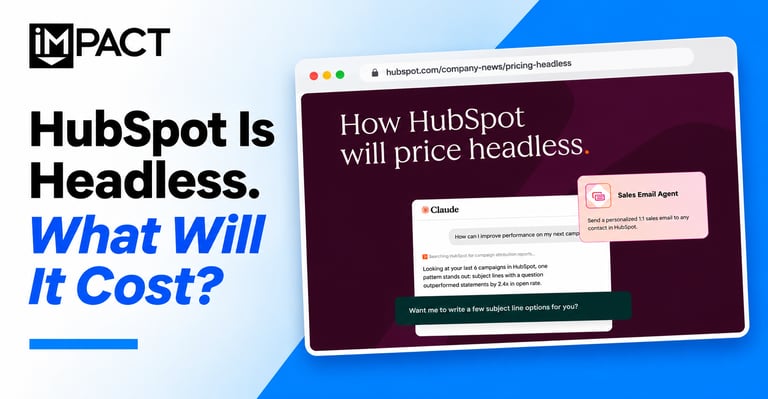
HubSpot published a new article called HubSpot Is Headless. Here's How We'll Price It.

The announcement comes just days after Brian Halligan returned as CEO and announced that he and Dharmesh Shah were refounding HubSpot as the Customer Harness Company.

I wrote about that shift in my article, What Does Brian Halligan Mean by HubSpot Becoming a Customer Harness Company?

A big part of that vision is making HubSpot easier for AI agents to use.

And that raises an interesting question.

If people increasingly use ChatGPT, Claude, and other AI tools to accomplish work inside HubSpot, how should HubSpot charge for that?

According to the announcement, HubSpot is taking a pretty customer-friendly approach.

There are three main parts:

  1. Everyday AI usage: You can use supported AI tools like ChatGPT and Claude to access HubSpot with your existing seat, within the capacity included with it. No additional headless access fee.
  2. Custom AI agents: You can connect agents you've built or purchased through HubSpot's existing APIs. These calls count toward your existing API limits and don't consume HubSpot Credits simply because an agent makes them.
  3. Advanced AI agents: HubSpot is building a more sophisticated environment where agents can access deeper business context, perform work at scale, and operate with greater oversight. That environment will use HubSpot Credits.

That third category is where a significant part of HubSpot's future revenue opportunity could come from.

We'll get into that.

What does "headless HubSpot" actually mean?

For years, when a company bought software, its employees had to learn how to use it.

Think about HubSpot.

Your sales team logs in to manage deals and contacts.

Your marketing team creates emails, landing pages, and workflows.

Your customer service team manages tickets and customer conversations.

And your HubSpot administrator configures the whole thing.

Now, think about what happens when AI can operate that software for you.

Let's say you're a sales manager.

Instead of logging into HubSpot, opening reports, reviewing individual deals, and looking through meeting notes, you open ChatGPT and ask:

"Review our entire sales pipeline. Which deals are most likely to slip this month, and what should each salesperson do to improve their chances of winning?"

ChatGPT connects to HubSpot, reviews the available information, and gives you recommendations.

You could then ask it to prepare follow-up emails or create tasks using whatever capabilities and permissions the connection supports.

That's a headless experience.

HubSpot provides the customer data and tools. AI becomes one of the ways you interact with them.

The technology that makes this possible includes something called MCP, or Model Context Protocol.

Think of MCP as a standardized way for AI assistants to connect to external tools and use their capabilities.

And here's why this matters.

HubSpot has already released its remote MCP server, introduced an Agent CLI for AI-assisted operations, and expanded its connections with leading AI tools.

So this future is already starting to happen.

Dharmesh Shah: "Headless without the headaches"

I think Dharmesh's November 17 LinkedIn post is one of the clearest explanations of what HubSpot is trying to accomplish.

In his fifth installment of notes from HubSpot's refounding, he discussed how other software companies are approaching AI access.

Some competitors require customers to upgrade to their most expensive tiers, purchase additional products, or pay for every MCP call.

HubSpot is choosing a different approach.

Dharmesh explained that if you already have a HubSpot seat and want to use Claude through HubSpot's MCP connector, you won't need to upgrade your seat or purchase a separate add-on.

Your existing seat includes capacity for everyday use.

And only customers doing higher volumes of activity should need additional capacity.

I think that's a big deal.

Consider a small business owner who already pays for HubSpot and Claude.

They want to use Claude to analyze their sales pipeline, understand customer conversations, and prepare for meetings.

They shouldn't have to purchase another expensive HubSpot subscription just to connect those two systems.

That's the direction HubSpot is promising.

Dharmesh also made another interesting point.

HubSpot wants to become the full-stack go-to-market infrastructure that businesses can connect to through whichever AI tools they prefer.

That could be ChatGPT, Claude, Grok, or HubSpot's own Breeze.

The idea is that HubSpot becomes increasingly useful regardless of where someone chooses to work.

So will using ChatGPT or Claude with HubSpot be free?

For typical use, HubSpot says the access is included with your existing seat.

There's an important distinction here.

Included access doesn't mean unlimited usage.

HubSpot says each seat will include enough capacity for everyday work through AI assistants.

For example, consider a salesperson who uses Claude to:

  • Summarize their open deals.
  • Prepare for a meeting with a prospect.
  • Review recent customer conversations.
  • Identify follow-up activities.
  • Get an overview of their pipeline.

This is the type of activity HubSpot is describing as everyday use.

According to the announcement, that access comes with the seat you're already paying for.

If someone starts using AI at significantly higher volumes, additional HubSpot Credits may be needed to expand that capacity.

How much everyday usage is actually included?

This is one of the biggest questions I still have.

HubSpot's announcement doesn't provide a universal number of MCP calls or AI actions included with each seat.

We know the company's intent is to cover typical daily work and charge for unusually high volumes.

But exactly what qualifies as high volume?

If a sales manager uses Claude to analyze 100 deals every morning, is that included?

What if someone runs 500 analyses a day?

Those are questions I'd like to see HubSpot answer with a clear rate sheet and examples.

Also, remember that HubSpot's included access doesn't cover the subscription costs of whichever AI tool you choose. If you're paying for ChatGPT or Claude, those costs are separate.

My advice would be to start experimenting with the included connector capabilities now, while paying attention to any usage limits HubSpot publishes.

What if your company builds its own AI agents?

This was another part of the announcement that caught my attention.

Chris Hogan explained in his post that third-party agents, whether a company builds them or buys them, can connect to HubSpot using its existing APIs.

And those API calls don't automatically consume HubSpot Credits.

That's significant.

Let's say your company builds an AI agent that reviews its CRM every morning.

It looks for deals that haven't moved in 30 days, identifies missing contact information, and prepares a report for the sales manager.

If the agent uses HubSpot's standard APIs, those requests count toward the API capacity already included in your subscription.

That is the same general model used by many existing software integrations.

You would only need additional HubSpot API capacity if the agent's usage goes beyond what your plan supports.

That gives companies another way to experiment with AI without automatically purchasing more HubSpot Credits.

Of course, there may still be costs associated with the AI models, infrastructure, or third-party services you use to build and run the agent.

HubSpot's announcement addresses HubSpot's pricing for access to its platform.

When would you actually start paying more for AI agents?

This is where things get interesting.

HubSpot is building what it calls a governed environment for AI agents.

Duncan Lennox, who authored HubSpot's pricing announcement, explained the approach in his LinkedIn post.

The goal is to give AI agents more than basic access to CRM records.

These agents could get deeper information about your business, your customers, your processes, and the rules under which they should operate.

HubSpot also wants to give businesses better ways to control what agents are allowed to do, monitor their activity, and see which agent performed which action.

For example, say your company wants an AI agent to help manage customer retention.

Every day, it could:

  1. Review customers with upcoming renewals.
  2. Analyze recent customer interactions and support tickets.
  3. Identify accounts showing potential signs of dissatisfaction.
  4. Recommend specific next steps.
  5. Prepare personalized communications for the appropriate employees to review.
  6. Record the actions it takes.

Or perhaps you want an agent that continuously enriches CRM records, prepares personalized prospecting messages, or performs other high-volume activities.

HubSpot's governed environment is being designed for work like this.

And according to the company, the work performed through these advanced agent capabilities will consume HubSpot Credits.

The environment is still being developed, and HubSpot hasn't published a complete pricing schedule for every future agent activity.

So customers shouldn't assume they know the cost until the actual capabilities and credit rates are published.

What are HubSpot Credits, and how do they work?

If you've been using HubSpot for a while, you may already have credits included in your subscription.

HubSpot Credits are the company's usage-based system for charging for particular features.

Today, they can be used for activities involving features such as Customer Agent, Prospecting Agent, Data Agent, and certain data-processing operations.

Different features consume different amounts of credits.

How many credits you receive generally depends on your subscription tier and any additional credit capacity you've purchased.

Credits typically reset monthly, and unused credits don't roll over.

That means a company with an allowance of 10,000 credits doesn't accumulate 30,000 unused credits just because it didn't use them for three months.

There's also an important difference between the new headless-access promise and your existing general HubSpot Credits allowance.

HubSpot is promising everyday connector capacity with seats. It has not yet published a complete explanation of how that allowance will be measured against other credit-consuming features.

I'd watch for that clarification as the pricing model develops.

How can you tell how much usage is included in your HubSpot plan?

Here's what I recommend every HubSpot customer do.

You can review most of this directly inside your HubSpot portal.

Step 1: Review what you're currently paying for

Log into HubSpot.

Click your account name in the upper-right corner and select Account & Billing.

On the Overview tab, review your subscriptions and add-ons.

Look at which HubSpot products you have, what edition you're paying for, how many seats are included, and what additional services you're purchasing.

Then open the Subscriptions tab to review your contract terms, billing frequency, and renewal date.

Step 2: Check your HubSpot Credits

From Account & Billing, open the HubSpot Credits section or navigate to Usage & Limits → HubSpot Credits, depending on your account interface.

You should be able to review:

  • Your monthly credit allocation.
  • How many credits you've used.
  • Historical usage.
  • Which features are consuming credits.
  • Any additional credit capacity you've purchased.
  • Your credit overage settings and spending limits.

Don't just look at the current month.

Review several months if possible.

Are you consistently using almost all your credits?

Or are you paying for additional capacity that rarely gets used?

Both are worth knowing.

Step 3: Check your API limits

If your company uses integrations or builds custom AI agents, you'll also want to review your API capacity.

In HubSpot, navigate to Account & Billing → Other Limits.

Look for API call usage.

This is where you can see how much API capacity your subscription includes and whether your existing integrations are approaching the limits.

This matters because custom agents using standard HubSpot APIs count toward that capacity, even when they aren't consuming HubSpot Credits.

Step 4: Review your seat usage

Next, open Users & Teams and review the seats assigned to your employees.

Ask yourself:

Are we paying for sales seats that aren't assigned?

Are there employees with premium seats who haven't logged into HubSpot recently?

Are people paying for features they don't use?

Could someone do their job with a different type of seat?

We've been reviewing this at IMPACT, and it's a worthwhile exercise.

Keep in mind that removing someone's seat doesn't necessarily remove the cost from your current contract. Purchased seat reductions often need to be handled at renewal.

Step 5: Check your overage settings

This step is particularly important if you're planning to use more AI agents.

HubSpot supports credit usage controls and notifications.

Depending on your current configuration, exceeding your purchased credits can trigger additional charges or an automatic increase in your credit capacity.

In fact, HubSpot says customers who purchased additional credits before September 16, 2026, generally had automatic upgrades as their default overage setting.

Those automatic upgrades can affect costs for the remainder of a contract.

I'd recommend reviewing your account-level spending limit and setting additional limits for specific credit-consuming features where appropriate.

You want to understand your potential spending before running agents at high volumes.

What if you still can't find the exact MCP limit?

You may not be able to find it yet.

The November 17 announcement provides the overall pricing approach, but doesn't publish one definitive everyday-usage allowance for every seat.

If the limit isn't visible in your account, ask HubSpot Support or your account manager what allowance applies to your current seat types, when additional credits begin to apply, and where that consumption can be monitored.

That's a fair question for any customer to ask.

Is HubSpot changing how everything is priced?

Potentially, yes.

And there's another development worth knowing about.

HubSpot has been introducing a separate, more flexible seats-and-credits pricing model.

Under that model, customers purchase a platform edition, add the seats their employees need, and pay for certain usage-based activities through HubSpot Credits.

One of the biggest potential changes is how marketing emails are billed.

Traditionally, many HubSpot customers purchase capacity based on the number of marketing contacts in their database.

Under the new flexible model, marketing email sending is billed based on actual usage through credits.

For a company with a large database but relatively low email volume, that could be an attractive change.

For a company that sends a massive number of emails, it could have a different financial impact.

This is a separate pricing migration from the November 17 headless announcement.

HubSpot says the flexible pricing model only applies to customers who have been specifically notified that they're included.

If you haven't received that notification, don't assume your subscription is changing.

HubSpot also says customers being migrated will not see an immediate price increase solely from the migration. Pricing can change at renewal, and additional usage can create new charges.

You can read more in HubSpot's Flexible Seats-and-Credits Pricing Migration FAQ.

Does this mean your HubSpot bill will eventually increase?

This is probably the question I'm most interested in.

HubSpot is a publicly traded company. Its investors want to see the business continue growing.

And Brian Halligan is returning at a time when AI could fundamentally change how businesses buy and use software.

So how does HubSpot grow revenue if it starts allowing customers to do more work through ChatGPT and Claude?

I think the answer is pretty straightforward.

HubSpot wants more businesses using its platform, more work flowing through its systems, and more valuable work being performed by AI agents.

Making everyday AI access affordable could help customers adopt the technology.

As businesses become more comfortable, they'll likely identify increasingly sophisticated opportunities.

Maybe they want to automate more sales research.

Maybe they want agents monitoring customer relationships.

Maybe they want AI helping qualify prospects, deliver customer service, or improve the quality of their data.

Those advanced capabilities could create additional usage-based revenue for HubSpot.

And that may be a very good thing for customers if they're getting meaningful value from that spending.

But I wouldn't assume everyone's bill is going up.

I see three possible outcomes.

Scenario 1: Your costs stay about the same.

You use ChatGPT or Claude with HubSpot for everyday work. Your usage remains within the capacity included in your subscription.

Scenario 2: Your costs increase because you use AI agents more extensively.

You deploy agents that perform large volumes of valuable work. You purchase more credits or API capacity to support that usage.

If the value exceeds the cost, that may be money well spent.

Scenario 3: Your costs decrease because you no longer need as much capacity elsewhere.

Perhaps you reduce unused seats, eliminate unnecessary add-ons, or eventually move to packaging that's a better fit for how your company operates.

The financial outcome will depend on your contract, usage, and how HubSpot evolves its pricing.

My expectation is that HubSpot wants customers to expand spending as they get more value.

That's a reasonable business model.

The responsibility for business owners is to understand what they're paying for and make informed decisions about when additional usage is worth buying.

Before paying more for AI, audit your existing HubSpot bill

This is something I've become increasingly interested in.

We're currently reviewing IMPACT's own HubSpot spending.

And we've found that simply understanding which seats we're paying for, who is using them, what marketing-contact capacity we've purchased, and how we're consuming credits raises a lot of good questions.

It's easy for software expenses to grow over time.

You add a few seats when employees join.

You purchase additional capacity when you need it.

You add a new feature or service.

Then several years go by, and you may be paying for things that no longer match how your company operates.

I'd encourage every HubSpot customer to conduct a similar review.

Here's what I'd look at:

  • Paid seats: How many are purchased, assigned, and actively used?
  • Marketing contacts: If you're on contact-based pricing, how much capacity have you purchased compared with actual usage?
  • HubSpot Credits: How many are included, purchased, and consumed each month?
  • Add-ons: Are you paying for extra reporting, API capacity, or other features you no longer need?
  • Contract terms: When can you reduce capacity, and what discounts might change at renewal?

This is especially relevant as HubSpot introduces new pricing options.

I wouldn't rush into purchasing additional AI capacity until you understand what you're already paying for.

You may have enough capacity to get started.

And you may find opportunities to reduce existing expenses.

What I'd recommend HubSpot customers do over the next 30 days

I wouldn't make this complicated.

Start with three things.

1. Understand what you're already paying for

Take 30 minutes with your HubSpot administrator or whoever manages your subscription.

Review your products, seats, credits, API limits, and renewal terms.

Get a clear picture of what's included and what's being used.

2. Start experimenting with HubSpot through AI

If your team is already using ChatGPT or Claude, explore HubSpot's supported connectors.

Pick something simple.

Ask AI to review a deal you already understand.

Have it summarize customer activity.

Ask it to prepare for a sales meeting.

Compare the answers with what you know.

See what works and where the AI still needs better information.

This will help your team become more comfortable with the capabilities before introducing more automation.

3. Identify where AI could accomplish valuable work

Bring your sales, marketing, and customer service leaders together.

Ask:

What activities are we spending hours on every week that AI could help us accomplish?

Make a list.

Then estimate the time involved and the potential value of improving those processes.

Start with a small experiment. Measure the results before expanding.

I would also make sure the people responsible for spending understand which AI activities use credits and what limits are configured.

My biggest takeaway from HubSpot's announcement

I've been involved with HubSpot since IMPACT became a partner in 2011.

Over the years, I've watched the platform evolve from inbound marketing software into a much broader system for managing customer relationships.

And now we're entering another phase.

Brian Halligan and Dharmesh Shah want HubSpot to become the infrastructure that helps AI agents and people work together to grow businesses.

That vision is going to require HubSpot to become more open, accessible, and useful to the AI tools people are already adopting.

The pricing announcement is an important part of making that happen.

I particularly like the philosophy Chris Hogan expressed in his post: Customers should have the freedom to work with their data through the tools they choose, without paying twice simply for access.

And I think customers should hold HubSpot to that promise.

We should expect clear pricing, understandable usage limits, and good controls over what our agents are allowed to do and spend.

My advice is simple: Start getting more value from the HubSpot subscription you're already paying for.

Understand your usage.

Clean up your data.

Get comfortable using AI with your CRM.

And as HubSpot introduces more sophisticated AI capabilities, invest in the ones that actually help your business grow.

If you're working with an IMPACT coach, I'd bring your HubSpot subscription and AI plans to your next coaching session.

And if you'd like help reviewing your HubSpot account, understanding your options, or figuring out how to use AI more effectively across marketing, sales, and customer service, talk with one of our HubSpot specialists.

The way we use HubSpot is changing.

It's worth making sure we're getting everything we can from it.


Sources and further reading

Bob Ruffolo

Written By

Bob Ruffolo founded IMPACT in 2009 and has led it as CEO ever since. What started as a simple web design company has grown into a business coaching and training company that helps leaders and their teams get better at sales, marketing, communication, and leadership. IMPACT has been a HubSpot partner since 2011, one of HubSpot's first, and today is a HubSpot Diamond Solutions Partner, twice named HubSpot Partner of the Year and a four-time Inc. 5000 honoree (2018 to 2021). Bob himself has been recognized as a 40 Under 40 winner and named to Glassdoor's Best CEO for Small Businesses list. Bob is the co-creator of the Endless Customers System with Marcus Sheridan, the methodology behind IMPACT's coaching, the USA Today bestselling book, the Endless Customers podcast, and the annual Endless Customers Live conference. It teaches companies to build marketing and sales capability in-house rather than outsourcing it indefinitely.