









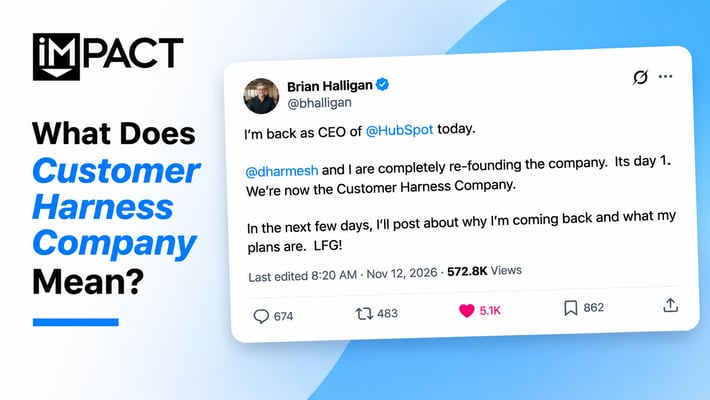
Yesterday, Brian Halligan announced that he's returning as CEO of HubSpot, the company he co-founded with Dharmesh Shah more than 20 years ago.
And he made a pretty bold statement.
“We're now the Customer Harness Company.”
He also said that he and Dharmesh are completely refounding HubSpot.
I've known Brian for a long time. IMPACT became a HubSpot partner back in 2011, and over the years, I've gotten to know Brian very well.
I've had the opportunity to watch him lead HubSpot through some pretty significant transformations. He's one of the best founders and CEOs I know, and I've always admired his ability to see where the market is going and rethink how businesses can better serve their customers.
So when Brian says he's refounding HubSpot, I pay attention.
But there's a question I'm already hearing from business owners and HubSpot users:
What the heck is a Customer Harness Company, and what does that mean for the HubSpot software we're using today?
Brian has promised to share more about his plans in the coming days. In the meantime, I want to explain what I believe he's talking about, what's already happening inside HubSpot, and what I'd recommend you start doing if your business runs on HubSpot.
First, what is a customer harness?
For the past 20 years, companies have purchased software and trained their employees to use it.
Think about your own HubSpot portal.
Your sellers log in to manage deals, review contact records, update pipelines, and create follow-up tasks. Your marketers build landing pages, emails, workflows, and campaigns. Your customer service team manages tickets, conversations, and customer information.
HubSpot gives everyone the tools to do their jobs.
Now, think about what happens when AI agents can actually do much of that work for us.
Instead of logging into HubSpot to review every deal, you might open ChatGPT or Claude and say:
Review all the open deals in our pipeline. Identify which ones are likely to slip, explain why, and recommend what each seller should do next.
The AI reads the information in HubSpot, analyzes it, and comes back with recommendations.
You could then ask it to prepare follow-up emails, create tasks, or update deal records, subject to the permissions and approvals you've configured.
That's the direction I believe Brian is talking about.
HubSpot is evolving from software your employees operate into a platform that both your employees and AI agents can use to grow your business.
In AI terminology, a harness is the infrastructure that helps AI agents connect with tools, access relevant information, perform actions, and operate within defined rules.
In HubSpot's case, that could mean providing the customer data, business context, applications, and connections that make AI agents useful across marketing, sales, and customer service.
That's a pretty significant change.
How Kipp Bodnar describes HubSpot's history in three chapters
In a post about Brian's return, HubSpot CMO Kipp Bodnar outlined the company's evolution in three chapters. It's a helpful way to understand what Brian's announcement could mean.
Chapter 1: Inbound marketing
HubSpot helped create an entirely new category of software. Businesses learned how to attract customers by publishing helpful content and earning their attention.
Chapter 2: The CRM platform
HubSpot evolved from marketing software into a broader customer platform. Sales, marketing, and service teams could work together around a shared record of their customers.
Chapter 3: The customer relationship harness
Kipp described the third chapter as building a customer relationship harness that helps millions of businesses grow better. Brian's own announcement calls HubSpot the “Customer Harness Company.”
My interpretation is that HubSpot wants to become the system that AI uses to help businesses attract customers, develop relationships, close deals, and deliver remarkable customer experiences.
And here's what makes that interesting.
You might eventually spend a lot less time actually working inside HubSpot to accomplish those things.
You may be able to use HubSpot without opening HubSpot
This is one of the biggest changes I think business owners should be preparing for.
Today, your team needs to learn how to use HubSpot. Where do you find a particular setting? How do you build a workflow? How do you create a report? How do you configure a pipeline?
A good portion of the training companies receive is about learning how to operate the software.
Now consider a future where you simply tell AI what you want accomplished.
Create a sales pipeline for our new service offering, with these six stages, the required information for each stage, and automated reminders when a deal hasn't progressed.
Or:
Look at the leads we've generated over the past 90 days. Tell me which sources are producing the most qualified opportunities and which campaigns aren't performing.
Or:
Identify our customers whose contracts expire in the next 90 days, summarize their recent interactions with us, and recommend who needs attention.
AI could help execute these tasks using HubSpot's underlying capabilities.
This concept is sometimes called headless software. It means software can be operated through other systems without requiring someone to click through its traditional interface.
And HubSpot is already building toward it.
In April 2026, HubSpot made its remote MCP server generally available. MCP, or Model Context Protocol, is a standard that helps AI assistants connect to outside software and use its capabilities.
HubSpot also introduced an Agent CLI in public beta, designed for AI agents to interact with CRM data and configuration through commands.
That means this isn't entirely hypothetical. The technology is already emerging, although the specific tasks an agent can complete depend on the connection, available tools, subscription, and permissions.
Will you still use Breeze, or will ChatGPT and Claude become your main interface?
I think this is one of the most interesting questions coming out of Brian's announcement.
HubSpot has invested heavily in Breeze, its own AI technology.
And if you haven't used Breeze recently, I'd encourage you to give it another look.
When I first tried Breeze a few years ago, my reaction was basically, “Eh, it's okay.” It's improved significantly since then.
Today, you can use AI capabilities in HubSpot to research information, get help with tasks, and work with your customer data.
But many business leaders and employees are also spending more time in ChatGPT and Claude. They're using these tools to research, write, analyze, plan, and increasingly accomplish work across several different applications.
I believe HubSpot's opportunity is to make its platform incredibly useful to those AI assistants, too.
ChatGPT or Claude could become the place where you direct the work. HubSpot could become the platform that provides customer context and helps execute it.
HubSpot can continue offering its own AI assistant as well.
The larger opportunity is giving businesses the flexibility to work with whichever AI tools make the most sense for them.
If HubSpot can make that experience easy, reliable, and secure, it could become even more valuable to the companies using it.
What should HubSpot customers expect over the next few years?
Brian hasn't shared his complete roadmap yet, so I want to be clear that these are my expectations, based on what HubSpot has already introduced and where AI technology is heading.
1. More work will be completed by AI agents
I expect HubSpot to continue moving toward AI agents that can perform increasingly sophisticated marketing, sales, and service activities.
Some tasks will be completed automatically. Others will require people to review and approve the work.
Your team will increasingly spend time setting direction, reviewing results, and improving how your company operates.
2. HubSpot will become easier to operate through other AI tools
I expect more functionality to become accessible through connections with external AI assistants.
This could reduce how much your team needs to navigate settings, menus, and individual features.
It's also possible that AI agents will eventually configure more of HubSpot itself, building workflows, properties, reports, and processes based on instructions.
How quickly and completely this happens remains to be seen.
3. Your CRM data and business context will become even more valuable
AI needs accurate information to produce useful results.
Think about everything your business already has inside HubSpot: customer and prospect records, emails, sales conversations, deals, service tickets, website activity, and marketing campaigns.
That information can help AI understand your customers and recommend what to do next.
But it needs to be organized, accurate, and connected to information about how your business actually operates.
HubSpot has already been investing in business context and AI capabilities that use that information. I expect that investment to continue.
4. The way HubSpot is packaged and priced could evolve
As more work is performed by AI rather than employees manually operating software, traditional per-seat software pricing may become less relevant for some capabilities.
We may see greater emphasis on usage-based pricing, AI credits, and individual capabilities that businesses can use as needed.
HubSpot has already introduced some usage-based AI pricing.
A larger move toward unbundling its products is possible, but I wouldn't treat that as an announced commitment.
What should you do right now if your company uses HubSpot?
You don't need to overhaul your technology stack because of yesterday's announcement. But I would start preparing.
Here are four things I'd recommend doing with your team.
1. Start using AI with deals you already know
If you're using HubSpot, pick an open deal that you're familiar with.
Open Breeze, or a supported external AI assistant connected to HubSpot, and start asking questions:
- What matters most to this buyer?
- How is our seller doing on this opportunity?
- What concerns has the buyer expressed?
- What should we do next to improve our chances of winning?
- Based on the information available, how likely are we to win this deal?
Compare its answers with what you know. Where was it helpful? What did it miss? Was information missing from the CRM?
This is one of the fastest ways to understand the capabilities and limitations of AI working with your customer data.
2. Get serious about cleaning up your CRM
I've said for years that if it's not in the CRM, it didn't happen.
That becomes even more relevant when AI is making recommendations based on your CRM data.
Are your sellers consistently logging their activities? Are deal stages being updated? Are calls being recorded and connected to the right records? Does your CRM accurately reflect your sales process?
If your data is incomplete or inaccurate, AI will struggle to give you reliable answers. And that's something you can start fixing today.
3. Give HubSpot more information about how your business works
One of the changes I've been paying attention to is HubSpot's investment in business context.
Think about the information that an experienced employee needs to understand your business.
Who are your ideal customers? What products and services do you sell? What makes you different? Who are your competitors? How does your sales process work?
AI benefits from having that information available.
Explore the Context capabilities in HubSpot and begin documenting the information that will help its AI understand your business.
Start small. Review what is already available, fill in gaps, and test whether the answers improve.
4. Start identifying work you'd like AI to handle
Get your marketing, sales, and customer service leaders together.
Ask a simple question:
What are the repetitive activities we're spending time on in HubSpot that we'd love AI to help us accomplish?
Maybe it's updating deals. Maybe it's reviewing pipeline performance. Maybe it's writing follow-up emails, building reports, or identifying customers who need attention.
Make a list. Then start experimenting with what's already possible.
Some ideas will work today. Others will require capabilities HubSpot hasn't released yet.
Either way, you'll start learning how to redesign work around AI.
What does this mean for the future of sales and marketing teams?
At IMPACT, we spend a lot of time helping companies become the most known and trusted brands in their markets.
We help them create content that answers buyers' questions, build better websites, improve how their sales teams sell, and use technology to deliver remarkable buying experiences.
I don't believe those goals are going away. If anything, they become even more important.
AI may be able to build a workflow, research a prospect, analyze a conversation, or prepare a follow-up.
But your company still needs to understand its buyers.
You still need to know what makes your business worth choosing.
You still need a great sales process, valuable content, strong leadership, and a culture of performance.
And someone needs to determine what good looks like so AI can help the team get there.
The technology will keep changing. The fundamentals of building trust with buyers will remain.
My take on Brian's return
I've always admired Brian's ability to look at a market and see what's coming before most people do.
When HubSpot started, inbound marketing was a radically different way of thinking about how businesses should attract customers. When the company expanded into CRM, it was another major transformation.
Now AI is creating an opportunity to rethink what business software should actually do.
I think that's why Brian is using the word refounding.
He's signaling that HubSpot's next chapter could be just as significant as its first two.
And for the hundreds of thousands of businesses already using HubSpot, this could be a very exciting evolution.
My advice is simple.
Don't wait for HubSpot to announce every feature on its roadmap before you start learning how to use AI with your customer data.
Start experimenting now.
If you're working with an IMPACT coach, bring this to your next coaching session and talk about how your team should be preparing.
And if you're not working with a coach but would like help getting more out of HubSpot and preparing for what's coming, talk with one of our HubSpot specialists.
Brian says this is Day 1 of HubSpot's next chapter.
I think it's a good time for all of us to start thinking about what our own next chapter looks like.

Sources: HubSpot's November 12, 2026 announcement; HubSpot remote MCP server announcement; HubSpot Agent CLI announcement; Brian Halligan's November 12 X post.

Written By
Bob Ruffolo founded IMPACT in 2009 and has led it as CEO ever since. What started as a simple web design company has grown into a business coaching and training company that helps leaders and their teams get better at sales, marketing, communication, and leadership. IMPACT has been a HubSpot partner since 2011, one of HubSpot's first, and today is a HubSpot Diamond Solutions Partner, twice named HubSpot Partner of the Year and a four-time Inc. 5000 honoree (2018 to 2021). Bob himself has been recognized as a 40 Under 40 winner and named to Glassdoor's Best CEO for Small Businesses list. Bob is the co-creator of the Endless Customers System with Marcus Sheridan, the methodology behind IMPACT's coaching, the USA Today bestselling book, the Endless Customers podcast, and the annual Endless Customers Live conference. It teaches companies to build marketing and sales capability in-house rather than outsourcing it indefinitely.
Bob Ruffolo founded IMPACT in 2009 and has led it as CEO ever since. What started as a simple web design company has grown into a business coaching and training company that helps leaders and their teams get better at sales, marketing, communication, and leadership. IMPACT has been a HubSpot partner since 2011, one of HubSpot's first, and today is a HubSpot Diamond Solutions Partner, twice named HubSpot Partner of the Year and a four-time Inc. 5000 honoree (2018 to 2021). Bob himself has been recognized as a 40 Under 40 winner and named to Glassdoor's Best CEO for Small Businesses list. Bob is the co-creator of the Endless Customers System with Marcus Sheridan, the methodology behind IMPACT's coaching, the USA Today bestselling book, the Endless Customers podcast, and the annual Endless Customers Live conference. It teaches companies to build marketing and sales capability in-house rather than outsourcing it indefinitely.


