









Why do buyers and AI pass over businesses with happy customers?
Because happy customers are invisible unless they leave reviews. Most businesses have plenty of satisfied customers and very few recent, detailed reviews to prove it. Buyers and AI tools build their shortlists from what customers say publicly, and how recently they said it. The distance between the experience you deliver and the proof anyone can see is the review gap.
What you'll learn:
- The three ways review requests fail, and why the quarterly email blast is the worst of them
- How reviews shape the shortlist for buyers and AI, and which star rating actually sells
- What makes a review something AI will cite, and how many reviews it takes to get there
- How to find the moment of realized value in your business and ask right then
- How to ask for a specific, useful review instead of a generic one
- How to automate the trigger in HubSpot with Trustpilot and Salesmsg
This session was co-hosted by IMPACT, Salesmsg, Trustpilot, and HubSpot. Allie Belles, an executive coach at IMPACT, covered the strategy. Jian Lee, a partner manager at Trustpilot, covered how reviews affect AI visibility. Chris Doore, who leads partnerships at Salesmsg, covered text versus email. Vlad Vezikov, a product manager on HubSpot's automation team, introduced the new workflows builder, and IMPACT's Stephanie Baiocchi hosted and ran the live demo.
We opened with a poll: how do you ask for reviews right now? The answers spread almost evenly across "we don't really," "an email blast when we remember," automated email, and automated text. About a third of attendees said they don't really ask at all.
What is the review gap, and what does it cost you?
Companies in every industry have far more happy customers than reviews. And when they do have reviews, they often don't have the right ones: recent, specific, and in the places their buyers actually look.
The cost is hard to see, because you never see the deals you lose this way. The buyer simply picks someone else. Even if you have a healthy pile of Google reviews, you don't know your true gap until you have a system that measures your reviews and puts them to work.
Why do most review requests fail?
Allie sees the ask break down in three places:
- It comes too late. Customers experience value at different moments. Ask after that moment has passed and you get the request everyone has received: a review link for an experience from six months ago.
- It lands in the wrong inbox. The request reaches the customer somewhere that isn't easy or natural for them to act on.
- It never gets sent. No ask means no reviews, and no new trust.
Then there is the move almost every team has made. Someone looks around and says, "Oh shoot, we need reviews. Let's send an email blast."
Please don't. A blast goes out when the calendar says so, not when your customer is happiest. Open rates are poor, the handful of reviews that come back are often thin, and a few months later you're back where you started. As Allie put it, "If the only thing you leave with today is don't send an email blast when asking for reviews, we've done our job here."
How do reviews shape the shortlist for buyers and AI?
Buyers usually compare a handful of companies before they decide, and reviews do a lot of the narrowing. According to BrightLocal's Local Consumer Review Survey 2026:
- 85% of consumers say positive reviews make them more likely to use a business
- 77% say negative reviews make them less likely
- 74% want to see reviews from the last three months, and 32% look for reviews from the last two weeks
- 89% expect businesses to respond to reviews
That recency number is why reviews have to be a steady process instead of a one-time push. And responding is not optional. People and AI tools can both spot a canned, templated reply, and it signals that you don't care what customers are telling you.
Which star rating sells best?
Allie asked attendees which star rating makes a buyer most likely to purchase. Most guessed high. The research she shared puts the sweet spot between 4.0 and 4.7 stars. A perfect 5.0 can actually lower trust, because it looks too good to be real. A rating in that range shows a real mix of experiences, and how you respond to each review matters more than chasing perfection.
How is AI changing the way reviews are read?
Buyers have always read reviews. Then search engines started reading and surfacing them. Now AI platforms interpret them: instead of handing a buyer a pile of reviews to sort through, they summarize what matters and present it as evidence for why a business made the shortlist.
The same BrightLocal survey found that 97% of consumers read reviews for local businesses, 45% have used an AI tool to get local business recommendations, and about half trust AI to summarize online reviews accurately.
Going into 2027, the cycle looks like this: customers write detailed reviews, AI finds the patterns, AI summarizes and recommends, buyers narrow their list, and then they validate it by reading the reviews themselves, visiting your website, and checking places like Reddit. Your reviews have to hold up when a human checks them.
Is Google enough?
No. Google reviews are table stakes, not the whole strategy. Allie recommends building around three platforms:
- Your primary platform. Wherever your buyers, and AI, actually research you. This is not decided by internal opinions.
- Your industry platform. Zillow for real estate, Angi or Houzz for home services, G2 or Clutch for software. An attendee added the Better Business Bureau, which Allie noted also affects AI visibility.
- Your secondary platform. Where a specific, often high-value, segment of your audience looks.
You don't need to ask every customer for all three. Asking for three reviews in three places at once overwhelms people and lowers the odds of getting any. Decide which audience gets which request.
What makes a review visible to AI?
Not every review gets read and cited by AI. Jian pointed to HubSpot's State of AEO in 2026 research, which found that content AI cites tends to share a few traits:
- Structured. Consistent content and data that AI can read quickly and cheaply.
- On a high-authority source. AI looks first to sites with strong credibility and trust signals.
- Fresh. According to Jian, AI typically only cites a source that has been updated within the last three months, so you need a steady flow of new reviews that reflect your business today.
- Tailored. Reviews that answer the questions your buyers are actually asking.
Trustpilot boils this down to reviews that are relevant to buyers' questions, recent, and hosted on a high-ranking, accessible source.
How many reviews does it take?
Jian shared findings from Seer Interactive's study of 800,000 AI responses on how review profiles shape brand presence in AI search:
- An unclaimed Trustpilot profile was cited less than 1% of the time
- A profile with just over a dozen reviews was cited more than 50% of the time
- An optimized profile, around 80 or more reviews, was cited about 75% of the time
- Brands at that stage were mentioned almost 10 times as often in competitive co-mentions, meaning AI brings them up even when a buyer asks about a competitor
Getting there happens in stages. First, establish your presence: claim your profile, automate review invitations so every customer gets asked (not just the ones you pick), and respond to every review, positive or negative. AI reads your responses too and uses them to form its view of your brand. Then scale by refining when and where you ask. At 80-plus reviews, your reviews become a competitive advantage.
What separates companies that thrive on reviews?
Picture two companies with the same star rating.
The first sends an email blast once a quarter, or whenever the marketing manager remembers. Someone responds to reviews now and then. Marketing reports the rating and calls it a win.
The second builds review requests into the customer journey:
- Every request has an owner and a trigger. A specific team is accountable, and a specific moment sends the ask.
- Feedback gets routed. Praise for a technician or a rough onboarding experience goes straight to the department that can act on it. Customers are often more candid in a review than they are face to face on a call.
- Sales uses the proof. When a prospect has an objection, a real customer review that addresses it goes much further than "our clients say..."
- Leadership learns from the patterns. Instead of celebrating 50 new reviews, leaders use them to decide where to double down and what to fix.
The problem isn't automation. It's the bulk ask. One personal request, triggered at the right moment, is still automation, and it's the kind that works.
When is the right moment to ask for a review?
Stop asking "when should we send the review email?" and start asking when your customer has just experienced enough value to want to talk about it. Allie calls this the moment of realized value, and it's what your trigger should be built on.
- Home services: right after the problem is solved
- Roof replacement: at the final walkthrough with the project manager
- Software implementation: at the first measurable win, whether that's during onboarding or the first time they run the report they've needed for years
- Consulting: at the first milestone, such as the first 90 days
Sit down as a team and map those moments. Make it part of your process and your culture, not a desperation play. Allie pointed to Eco Plumbers, Electricians, and HVAC Technicians, a client with more than 10,000 reviews across multiple platforms. CEO Aaron Gaynor gets a notification for every review under three stars, because he knows how valuable that feedback is.
And in-person asks still count. A QR code on a brochure, a phone, or a tablet at the moment of value is a great ask. Follow it up with email and text.
How do you ask for a review that actually helps?
Don't ask for a five-star review. Ask for an honest one, and ask for evidence. Questions like these get you there:
- What were you worried about before buying that we helped solve?
- What surprised you most?
- What result did you get?
- What would you tell someone comparing us to another option?
Allie's good-to-great example: good is "Would you please leave us a review?" Great is "Would you mind sharing what we helped you with, who you worked with, and what stood out about the experience?" You're guiding the customer, not scripting their praise. People don't like being told exactly what to say, but specific prompts get you more useful reviews.
Here's what that looks like in practice. A Baethke Plumbing customer in Chicago described a sewer drain blockage backing up into their basement. Several local companies were unavailable, Baethke came out despite being farther away, and the problem was fixed in under 24 hours. The customer also mentioned a financing package that let them defer payment until year-end bonuses came in, with no added interest. That one review answers a speed question and a price objection for the next buyer.
Another Baethke review included an update: technicians Chaz and James came back to retrieve an antique earring that had been dropped down a shower drain, and the customer added a photo. Encourage photos and real stories. They make a review far more convincing.
Should you ask by text or email?
Both can work, so start with where your audience is. Chris shared why text deserves a place in the mix:
- 98% of texts get opened, compared to about 22% for email on a good campaign
- 42% of text replies come from the follow-up, not the first message
Blasting texts fails for the same reasons blasting email does, and it can also put you out of compliance. The play Chris recommends is not text or email, it's both: email carries the ask, and text makes sure they see it.
- A moment in HubSpot triggers a verified review invitation email from Trustpilot.
- Minutes later, Salesmsg sends a personal text from the contact owner: "Hey Sarah, this is Chris. We just emailed you a review link. Mind checking your inbox?"
- One reminder, then stop.
Depending on your industry and review platform, you can also put the review link directly in the text. With Trustpilot and HubSpot, that takes a little extra setup.
Whichever path you choose, three things make it work:
- It comes from a real person, using the contact owner's number, not a no-reply blast.
- Replies land in the CRM, like the HubSpot timeline, so you can fix a problem before it turns into a bad review.
- Questions get answered, even at 9 PM, by an AI agent that can respond and route anything urgent to your team.
To text customers, you need their mobile number and their permission. And before you change how you ask, check your review platform's guidelines on how to ask, which link to use, and whether incentives are allowed. The rules vary by platform.
How do you automate the review request in HubSpot?
Vlad introduced HubSpot's new workflows builder, part of Agent Hub, which brings HubSpot agents, custom agents, and workflows together in one place. You can use Breeze Assistant to help build workflows, including ones that use the Trustpilot workflow action. You don't have to use the new builder, but it's HubSpot's go-forward builder and existing workflows will eventually migrate to it, so it's the place to build anything new.
Stephanie then built the workflow live:
- Set the trigger. She used Breeze to create an active segment of contacts with the decision maker association label who have reached a set point in their customer journey with IMPACT.
- Add the Trustpilot step. Once the Trustpilot integration is connected, the review invitation step asks the contact from the trigger, either immediately or after a delay you choose. The invitation uses your Trustpilot templates, which is where you customize the questions you ask, and sends a verified review link.
- Add tags. Attach HubSpot properties or custom tags to each review so you can filter, report on, and act on reviews in Trustpilot with full customer context. Trustpilot also adjusts its prompt based on the star rating a reviewer hovers over, asking what went well for a high rating and what could improve for a low one.
- Add the Salesmsg text. Choose the contact SMS action, use the mobile phone number property, send from the contact owner or a shared inbox, and write a short, personal nudge.
- Optionally, hand off to an agent so the customer can get questions answered even when their contact owner isn't available.
That's the whole workflow: one trigger, one personal ask, one reminder.
What should you do this week?
Pick one customer moment and build one workflow around it. Ask at the moment, use the channel your customer actually answers, and automate the trigger, not the blast.
In Allie's words: don't build a company that collects reviews. Build a company that thrives from them.
Reviews are just one of the trust signals AI considers when deciding who to recommend. To see where your other gaps are, run your website through IMPACT's instant diagnostic. It checks the 10 factors AI considers, and no email is required.
Frequently Asked Questions
How often should we ask for reviews?
Not on a calendar. Ask at each customer's moment of realized value, like a solved problem, a final walkthrough, or a first measurable win. Because 74% of consumers want reviews from the last three months, a steady flow of requests tied to those moments beats any periodic push.
What star rating should we aim for?
Research shared in the session puts the most persuasive range at 4.0 to 4.7 stars. A perfect 5.0 can look too good to be true and lower trust. Focus on getting honest reviews and responding thoughtfully to every one.
Should we ask customers for a five-star review?
No. Ask for an honest review and prompt for specifics: what they were worried about, what surprised them, what result they got, and what they'd tell someone comparing you to another option.
Do we need reviews somewhere other than Google?
Yes. Google is table stakes. Build around a primary platform where your buyers and AI research you, an industry platform like G2, Houzz, Angi, Zillow, or Clutch, and a secondary platform for a specific audience.
Is text or email better for review requests?
Use both. Email carries the review invitation, and a personal text from the contact owner a few minutes later makes sure they see it. Send one reminder, then stop. You need a customer's mobile number and permission before you text them.
Can we offer incentives for reviews?
It depends on the platform. Each review site has its own rules about incentives, how you ask, and which links you can use, so check your platform's guidelines before you change your process.
Do we need HubSpot, Salesmsg, or Trustpilot to do this?
No. The strategy works with any tools: find the moment, make a personal ask in the right channel, and automate the trigger. HubSpot, Trustpilot, and Salesmsg make it easy to build as one workflow.
Should we respond to every review?
Yes. 89% of consumers expect businesses to respond, and AI reads your responses along with the reviews. Skip templated replies, which both people and AI can spot.
This article is adapted from a live IMPACT webinar.
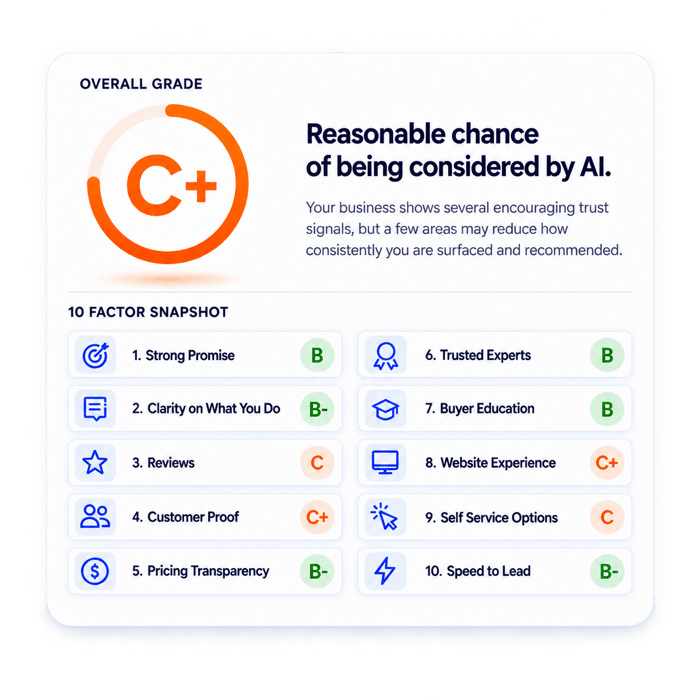
How known, trusted, and recommended is your company?
See how your business scores across the 10 factors that influence whether buyers and AI know you, trust you, and recommend you.
Run My Free Diagnostic →About IMPACT Webinars
IMPACT's on-demand webinar recordings can all be found here with recaps, summaries, resources, and full recordings.