
/Assets/arrow-facing-left--black-01.svg)
/Assets/navigation-global--close-symbol-black-01-1.svg)
/Assets/base/Close.svg)

/Assets/Icon%20Library/social/facebook-logo.svg)

/Assets/Icon%20Library/social/instagram-logo.svg)
/Assets/Icon%20Library/social/youtube-logo.svg)





Every year or two, a new ad platform shows up promising to be the next unfair advantage.
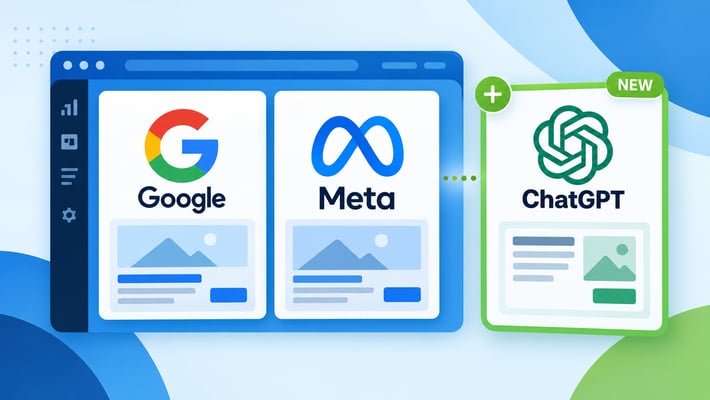
In 2026, that's ChatGPT. OpenAI opened up advertising inside its free chat product, and if you run marketing for a company between $5 million and $50 million in revenue, you have probably already asked yourself whether you need to be there before your competitors beat you to it.
At IMPACT, our paid media team helps businesses both in and outside of the Endless Customers System decide how to run ads that support their business goals with real returns. Our team of experts has seen trends come and go, and knows when a new platform makes sense.
This article walks through how to decide, using ChatGPT advertising as the live example, whether a new ad platform deserves a place in your budget right now, and how to test one without burning through your advertising budget.
What's the latest with ChatGPT/OpenAI ads?
ChatGPT advertising lets businesses show ads to people using the free version of ChatGPT. However, it behaves less like a mature ad platform and more like a product still being built. And if you're wondering why you've never seen a ChatGPT ad, it only reaches free-tier users.
That might be the first thing that affects your decision. If your buyer is the kind of person whose company already pays for AI tools, a meaningful share of your audience simply will not see your ad, no matter how much you spend.
The platform's short history explains why expectations need to stay realistic.
-
It launched requiring a minimum spend of $200,000 a year, with no conversion tracking and no way to tell an advertiser how their ad had actually performed.
-
A self-service pilot followed a few months later, invite-only at first, still missing conversion data and offering a limited set of ad formats.
-
Conversion tracking through a pixel arrived about a month after that.
-
Geographic targeting, the ability to aim ads at a city, zip code, or state instead of the entire country, came later still, and quietly.
-
As of this writing, the platform just added carousel-style ads for product feeds.
None of that makes ChatGPT advertising a bad idea forever. It makes it a young platform, and young platforms are missing features that mature ones take for granted. That is the frame to hold onto for the rest of this article.
Is ChatGPT advertising a good fit for your type of business?
Best fit: ChatGPT ads fit best today for retailers and ecommerce brands with a physical product feed, since the platform can show a product image, a price, and a link in roughly the same way a shopping ad does.
Medium fit: There are options for geographic targeting, which makes it potentially a good fit for home service businesses, too. That said, the audience is still limited to free-tier ChatGPT users, which for a local, high-consideration purchase is a narrower and less predictable pool than what Google or Meta already deliver.
Worst fit: B2B is the weakest fit of the three, and the reason is almost mechanical rather than strategic. Established B2B companies, particularly ones doing more than three to five million dollars a year, tend to give employees paid AI tools, and paid tiers don't show ads.
If your buyer works at a company like that, they are structurally unlikely to ever see your ad on this platform. Smaller and newer B2B companies, ones that haven't yet outfitted every employee with paid AI subscriptions, are a marginally better fit, but still a distant second to a platform like LinkedIn built specifically for reaching a business audience.
If ROI is important to your ads campaign...
There's a second layer worth understanding before you write anything into your ad budget.
The platform doesn't connect directly to HubSpot yet, and roughly half of the conversions it reports come back as view-through conversions with no UTM parameter attached.
What that means for you: If someone saw your ad and later showed up on your site through an unrelated path, the platform won't credit the ad for it. It's not necessarily wrong, but it's not verifiable either, and that matters a lot if you're used to tracing every dollar of ad spend to a closed deal in your CRM.
What makes a new ad platform worth the risk?
A new ad platform is only worth the risk once your existing channels are optimized and their returns are starting to flatten out. Chasing a new platform while your proven ones are still leaving performance on the table almost always costs more than it returns.
Google and Meta remain the biggest players for a reason. They have the scale, the targeting maturity, and the direct connections into systems like HubSpot that let you see exactly which dollar produced which lead. If a company hasn't yet gotten a proven channel like Google Ads dialed in, adding ChatGPT ads on top of that doesn't fix the underlying problem. It just adds a second unoptimized channel.
The signal to watch for is diminishing returns: the point where putting more money into Google or Meta stops producing a proportional increase in results.
That's the moment a new platform, whether that's OpenAI, Microsoft, or something that launches next year, starts to earn a real look. Before that point, the better use of the next marketing dollar is almost always more optimization on what you already have, not a new platform.
How do you test a new ad platform without wasting your budget?
Treat a new platform as a defined test with a start and an end date, not as an ongoing costly experiment. Set the spend, the targeting, the creative, and the metric you're deciding on before a single dollar goes out the door, then let the data make the call instead of your gut.
A workable structure looks like this:
- Set a fixed budget and a fixed window, typically 60 days, that you're comfortable losing entirely if the test fails.
- Define your targeting and creative context up front, including what OpenAI calls "context," the prompt-level targeting information that shapes which conversations your ad can appear in.
- Pick one primary metric to evaluate at the halfway point, usually click-through rate, and one metric to evaluate at the end, usually landing page conversion rate.
- At day 30, decide whether to adjust the creative or the context based on what the data shows, not on a hunch.
- At day 60, make a clear call: scale it, adjust and run a second test, or pull the budget back to the channels that are already proven.
Our paid media team walks through this exact framework, along with a deeper look at where ChatGPT advertising currently falls short, in a recent episode of the Endless Customers podcast.
When is the right time to actually pull the trigger on a new ads platform?
The right time is when the following three things are true: your existing channels are optimized, you have budget you can afford to lose on a defined test, and you're willing to actively manage a platform that is still changing on a weekly basis.
That last part is easy to underestimate. The advertising landscape underneath all of this is shifting quickly, not just on ChatGPT. Google is folding Local Services Ads into Performance Max starting with industries like roofing this month, which will reduce advertiser control over how those leads get sourced.
Google Display is evolving into what it calls Demand Gen, leaning harder on automated personalization. Meta increasingly generates ad creative on its own unless you turn that feature off, and the results are inconsistent enough that a business without someone actively watching the account can end up with an ad that actively works against its brand.
None of that is a reason to avoid new platforms forever. Just add them on purpose, with a plan, once the fundamentals underneath them are solid, instead of adding them because they're new.
Use paid ads to make good results great
At IMPACT, we help companies build the kind of marketing engine, inside the Endless Customers System, that can be successfully scaled with the help of paid ads.
Whether your goal is to learn how to manage your ads yourself or build an agency relationship you can trust, check out our Paid Ads Management Services for more information.
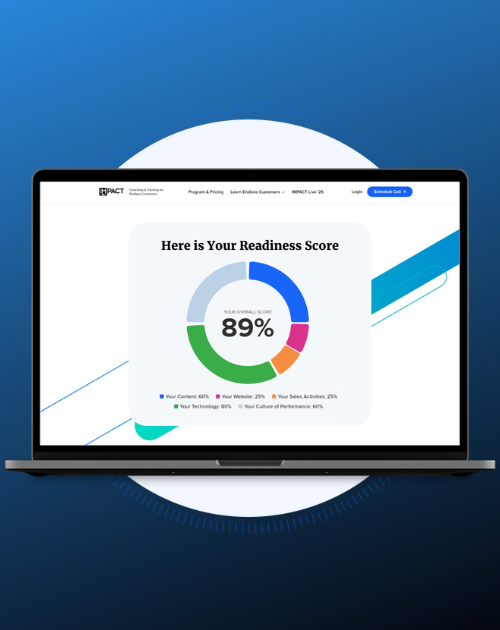
If you're trying to figure out where your next marketing dollar should actually go, start with the free AI Marketing Assessment. It's the fastest way to see whether your existing channels have room to run before you add a new one.
Free Assessment
Free Marketing Assessment: Where do you stand?
AI is changing how buyers find businesses, and most companies are dangerously underprepared. Take this free assessment and find out if yours is at risk of becoming invisible to your buyers.

Written By
Bob Ruffolo founded IMPACT in 2009 and has led it as CEO ever since. What started as a simple web design company has grown into a business coaching and training company that helps leaders and their teams get better at sales, marketing, communication, and leadership. IMPACT has been a HubSpot partner since 2011, one of HubSpot's first, and today is a HubSpot Diamond Solutions Partner, twice named HubSpot Partner of the Year and a four-time Inc. 5000 honoree (2018 to 2021). Bob himself has been recognized as a 40 Under 40 winner and named to Glassdoor's Best CEO for Small Businesses list. Bob is the co-creator of the Endless Customers System with Marcus Sheridan, the methodology behind IMPACT's coaching, the USA Today bestselling book, the Endless Customers podcast, and the annual Endless Customers Live conference. It teaches companies to build marketing and sales capability in-house rather than outsourcing it indefinitely. In recent years Bob has led IMPACT's shift to an AI-first company and become a go-to voice for leaders trying to understand what AI means for marketing, sales, and the workforce.
Bob Ruffolo founded IMPACT in 2009 and has led it as CEO ever since. What started as a simple web design company has grown into a business coaching and training company that helps leaders and their teams get better at sales, marketing, communication, and leadership. IMPACT has been a HubSpot partner since 2011, one of HubSpot's first, and today is a HubSpot Diamond Solutions Partner, twice named HubSpot Partner of the Year and a four-time Inc. 5000 honoree (2018 to 2021). Bob himself has been recognized as a 40 Under 40 winner and named to Glassdoor's Best CEO for Small Businesses list. Bob is the co-creator of the Endless Customers System with Marcus Sheridan, the methodology behind IMPACT's coaching, the USA Today bestselling book, the Endless Customers podcast, and the annual Endless Customers Live conference. It teaches companies to build marketing and sales capability in-house rather than outsourcing it indefinitely. In recent years Bob has led IMPACT's shift to an AI-first company and become a go-to voice for leaders trying to understand what AI means for marketing, sales, and the workforce.
/Assets/Icon%20Library/social/linkedin-logo.svg)
Share
/Assets/Icon%20Library/social/x%20corp.svg)
/Assets/Icon%20Library/social/mail-to.svg)
/Assets/base/Learning%20Center%20Resource%20Category%20Icons/Website%20link.svg)
NEED HELP WITH YOUR MARKETING STRATEGY?
If you’re looking to take control of your sales and marketing with a proven system built for the age of AI, IMPACT can help. We can guide you on how to control your growth, stop relying on agencies, and become the most known and trusted brand in your market.
NEED HELP WITH YOUR MARKETING STRATEGY?
If you’re looking to take control of your sales and marketing with a proven system built for the age of AI, IMPACT can help. We can guide you on how to control your growth, stop relying on agencies, and become the most known and trusted brand in your market.