
/Assets/arrow-facing-left--black-01.svg)
/Assets/navigation-global--close-symbol-black-01-1.svg)

/Assets/base/Close.svg)

/Assets/Icon%20Library/social/facebook-logo.svg)

/Assets/Icon%20Library/social/instagram-logo.svg)
/Assets/Icon%20Library/social/youtube-logo.svg)





For years, businesses could answer a common question and expect the article to bring in search traffic. Now, buyers can get many of those answers from an AI Overview or ChatGPT without visiting a website. For CEOs and business owners, that raises a fair question: Is written content still worth the investment?
At IMPACT, we have helped hundreds of companies build trust and generate revenue through content. Through the Endless Customers System™, we coach businesses to answer buyers’ questions openly and become the most known and trusted brand in their market. One of the system’s Four Pillars is “Be More Human,” a principle that carries more weight as AI makes basic information easier to produce.
This article will show you which content AI can readily replicate, where to find original ideas inside your company, and how to turn your team’s experience into resources that buyers and AI systems have a reason to trust.
Why is traditional blog content losing traffic?
Traditional blog content is losing traffic because search engines and AI tools can now answer many common informational questions without requiring someone to visit the original article.
Daniel Stanica documented the shift in “The Great Blogging Collapse: What Happened to 100 Successful Blogs?” He compared 100 previously successful, revenue-producing blogs between 2022 and 2026. The median blog lost 85% of its estimated organic traffic, and only 21 grew.
The study covers a specific cohort, not every blog on the internet. Still, the pattern is useful for business leaders in any industry. Many of these sites depended heavily on generic “what is,” “how to,” and “best ways to” articles that could be summarized easily.
The sites that performed better tended to give readers something harder to substitute: first-hand experience, original proof, a recognizable person or brand, and an audience that returned directly.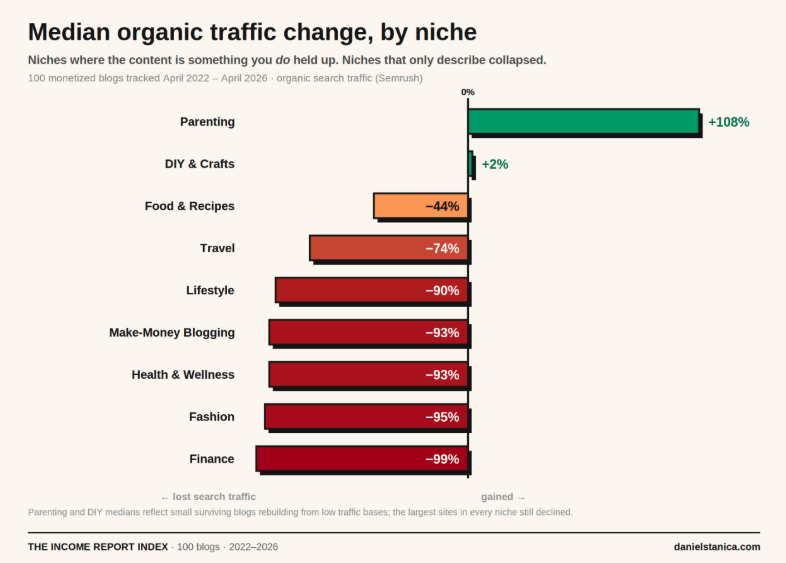
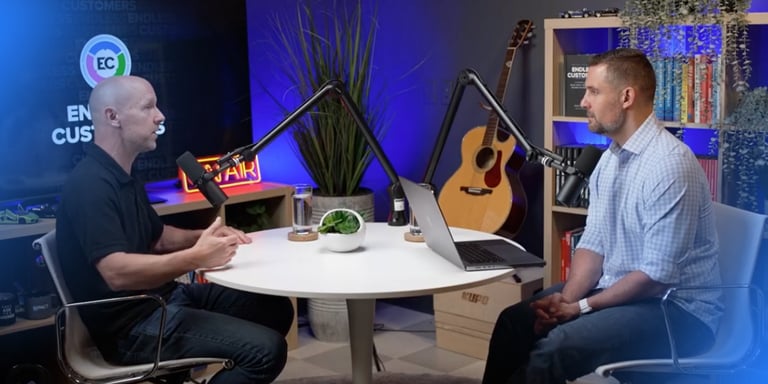
In a recent episode of the Endless Customers Podcast, Bob Ruffolo and I discussed what this research means for businesses and shared examples of experience-driven content companies can create.
What kind of content can AI easily replicate?
AI can readily replicate content that summarizes widely available information without adding first-hand evidence, a distinct point of view, or details earned through doing the work.
An article can be accurate and polished while offering little that is new. AI can often assemble a similar definition, list of tips, or surface-level how-to from existing sources.
Your business should still answer common questions about cost, problems, comparisons, reviews, and “best of” options. These topics shape buying decisions. Answer them with information competitors cannot credibly copy.
A pricing article becomes more valuable when it explains what caused recent projects to exceed their estimates. A comparison becomes more useful when your team has installed, tested, or supported both options. A “common problems” article becomes more trustworthy when it shows how your company changed its process after seeing those problems in the field.
What makes great original content?
Content becomes difficult for AI to replicate when it documents a result, observation, or lesson that could only come from your company’s direct experience.
Experience is more than a single quote from someone on your team. It is verifiable proof that your team has done the work and paid attention. That might include original photos, test results, project data, customer language, screenshots, process changes, or a well-supported disagreement with common advice.
Think about a recipe that shows what the mixture should look like at each stage. The reader benefits from someone making the recipe, noticing where people struggle, and documenting those moments. So when your sourdough recipe looks like it's heading south, you can troubleshoot along the way. Businesses can offer that guidance in nearly any industry.
Free Assessment
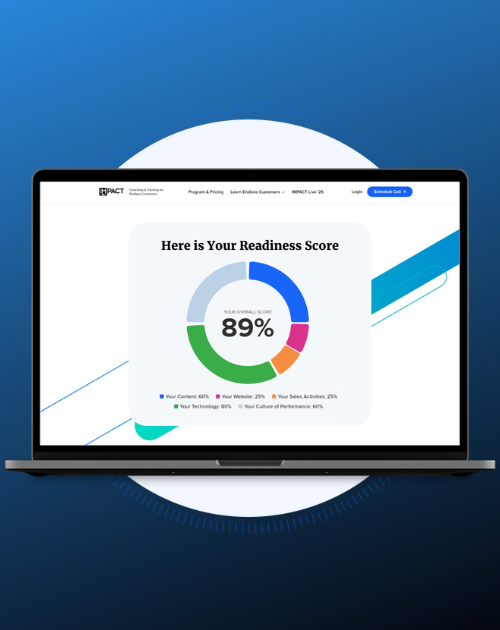
Free Marketing Assessment: Where do you stand?
AI is changing how buyers find businesses, and most companies are dangerously underprepared. Take this free assessment and find out if yours is at risk of becoming invisible to your buyers.
Where can you find original content inside your business?
Your best original material is usually hiding in sales conversations, customer work, internal changes, and the informed opinions your team has developed over time.
You don't need a research department. Look for moments when employees know more than the standard answer:
- Problems your team has solved: Explain what went wrong, what you changed, and what others can learn from it.
- Claims you can demonstrate: Test the claim, document the process, and show the result instead of relying on marketing language.
- Patterns your employees notice: Salespeople, installers, service teams, and account managers hear questions and see problems that may never appear in keyword research.
- Processes your company improved: Show how your approach evolved and why each change created a better experience or result.
- Advice your team questions: If your experience conflicts with common industry guidance, explain what you tried and what led you to a different conclusion.
For example, at IMPACT, our content manager uses AI tools like AskElephant or HubSpot's Breeze AI to mine coaching conversations for client pain points or recurring questions during the sales process. From that, we are able to create content that directly helps our community.
There are unexpected opportunities to create trust-building, unique content everywhere you look.
Trailstone Insurance, a member of the Endless Customers community, created content after receiving a negative review. The company explained what happened, how the team responded, and what it changed internally. Buyers gained evidence of how the company behaves when something goes wrong.
How do you turn your team’s experience into useful content?
Start with a real buyer question, identify the employee closest to the issue, and document the specific evidence that makes their answer credible.
Your marketing team need not possess every insight. Its job is to draw knowledge from the people who work with customers, products, and processes every day.
Begin with a question buyers ask. Interview the expert who has seen the issue firsthand. Ask what happened the last time they encountered it, what buyers misunderstand, what evidence supports their opinion, and when their recommendation would not apply.
Before drafting, gather proof such as a project photo, sample calculation, anonymized customer example, or side-by-side test. Use it to help the reader make a better decision, not merely to advertise your company’s experience.
Can you still use AI to help create this content?
Yes. AI can help interview experts, organize source material, find gaps, and shape a draft, as long as your team remains the source of the original insight.
Using AI does not automatically make content generic. Asking for a complete article from a broad prompt often does. Provide transcripts, examples, data, customer questions, and clear instructions. Then have a knowledgeable person review the draft for accuracy, nuance, and voice.
For a step-by-step workflow, read How to Create Human Content While Using AI. That guide explains how to use AI as an interviewer and writing partner without allowing it to replace your team’s thinking.
How can you tell if your content is genuinely irreplaceable?
Your content is harder to replace when another company could not publish the same piece credibly without doing the work, gathering the evidence, or consulting people with comparable experience.
Before you publish, ask:
-
Could a competitor change the company name and claim this article as its own?
-
Does the piece contain evidence that our team has done what we are teaching?
-
Will the reader learn something they would not get from a general AI response?
-
Have we made the answer more useful through examples, context, or honest limitations?
Every article does not need a formal study or dramatic story. It needs to give buyers a reason to trust your company’s answer. Documenting what your team knows creates a record of expertise that supports sales, strengthens your brand, and gives AI systems better source material to cite.
That is what it means to be more human within the Endless Customers System™. Your people, their judgment, and the proof behind their work become part of how your business earns trust before a buyer ever speaks with sales.
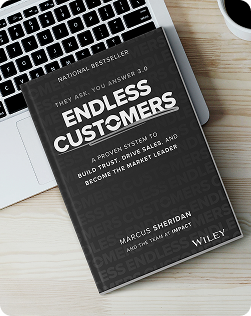
FREE BOOK PREVIEW
Endless Customers Special Preview Edition
Get a taste of the book that brings you a proven system to build trust, drive sales, and become the market leader. This special preview edition has select chapters and The Four Pillars of a Known and Trusted Brand, resources to accelerate your success, and more.
.jpeg)
Written By
Stephanie Baiocchi is the Director of Marketing & Events at IMPACT, where she leads Endless Customers Live — IMPACT's three-day, in-person conference for business owners, sales teams, and marketing leaders putting the Endless Customers System to work. She has worked in digital sales and marketing since 2011, spending time on both the client side and the agency side before joining IMPACT. Over the past 15 years, she has produced more than 25 events and programs, from multi-day national conferences to workshops, virtual summits, and recurring community meetups as leader of the Chicago HubSpot User Group.
Stephanie Baiocchi is the Director of Marketing & Events at IMPACT, where she leads Endless Customers Live — IMPACT's three-day, in-person conference for business owners, sales teams, and marketing leaders putting the Endless Customers System to work. She has worked in digital sales and marketing since 2011, spending time on both the client side and the agency side before joining IMPACT. Over the past 15 years, she has produced more than 25 events and programs, from multi-day national conferences to workshops, virtual summits, and recurring community meetups as leader of the Chicago HubSpot User Group.
/Assets/Icon%20Library/social/linkedin-logo.svg)
Share
/Assets/Icon%20Library/social/x%20corp.svg)
/Assets/Icon%20Library/social/mail-to.svg)
/Assets/base/Learning%20Center%20Resource%20Category%20Icons/Website%20link.svg)
NEED HELP WITH AI FOR MARKETING?
If you’re looking to take control of your sales and marketing with a proven system built for the age of AI, IMPACT can help. We can guide you on how to control your growth, stop relying on agencies, and become the most known and trusted brand in your market.
NEED HELP WITH AI FOR MARKETING?
If you’re looking to take control of your sales and marketing with a proven system built for the age of AI, IMPACT can help. We can guide you on how to control your growth, stop relying on agencies, and become the most known and trusted brand in your market.