









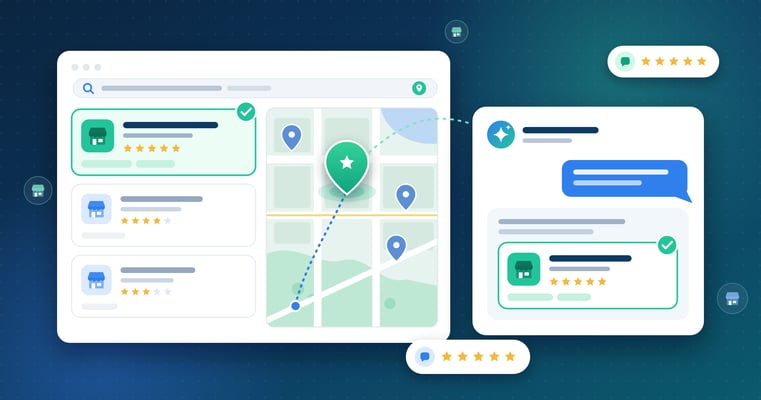
A homeowner's water heater fails on a Saturday morning, but she doesn't scroll through ten pages of search results.
Two scenarios most likely happen: She glances at the three companies in Google's map results, reads a few reviews, and checks what her neighbors say on Nextdoor.
Or...
She asks ChatGPT, Gemini, or some other AI platform, "What local company can come fix my water heater on a Saturday that does great work and has great reviews?"
In either scenario, businesses get funneled into a shortlist, and if you don't make the shortlist, you never know that opportunity even existed.
I hear that frustration from owners every week. They run good businesses, but they still can't figure out why a competitor keeps getting the call. I've coached companies through this for almost 18 years, and the ones that win local recommendations do the same handful of things. Thankfully, most of those things aren't technical tricks, but real, sustainable strategies.
At IMPACT, we help great businesses become the most known, trusted, and recommended company in their market with the Endless Customers System™. If you're still sorting out where AI fits in your marketing overall, start with our guide to AI for marketing.
This article covers how local buyers search today, why the health of your business decides your visibility, and what to build: location pages, reviews, local content, community presence, and a sales experience that earns the next recommendation.
How are local buyers finding businesses now?
Local buyers find businesses through generative AI tools as often as through traditional search. BrightLocal research puts 45% of consumers using AI tools for making local business decisions.
They ask ChatGPT, Gemini, or Google's AI Overviews who to hire, then head to other platforms to confirm their choice, places like Google Maps, social media, and Nextdoor. AI is now influencing which company a buyer picks, and which companies the buyer even sees.
That's why our coaches start every local strategy conversation with two questions. What is your buyer looking for? And where are they looking for it?
The second answer is usually wider than owners expect: your website and Google Business Profile, YouTube, social platforms, review sites, local TV, and the jersey of the youth basketball team down the street.
Optimizing each of those platforms with local copy, terms, and geography helps both buyers and AI quickly realize that you are a part of that community. This starts the process of building trust online.
Why does the quality of your business decide your local visibility?
Google's algorithms and AI models are getting better at recommending the companies that deserve the top spots. They look at what real customers already say about you online. If customers aren't recommending you, no page, profile, or agency can make the algorithms do it for you, so improving the business comes first.
Then build a review strategy that consistently brings in high-quality, specific reviews from your happiest customers. Use tools to ask at the right moment, build it into your culture, and make sure that those reviews (because those reviews are so precious to your AI visibility and human judgment online) are not another thing that falls to the bottom of the to-do list.
Aaron Gaynor, CEO of Eco Plumbers, runs a company of more than $150 million a year, and every one-star review goes straight to him. He calls those customers personally, finds where the process broke, and fixes it. He walks through his whole review system on an earlier episode of the Endless Customers podcast.
No business can be the best at everything. Pick the handful of things you'll do better than anyone in your market, build your reputation on them, and be clear about who you're a poor fit for.
A company that promises everything can't keep every promise. Trace a bad review back to its source, and you'll usually find work the company wasn't great at or an expectation nobody set.
How much area should your local pages cover?
Build each page around the largest city in a realistic service area, then list the surrounding suburbs inside the page. A plumber's Orlando page might list Lake Mary, Winter Park, Oviedo, and other towns in the metro area.
The goal isn't to create 100s of local pages, but to get specific enough to target the right areas.
Don't go too broad, either. A "Central Florida" page doesn't help someone searching for a plumber near them, since Central Florida stretches to Ocala and Daytona, each an hour or more from Orlando.
An oversized area also creates an operations problem: a technician who could have run five calls in a day runs two because of drive time.
What belongs on the page?
| Page section | The buyer question it answers |
|---|---|
| Cost | What will this cost me in my area? |
| Services | Do they do the exact job I need? |
| Areas served | Will they come to my neighborhood? |
| Local reviews | Do people near me trust this company? |
| Comparison | How do they stack up against the other local companies I'm considering? |
| Verified proof | Can they back up what they claim? |
| Booking tool and call to action | How do I schedule, get an estimate, or book a discovery call right now? |
Specific claims beat general ones, and claims you can verify beat both. If you pull more permits for this type of work than anyone in your area, say so, show a table comparing your count to competitors, and link to the third-party source.
Comparisons are great, too. The first of the Four Pillars of a Known and Trusted Brand says it plainly: "Say what others in your space aren't willing to say. Address the hard questions: cost, problems, comparisons, reviews. Do that openly and without hesitation." Your buyers already know your local competitors, and they'll compare you either way. Help them do it.
Then make your strongest promise impossible to miss.
When IMPACT CEO Bob Ruffolo's basement flooded, everyone told him to call Connecticut Basement Systems. Even though they can cost as much as three times more than competitors, its lifetime warranty is the reason people kept recommending it anyway.
And when you ask ChatGPT who to call to waterproof a basement in Connecticut, that warranty shows up as part of the reason it recommends them
How do reviews help you get found by Google and AI?
Google reviews feed Google Maps, and in my coaching work I've seen Gemini and other AI tools draw on Google reviews when they recommend local companies.
The most useful reviews mention the specific service, the area where you did the work, and the people who did it. Those details tell buyers and AI models what you do, where, and how well.
Don't stop at Google. Ask for reviews on the platforms your buyers trust, whether that's Nextdoor for a home services company or G2 for a software firm.
Reviews that mention employees by name do something extra. The fourth pillar puts it this way: "Be more human than others in your space are willing to be."
People buy from people that they trust.
Why does showing up in your community still matter?
Buyers trust what they can see in person. After years of doing everything digitally, local buyers want to see the companies they hire at events, on local TV, and in their mailboxes again. A visible presence in your community builds the recognition that turns into reviews and recommendations.
Some of the older tactics are working again:
- Sponsor a local youth sports team.
- Pitch your local news and daytime TV stations on segments that teach buyers how to make a good decision, which educates buyers instead of advertising to them.
- Send press releases about real news in your company.
- Put up banners and posters, and use direct mail.
- Partner with local social media voices your buyers already trust.
One of our clients, Shugarman's Bath, found a local social media creator with a strong following whose mother had her bathroom remodeled by Shugarman's. The team asked to collaborate on a post about how they made her bathroom safe and beautiful, and the post performed well. It worked because the relationship came first and his values matched theirs.
We aren't saying that your leadership team needs to be at every event. Salespeople and customer service staff who love their community can show up for you, and if you serve more than one market, research the right partners in each one.
Bob Ruffolo and I talked through these tactics in more depth on the Endless Customers podcast.
What happens after a buyer clicks "schedule"?
The customer experience after the first click decides whether a buyer becomes your next recommendation. Your marketing earns the appointment, and your sales process has to deliver on the trust that marketing built. Buyers will pay more for a company when they feel guided and educated from the first visit through the finished job.
Send education before, during, and after every appointment. We call this Assignment Selling, and it's one of the core sales activities we coach.
Valley Roofing, another IMPACT client, sends homeowners personalized education videos before appointments. So when Lowell, the technician, walks up to the door, people are excited and ready to talk about their roof. Some even greet him with handshakes and hugs.
Those homeowners remember the person who coached them through a big decision, and he's the one they mention in their reviews.
Frequently asked questions
Do B2B companies need local SEO?
If you sell to buyers in a specific region, yes. The same principles apply: build pages for the areas you serve, earn reviews on the platforms your buyers use (G2 for software, for example), and show up in your market's business community.
Can I pay to reach the top of local results?
Ads can put you at the top of the page, but they can't make buyers choose you. A company with weak reviews earns fewer clicks, which raises its ad costs for the same placement.
Should I mention competitors on my location pages?
Yes. Your buyers will compare you to other local companies anyway. A fair comparison of warranties, pricing, or service areas makes your page more useful and shows you're confident in what you offer.
Become the company your community recommends
Google and AI tools recommend the local businesses that customers already trust and talk about.
That starts with a business worth recommending. From there, it takes service-specific location pages, detailed local reviews, local content, a real presence in your community, and a sales experience that matches your marketing.
Related reading
- 19 AI Trust Signals That Determine If Your Business Gets Found Online: The signals AI tools check before they recommend a business.
- AEO Best Practices: 5 Ways to Improve Your Brand's AI Visibility: Practical steps to show up more often in AI answers.
- What is The Big 5?: The five content topics buyers search for most, and how to cover them.
- What Is Google's AI Mode?: How Google's AI search changes what buyers see first.
- Website Strategy in 2026: How to build a site that drives sales, including the pages buyers need.

Share


NEED HELP WITH YOUR MARKETING STRATEGY?
If you’re looking to take control of your marketing with a proven system built for the age of AI, IMPACT can help. We can guide you on how to control your growth, stop relying on agencies, and become the most known and trusted brand in your market.
NEED HELP WITH YOUR MARKETING STRATEGY?
If you’re looking to take control of your marketing with a proven system built for the age of AI, IMPACT can help. We can guide you on how to control your growth, stop relying on agencies, and become the most known and trusted brand in your market.