
/Assets/arrow-facing-left--black-01.svg)
/Assets/navigation-global--close-symbol-black-01-1.svg)

/Assets/Icon%20Library/social/facebook-logo.svg)

/Assets/Icon%20Library/social/instagram-logo.svg)
/Assets/Icon%20Library/social/youtube-logo.svg)






Some of the most important work a sales or business development team does will not show up on a revenue report for months.
A new channel, a partnership, a longer and more considered deal, all of it can be moving in exactly the right direction while looking, from the outside, like nothing is happening at all.
That gap between real progress and visible progress is where teams quietly lose motivation. Not because the work isn't working, but because nobody built a way to see how it's working right now.
At IMPACT, we coach growing companies through the Endless Customers System™, and a big piece of that is sales and marketing coaching and alignment. And this is one of the most common measurement problems revenue leaders bring to us: how do you hold a team accountable, and keep them motivated when the real result is still a long way off?
Here is the difference between a leading indicator and a lagging indicator, why that distinction matters more than most sales dashboards account for, and how one payroll company put it into practice with a part of its business that used to run entirely on guesswork.
Why does long-cycle sales and business development work feel like it's going nowhere?
Long-cycle sales and business development work feels like it's going nowhere because the only proof most teams are given that it's working is the final result, and the final result can be a year or more away. Without anything in between, effort and outcome stop feeling connected.
This shows up anywhere a team is building something that pays off later: a referral or partner program, a new CRM, a new outbound channel, a slower-moving enterprise deal, or a content program that takes months to influence a buyer.
Whatever the initiative, the underlying problem is the same: revenue is the last thing to move, not the first.
What's the difference between a leading indicator and a lagging indicator?
A lagging indicator tells you whether the work already paid off, like closed-won revenue.
A leading indicator tells you whether the work happening right now is likely to pay off later, like a new conversation started or progress through a defined stage.
Long-cycle initiatives live and die by which one a team is actually being measured against.
By quantifying those leading indicators and holding people to those KPIs, you can motivate a team that would otherwise become discouraged because they're just waiting for that final check to come in the mail, and it might take a while to get there.
That doesn't invalidate the early work you're doing to lay the groundwork for future growth.
But you need to find ways to give people a separate space that allows them to track their progress against those leading metrics, so the work feels meaningful, the work feels valuable.
Why do sales teams lose motivation on new initiatives?
Teams lose motivation before revenue shows up because they're being graded on something almost entirely out of their short-term control. A rep or a BD lead can do everything right in month one and still have nothing to show a manager who is only looking at closed deals.
This is how you combine the psychology of understanding what's going to motivate people to do their best work with the technology and the tools and the workspaces that let them see that work come to life. It takes both halves.
The psychology explains why a team needs proof of progress. The system is what actually produces that proof.
How do you build a system that actually tracks leading indicators?
You build it by giving the long-cycle relationship a home of its own in HubSpot, separate from a standard deal or contact record, with stages that reflect how that specific kind of relationship actually develops.
A generic pipeline built for a normal sales deal, or a spreadsheet bolted onto the side of your CRM, will not capture something that moves at a different pace and by different rules.
What does that look like?
That means a custom object with its own pipelines: one to evaluate whether a prospective partner or account is a mutual fit, and another to move it through a defined nurture process instead of an improvised first conversation.
An object inherently means ownership. You can assign that relationship for someone to own, and then inherently there's accountability. You can tie leads and deals back to that object so you can actually quantify the value of the relationship, instead of just going on a feeling.
This is the kind of system-building IMPACT coaches clients through as part of the Endless Customers System, because the tracking mechanism matters just as much as the strategy behind it.
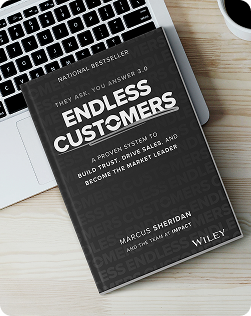
FREE BOOK PREVIEW
Endless Customers Special Preview Edition
Get a taste of the book that brings you a proven system to build trust, drive sales, and become the market leader. This special preview edition has select chapters and The Four Pillars of a Known and Trusted Brand, resources to accelerate your success, and more.
What happens when you start watching leading indicators?
When a team gets credit for leading indicators, the early, unglamorous work of a long-cycle initiative stops feeling invisible. People keep showing up to do it because there's proof, updated regularly, that it's moving somewhere.
How Paragon Payroll put this into practice
Brian McVicker, Chief Revenue Officer at Paragon Payroll, a cannabis-committed HCM and payroll provider, ran into this exact problem with his referral partner program. Most of Paragon's new business comes through referral partners, but Brian had no reliable way to see which relationships were actually progressing and which had quietly gone cold. "Anecdotally I could make some guesses," he said, "but I need data."
His team built a custom object in HubSpot with its own pipelines: one to evaluate whether a prospective referral partner is a mutual fit, and a second, still in progress, to move an accepted partner through a defined nurture process instead of an improvised first meeting.
Brian rebuilt his own partner pipeline once already, after an earlier version didn't get real adoption from his team, then reviewed the rebuild directly with his business development and marketing teams before rolling it out again.
Once the pipeline gave him visibility into which relationships were actually progressing, he was no longer relying on a gut feeling formed at a trade show a year earlier.
That visibility was one piece of a broader shift at Paragon, alongside changes to how the company used HubSpot across its sales team more generally, and the combined result shows up in the numbers Brian tracks every year: an average sales cycle that's dropped to 20 days from as long as 60, and annual revenue that's grown from under $1 million to a consistent $2 to $3 million.
How do you know if you're tracking the right leading indicators?
A leading indicator is the right one if it reliably shows up before the outcome you actually care about, not just before any activity.
Test that with a quick backtest instead of a gut check: pull your last 10 to 20 closed-won deals and check whether the indicator you're tracking actually preceded each one. If it only shows up in half of them, that's an activity count, not a leading indicator.
In a referral partner pipeline, that's the difference between tracking partner meetings held, which happen whether or not anything comes of them, and tracking partner-sourced opportunities that reach a defined pipeline stage, which correlates with revenue far more reliably.
This is also where a leading indicator system needs upkeep rather than a one-time setup. Put it on an actual review cadence (monthly is a reasonable starting point) instead of waiting for a bad quarter to prompt a look.
Watch adoption itself as a signal, too: when the people entering the data start skipping fields or logging them after the fact instead of in real time, that tells you the system needs rebuilding faster than any missed number will.
Review that rebuild with the reps and BD leads actually using it, not just with sales leadership, since they're the ones who can tell you which field is friction and which one is signal.
Measuring the work before results hit your bottom line
Long-cycle sales and business development work needs its own way to be seen, built for leading indicators, not just the eventual result.
It doesn't matter if it's new software, processes, or strategy; measure the early signals as seriously as the final one. Then your team isn't waiting a year to see if it will eventually pay off.
IMPACT coaches companies through exactly this kind of measurement problem as part of the Endless Customers System™ and our HubSpot Training Program.
If your own team is doing long-cycle work with no way to prove it's on track, talk with our team about how we can help.
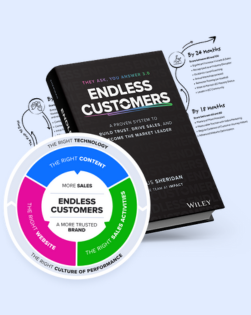
Learn How to Make It Happen
The Endless Customers Coaching Program
If your marketing isn’t delivering and you’re ready for a proven, future-ready system built for the age of AI (one your team can run in-house) check out our coaching program.

Written By
Jessica Palmeri is Director of HubSpot Training at IMPACT, where she helps companies drive day-to-day HubSpot adoption by teaching their teams to use the tools well. Jessica has been a HubSpot Certified Trainer since 2019 and has run more than 1,000 HubSpot training sessions since then. She follows a teach-a-team-to-fish approach because she's seen that lasting user adoption comes from training people to understand the tools they use every day. Her clients are most often in professional services, finance and accounting, home services, construction, and manufacturing. On a typical day, Jessica works inside clients' HubSpot portals, acts as the system administrator for IMPACT's own portal, and helps colleagues troubleshoot HubSpot issues. She also meets with people at HubSpot corporate to stay current on product development and where the platform is headed. One of her best-documented wins is Kaplan, whose HubSpot training success story IMPACT featured in a video at IMPACT Live in April 2024. Jessica speaks online and in person at webinars, workshops, small group trainings, and podcasts. Her topics include train-the-trainer adoption models and training sales and customer service teams to use HubSpot.
Jessica Palmeri is Director of HubSpot Training at IMPACT, where she helps companies drive day-to-day HubSpot adoption by teaching their teams to use the tools well. Jessica has been a HubSpot Certified Trainer since 2019 and has run more than 1,000 HubSpot training sessions since then. She follows a teach-a-team-to-fish approach because she's seen that lasting user adoption comes from training people to understand the tools they use every day. Her clients are most often in professional services, finance and accounting, home services, construction, and manufacturing. On a typical day, Jessica works inside clients' HubSpot portals, acts as the system administrator for IMPACT's own portal, and helps colleagues troubleshoot HubSpot issues. She also meets with people at HubSpot corporate to stay current on product development and where the platform is headed. One of her best-documented wins is Kaplan, whose HubSpot training success story IMPACT featured in a video at IMPACT Live in April 2024. Jessica speaks online and in person at webinars, workshops, small group trainings, and podcasts. Her topics include train-the-trainer adoption models and training sales and customer service teams to use HubSpot.
/Assets/Icon%20Library/social/linkedin-logo.svg)
Share
/Assets/Icon%20Library/social/x%20corp.svg)
/Assets/Icon%20Library/social/mail-to.svg)
/Assets/base/Learning%20Center%20Resource%20Category%20Icons/Website%20link.svg)
NEED HELP WITH YOUR SALES PROCESS?
If you’re looking to improve your sales process and not sure where to start, IMPACT can help. We’ll guide you on how to structure the right team, use strategic content to build trust, and drive real results.
NEED HELP WITH YOUR SALES PROCESS?
If you’re looking to improve your sales process and not sure where to start, IMPACT can help. We’ll guide you on how to structure the right team, use strategic content to build trust, and drive real results.