






Subscribe now and get the latest podcast releases delivered straight to your inbox.


Updated October 24, 2026.
A useful business book changes a decision, a conversation, or a habit. It gives you something to put to work.
These 50 books cover the subjects we keep coming back to at IMPACT: earning trust, educating buyers, building capable teams, using AI thoughtfully, and running a business that can deliver on its promises.
Some are direct foundations of our work. Others offer a useful way to examine a particular problem. We have included our interpretation of how each connects to Endless Customers, along with a practical next step. Including a book does not mean every claim or tactic in it fits every business.
If your immediate concern is being found and recommended in AI search, keep that larger picture in mind. Clear expertise, credible evidence, consistent information, and a customer experience people can describe give your business something worth discovering. No book or content format can guarantee an AI recommendation.
The Fandom Playbook is scheduled for October 27, 2026. Its entry is clearly marked as a preview of a forthcoming book.
Where should you start?
- For a company-wide growth approach: start with Endless Customers.
- For clearer buyer communication: try Building a StoryBrand 2.0 or Everybody Writes.
- For a team implementing AI: pair The AI Transformation Blueprint with Co-Intelligence.
- For leadership and execution: begin with Traction, Radical Candor, or The Advantage.
- For understanding the economics of growth: read Simple Numbers.
Jump to a book
- Endless Customers
- They Ask, You Answer
- The Visual Sale
- Fanocracy
- The Fandom Playbook
- Building a StoryBrand 2.0
- Everybody Writes, second edition
- Content Rules
- Youtility
- Talk Triggers
- UnMarketing, second edition
- This Is Marketing
- Obviously Awesome
- Made to Stick
- Long Story Short
- Steal Like an Artist
- All Marketers Are Liars (Tell Stories)
- Brainfluence
- The Tipping Point
- The New Rules of Marketing & PR
- Content Inc.
- Loop: Outlearn. Outmarket. Outgrow.
- The AI Transformation Blueprint
- Co-Intelligence
- Marketing Artificial Intelligence
- The Sales Acceleration Formula
- The Trusted Advisor
- Gap Selling
- Let's Get Real or Let's Not Play
- The JOLT Effect
- Uncommon Service
- Unreasonable Hospitality
- Radical Candor
- Good to Great
- Start With Why
- The Advantage
- The Five Dysfunctions of a Team
- Multipliers
- Traction
- Get a Grip
- Rocket Fuel
- How to Be a Great Boss
- What the Heck Is EOS?
- The EOS Life
- Simple Numbers, Straight Talk, Big Profits!
- The Great Game of Business
- The E-Myth Revisited
- Essentialism
- Atomic Habits
- Outliers
1. Endless Customers
By Marcus Sheridan · Book details
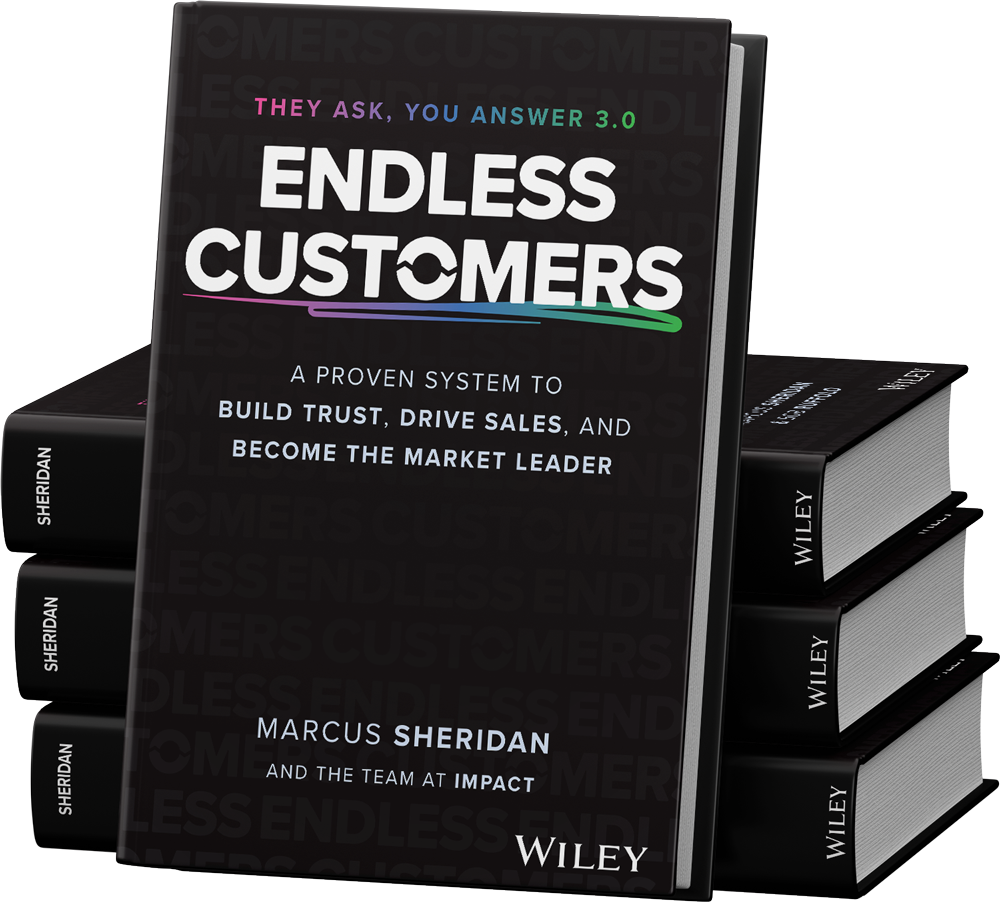
Endless Customers lays out a system for becoming the most known and trusted business in your market. It connects candid buyer education, video, self-service tools, and company-wide participation to the way people research and buy.
Why it belongs here: This is the foundation of our work at IMPACT. Buyers need clear reasons to trust you before they speak with sales. As AI becomes another place people ask for recommendations, the quality and specificity of your public expertise matter even more.
Put it to work: Choose one question your sales team hears every week and publish the complete answer.
2. They Ask, You Answer
By Marcus Sheridan · Book details
Marcus's earlier book starts with a straightforward commitment: answer the questions buyers actually ask, including the uncomfortable ones about price, problems, competitors, and alternatives. It explains how teaching can become a company's approach to marketing and sales.
Why it belongs here: The principle still holds. Your team hears valuable questions every day. Answering them openly helps people make informed decisions and gives sales useful material to share. Endless Customers expands that foundation for the way buyers behave now.
Put it to work: List the questions your website currently avoids. Start with the one most likely to delay a purchase.
3. The Visual Sale
By Marcus Sheridan and Tyler Lessard · Book details
The Visual Sale explains how businesses can use video throughout marketing and sales, from answering common questions to communicating directly with an individual buyer. It treats video as a practical communication skill that a company can develop.
Why it belongs here: People want to see the product, the process, and the people behind a promise. A useful video can show evidence that a paragraph struggles to convey. We also want salespeople to become comfortable teaching on camera, with support from their marketing team.
Put it to work: Record a short explanation of the most misunderstood part of your proposal.
4. Fanocracy
By David Meerman Scott and Reiko Scott · Book details
Fanocracy explores how shared passions and human connection turn customers into fans. The authors draw lessons from fandom and apply them to organizations that want relationships people choose to maintain and talk about.
Why it belongs here: A trusted brand grows through the experiences people have with it. This book encourages leaders to think about belonging, generosity, and the people behind the business. Those are useful questions when AI makes competent but impersonal communication easier to produce.
Put it to work: Find one opportunity to bring customers together around an interest or challenge they share.
5. The Fandom Playbook
By David Meerman Scott · Book details
Forthcoming: scheduled for October 27, 2026. This preview is based on the author's published overview.
Scott's follow-up to Fanocracy focuses on putting a more human approach to business into practice. His overview emphasizes shared interests, generosity, customer advocacy, and creating opportunities for people to connect.
Why it belongs here: We are including this forthcoming title because its subject fits a question many businesses face: how do you build meaningful relationships when customers encounter so much automated content? Its place here is a reading recommendation, rather than a claim that we have assessed the finished book.
Put it to work: Identify a customer relationship you could strengthen through a useful personal interaction this month.
6. Building a StoryBrand 2.0
By Donald Miller · Book details
Miller's updated StoryBrand book helps businesses clarify their message through a story structure that centers the customer and the problem they want to solve. The business plays the role of a capable guide with a clear plan.
Why it belongs here: A buyer should quickly understand what you do, who you help, and what happens next. That clarity supports website conversion, sales conversations, and consistent descriptions of your business wherever people discover it. The words still need real proof behind them.
Put it to work: Rewrite your homepage introduction around the customer's problem and the outcome you help them reach.
7. Everybody Writes, second edition
By Ann Handley · Book details
Handley's revised writing guide covers the habits, editing decisions, and attention to the reader that make business writing useful. It gives marketers a practical way to improve their work without pretending every first draft will be good.
Why it belongs here: AI can produce a draft quickly. Your team still has to decide whether the draft says something accurate, specific, and worth reading. Handley's focus on craft supports the human judgment that keeps your content from sounding like every other company's.
Put it to work: Edit one article for the reader's needs before you edit it for keywords.
8. Content Rules
By Ann Handley and C.C. Chapman · Book details
Content Rules helps businesses approach publishing across formats such as articles, video, podcasts, and webinars. Its central concern is creating material people find useful and engaging, supported by a recognizable voice and a sustainable approach to production.
Why it belongs here: Your subject matter expertise can serve buyers in several formats. We want teams to capture that expertise once, then adapt it thoughtfully to the places their audience learns. A transcript, an article, and a video should each work for their intended reader or viewer.
Put it to work: Choose one customer question and plan an article, a demonstration, and a sales follow-up around it.
9. Youtility
By Jay Baer · Book details
Youtility makes the case for marketing that is valuable enough that people would seek it out. Baer describes how helping customers solve real problems can earn attention and strengthen relationships over time.
Why it belongs here: Pricing explainers, comparison guides, calculators, and honest buying advice all fit this philosophy. They give someone a reason to engage before they are ready for a sales conversation. They also make your expertise visible through something a buyer can actually use.
Put it to work: Create one resource that helps a buyer make progress without requiring a meeting.
10. Talk Triggers
By Jay Baer and Daniel Lemin · Book details
Talk Triggers explores how deliberate differences in the way a business operates can give customers something worth discussing. It provides a process for identifying, testing, and delivering experiences that encourage word of mouth.
Why it belongs here: A memorable claim needs a memorable experience behind it. This book pushes leaders to make choices customers can feel and describe. That is a useful foundation for testimonials, referrals, and a reputation that extends beyond the company's own marketing.
Put it to work: Ask customers what they have told someone else about working with you.
11. UnMarketing, second edition
By Scott Stratten and Alison Stratten · Book details
UnMarketing challenges habits that treat people as targets for interruption. The Strattens focus on relationships, engagement, and the effect that everyday customer experiences have on what people think and say about a business.
Why it belongs here: We see a useful warning for teams adopting AI: sending more messages is easy, but attention and trust still have to be earned. A message should have a reason to exist from the recipient's perspective. The experience after someone responds matters just as much.
Put it to work: Review an automated email sequence and remove any message that offers the recipient no useful next step.
12. This Is Marketing
By Seth Godin · Book details
Godin asks marketers to understand the people they serve and the change those people want to make. His emphasis on a specific audience encourages businesses to make deliberate choices about who their work is for.
Why it belongs here: Trying to appeal to everyone often produces vague content and weak positioning. We want a buyer to recognize their own situation in your examples, comparisons, and advice. That starts with a clear understanding of the customers you are equipped to help.
Put it to work: Describe your best-fit customer using their problem, priorities, and buying situation.
13. Obviously Awesome
By April Dunford · Book details
Dunford explains how positioning helps a customer understand a product's value in the context of alternatives. Her process examines competitive choices, distinct capabilities, the value those capabilities create, and the customers who care most.
Why it belongs here: Specific positioning makes honest comparison content possible. It helps you explain where you are a strong fit and where another option may make more sense. We would apply that clarity to website messaging, sales education, and consistent descriptions of your company online.
Put it to work: Name the alternatives buyers consider, including doing nothing, and explain the tradeoffs honestly.
14. Made to Stick
By Chip Heath and Dan Heath · Book details
The Heath brothers investigate why some ideas are understood and remembered while others disappear. They show how concrete detail, credible evidence, emotion, and stories can help people grasp a message and carry it with them.
Why it belongs here: Subject matter experts often know so much that they forget what a beginner needs explained. This book is useful when turning that expertise into a pricing video, an article, or a sales presentation. Memorable teaching starts with something the audience can understand.
Put it to work: Replace one abstract claim with a concrete example a customer would recognize.
15. Long Story Short
By Margot Leitman · Book details
Leitman's storytelling guide helps people find stories in their own experiences and shape them for an audience. It pays attention to structure, emotional stakes, detail, and delivery, with practical exercises for developing the skill.
Why it belongs here: The best customer stories often begin with a specific moment: something failed, someone hesitated, or a decision changed the outcome. We want teams to notice those moments and preserve the customer's voice. That produces more believable stories than a list of flattering adjectives.
Put it to work: Interview a customer about the moment they realized they needed to change something.
16. Steal Like an Artist
By Austin Kleon · Book details
Kleon explores how creative work develops through influences, curiosity, practice, and the connections people make between ideas. His advice encourages readers to study broadly and build something of their own from what they learn.
Why it belongs here: A useful content team pays attention to good teaching inside and outside its industry. The goal is to develop a stronger point of view through experience and research. Copying a competitor's article or accepting an AI rewrite does little to establish your expertise.
Put it to work: Study a useful explanation from another field and apply its teaching approach to an original customer example.
17. All Marketers Are Liars (Tell Stories)
By Seth Godin · Book details
Godin examines how people interpret stories through the beliefs and expectations they already hold. Despite the provocative title, the useful lesson is that a story needs to be authentic and supported by the experience customers have.
Why it belongs here: We would use this book to examine the gap between your marketing story and your actual delivery. Buyers bring assumptions to a decision, and good content addresses them openly. A persuasive story becomes a liability when the business cannot substantiate it.
Put it to work: Choose one brand promise and identify the evidence a skeptical buyer could use to verify it.
18. Brainfluence
By Roger Dooley · Book details
Dooley brings together short applications of behavioral and neuromarketing research to communication, purchasing, and customer experience. The format makes it a collection of ideas to investigate, rather than a single operating system for a business.
Why it belongs here: The useful application is understanding where buyers experience confusion or unnecessary effort. We recommend testing ideas with actual customers and examining the underlying evidence. A behavioral finding is context dependent, and it should never become an excuse for deceptive design or pressure.
Put it to work: Watch a customer use a key page and fix one point of confusion before adding another persuasion tactic.
19. The Tipping Point
By Malcolm Gladwell · Book details
Gladwell explores how ideas and behaviors can spread through networks, memorable messages, and the conditions surrounding them. His stories encourage readers to look beyond the idea itself and consider the people and environment involved.
Why it belongs here: A useful article needs a distribution plan. Who will share it? Which customer conversation does it belong in? What makes it timely? We use those questions without treating the book as a formula that can promise virality or predict a campaign's results.
Put it to work: Identify three people or communities for whom your next piece of content would be useful.
20. The New Rules of Marketing & PR
By David Meerman Scott · Book details
Scott's long-running guide explains how organizations can communicate directly with audiences through useful digital content and timely participation. It connects publishing, public relations, and an understanding of the people a business wants to reach.
Why it belongs here: Businesses can build a public body of expertise that buyers discover before making contact. The distribution channels evolve, but the responsibility to say something useful remains. We would read the current edition alongside a practical plan for maintaining accurate, credible information about the company.
Put it to work: Find one recurring customer question that currently sends people to someone else's website for an answer.
21. Content Inc.
By Joe Pulizzi · Book details
Content Inc. describes building a loyal audience around a distinct content focus before developing ways to earn revenue from that audience. Pulizzi treats publishing as a business discipline that requires consistency, differentiation, and patience.
Why it belongs here: Most IMPACT clients already have a business, so they will adapt the model. The useful lesson is to build a relationship with an audience you understand and can reach again. That matters when search traffic fluctuates and a social platform changes what it distributes.
Put it to work: Define the recurring question or subject your business could become known for answering exceptionally well.
22. Loop: Outlearn. Outmarket. Outgrow.
By Kipp Bodnar and Kieran Flanagan · Book details
Loop presents a marketing system organized around expressing a clear identity, tailoring experiences, amplifying distribution, and learning from results. It addresses how teams can use AI while keeping human taste and customer understanding central to their work.
Why it belongs here: We want teams to learn from buyer behavior and improve their work continuously. The connection to Endless Customers is the need for a clear point of view, credible expertise, and feedback from sales. AI works better when those inputs are grounded in the business.
Put it to work: Review one campaign with sales and decide what buyer feedback should change in the next version.
23. The AI Transformation Blueprint
By Paul Roetzer · Book details
Roetzer's new book introduces connected approaches to organizational and individual AI adoption. Its published framework covers the business decisions, capabilities, governance, and personal development needed to move beyond disconnected experiments.
Why it belongs here: Buying tools gives a team access to technology. Leaders still need to define the work that should improve, support people as their roles change, and decide how results will be evaluated. This is the kind of operating conversation we want an AI initiative to produce.
Put it to work: Pick one workflow and document the desired improvement, accountable owner, and human review points.
24. Co-Intelligence
By Ethan Mollick · Book details
Mollick explores what it means to work and learn alongside generative AI. He encourages direct experimentation while taking seriously the technology's uneven abilities, errors, and effects on how people do their jobs.
Why it belongs here: A marketing or sales team needs practical experience to learn where AI helps and where it creates extra work. We would pair experimentation with clear standards for evidence, privacy, and review. The business remains responsible for the content and advice it puts into the world.
Put it to work: Try AI on one repeatable task, then compare the time saved and the corrections required.
25. Marketing Artificial Intelligence
By Paul Roetzer and Mike Kaput · Book details
Roetzer and Kaput explain AI concepts through marketing applications and business use cases. Published before the current wave of generative tools, it helps readers understand the wider field of prediction, automation, and machine-assisted decision-making.
Why it belongs here: AI literacy should extend beyond knowing how to write a prompt. A team benefits from understanding what a system is trying to predict or produce, what data it relies on, and how to judge its output. Read its principles alongside current product documentation.
Put it to work: Inventory your existing marketing software and identify which AI features solve a real problem.
26. The Sales Acceleration Formula
By Mark Roberge · Book details
Roberge describes the systematic approach he used while building HubSpot's sales organization. The book connects hiring, training, coaching, demand generation, and technology to a repeatable process for improving sales performance.
Why it belongs here: Sales and marketing need shared definitions and feedback. More leads have limited value when the team cannot consistently qualify, educate, and help them move forward. We would adapt Roberge's approach to the company's market and sales model, then use CRM evidence and coaching to improve the system.
Put it to work: Choose one stage of your sales process, define the buyer's required progress, and agree on a measurable exit condition.
27. The Trusted Advisor
By David H. Maister, Charles H. Green, and Robert M. Galford · Book details
The Trusted Advisor examines the behaviors that allow professionals to become people their clients rely on. It connects credibility, reliability, personal trust, and an orientation toward the client's interests to the quality of the relationship.
Why it belongs here: A buyer notices whether a salesperson is listening or waiting to deliver a pitch. Honest advice may include recommending a smaller purchase, a different approach, or more time to decide. Those choices demonstrate the judgment and integrity that marketing promises alone cannot establish.
Put it to work: Review a recent sales conversation for moments when the buyer needed advice rather than another feature explanation.
28. Gap Selling
By Keenan · Book details
Gap Selling focuses on understanding a customer's current situation, desired future, and the problems separating the two. It encourages sellers to investigate the business consequences of a problem before recommending a solution.
Why it belongs here: Discovery should help both parties decide whether there is a meaningful problem the business can solve. That understanding also improves content: a useful article can explain symptoms, causes, tradeoffs, and consequences in the language buyers use.
Put it to work: Rewrite your discovery questions to explore the buyer's situation before discussing your offering.
29. Let's Get Real or Let's Not Play
By Mahan Khalsa and Randy Illig · Book details
Khalsa and Illig present a collaborative approach to selling built around understanding what clients need to accomplish. Their emphasis on honest communication encourages sellers to examine assumptions, ask useful questions, and work toward a decision that serves the client.
Why it belongs here: We want buyers and sellers to be able to discuss budget, fit, concerns, and decision criteria directly. That openness helps prevent a proposal from becoming a guess. It also supports a sales culture in which disqualifying a poor fit is a responsible outcome.
Put it to work: Before preparing a proposal, confirm the problem, desired result, and decision process in the buyer's own words.
30. The JOLT Effect
By Matthew Dixon and Ted McKenna · Book details
Dixon and McKenna investigate customer indecision, particularly the fear of making a poor choice after a buyer has recognized a need. The book examines how sellers can help people move from interest toward a confident decision.
Why it belongs here: Buyers can become overwhelmed by options, incomplete information, and uncertainty about implementation. Clear comparisons, realistic expectations, and a well-supported recommendation can help. We would use these ideas to make a decision easier to understand while preserving the buyer's control.
Put it to work: Ask a stalled buyer what they are most concerned might go wrong, then address that concern specifically.
31. Uncommon Service
By Frances Frei and Anne Morriss · Book details
Frei and Morriss examine how companies design service that is consistently excellent in the areas customers value. They emphasize deliberate tradeoffs, an economic model that supports the promise, and systems that allow ordinary employees to succeed.
Why it belongs here: A business should be clear about what it chooses to do exceptionally well. Marketing can explain that choice, but operations have to deliver it. This book belongs in a marketing list because the customer experience determines whether your claims become a trusted reputation.
Put it to work: Identify the service attribute your customers value most and one lower-priority area where you can simplify.
32. Unreasonable Hospitality
By Will Guidara · Book details
Guidara draws on his experience in restaurants to explore the effect of thoughtful, personal hospitality. He shows how attention to people and their particular circumstances can turn a routine interaction into something memorable.
Why it belongs here: The useful question for a business is where a customer might feel overlooked, uncertain, or pleasantly surprised. A team that notices those moments can strengthen relationships in ways an automated sequence may miss. We would apply the ideas with a service model the company can sustain.
Put it to work: Choose one point in onboarding where a personal gesture would make a customer feel more confident.
33. Radical Candor
By Kim Scott · Book details
Scott connects caring about people with a willingness to give clear, direct feedback. The book explores the conversations and management habits that help teams improve without confusing kindness with avoidance or honesty with aggression.
Why it belongs here: Content, sales coaching, and leadership development all require useful feedback. A manager needs to be able to explain why an article misses a buyer's question or why a sales conversation went poorly. That feedback lands better when the person knows the manager is invested in their growth. We would use this book to strengthen regular coaching, with room for employees to challenge their manager as well.
Put it to work: Give one piece of specific feedback about an observable behavior, explain its effect, and invite the other person's perspective.
34. Good to Great
By Jim Collins · Book details
Collins studies companies that made sustained improvements in performance and examines themes such as leadership, people, discipline, and a clear understanding of the business. The book asks leaders to confront facts and make consistent operating choices.
Why it belongs here: A marketing strategy has to fit a capable business. The questions about focus, leadership, and execution are useful for a company adopting Endless Customers. We would treat the research as a source of questions and principles, rather than a guarantee that copying a featured company will produce the same result.
Put it to work: Name one uncomfortable operating fact your leadership team needs to address before increasing demand.
35. Start With Why
By Simon Sinek · Book details
Sinek argues that leaders and organizations communicate more meaningfully when they understand the purpose behind their work. He explores the connection between that purpose, the choices a business makes, and the people it attracts.
Why it belongs here: Purpose can help a team make decisions and explain what it stands for. Buyers also need specifics: what you do, who you help, what it costs, and how you deliver. We would use this book to connect a clear purpose to visible actions and useful customer communication.
Put it to work: Find one operating decision that demonstrates your stated purpose without needing a slogan.
36. The Advantage
By Patrick Lencioni · Book details
Lencioni makes the case for organizational health through a cohesive leadership team, clear decisions, consistent communication, and systems that reinforce what the company believes. The work begins with leaders agreeing on the things that matter.
Why it belongs here: A content manager cannot resolve a leadership team's disagreement about customers, positioning, or priorities alone. A business that wants to become known and trusted needs internal clarity. This book is a useful companion to the company-wide commitment required by Endless Customers.
Put it to work: Have leadership independently answer who the company serves and what its immediate priority is, then compare the answers.
37. The Five Dysfunctions of a Team
By Patrick Lencioni · Book details
Through a leadership fable, Lencioni examines the patterns that undermine teamwork, including weak trust, avoided conflict, unclear commitment, and poor accountability. The book links the quality of team interactions to shared results.
Why it belongs here: Sales and marketing alignment depends on people being able to discuss what is working and what is failing. Shared meetings help when the team can disagree constructively, make decisions, and follow through. Those behaviors are especially valuable when implementing a new way of working.
Put it to work: Bring one unresolved sales-and-marketing disagreement into a meeting and finish with a clear decision and owner.
38. Multipliers
By Liz Wiseman · Book details
Wiseman contrasts leadership behaviors that develop people's intelligence and contribution with behaviors that suppress them. She pays particular attention to well-intentioned managers whose habits unintentionally limit the people around them.
Why it belongs here: Our coaching work aims to build capability inside a company. Leaders help that happen when they ask better questions, create room for judgment, and let their people own results. The same principle matters when AI enters a workflow: employees still need opportunities to develop expertise.
Put it to work: At your next review, ask the team to recommend a solution before offering your own.
39. Traction
By Gino Wickman · Book details
Traction introduces the Entrepreneurial Operating System, or EOS, and its approach to vision, people, data, issues, process, and execution. It gives leadership teams a common set of tools for running the business with greater clarity and accountability.
Why it belongs here: A company needs the ability to execute the growth strategy it chooses. Clear ownership, useful scorecards, and a regular meeting rhythm can support the work required by Endless Customers. EOS helps organize the business; your buyer education and sales strategy supply specific work to execute.
Put it to work: Assign a clear owner and a measurable quarterly outcome to your most important growth initiative.
40. Get a Grip
By Gino Wickman and Mike Paton · Book details
Get a Grip presents EOS through a business fable, showing a leadership team working through familiar problems and applying the system. It helps readers see how the tools connect in the messy reality of running a company.
Why it belongs here: A framework is easier to understand when people can picture the conversations and decisions it creates. This book can help a leadership team discuss implementation together. We would pair the reading with actual issues in the company rather than treating the story as an exact prescription.
Put it to work: Choose one situation in the book that resembles your business and discuss what your team would do next.
41. Rocket Fuel
By Gino Wickman and Mark C. Winters · Book details
Rocket Fuel explores the complementary roles of the Visionary and Integrator in an entrepreneurial business. It examines how a productive relationship between those roles helps turn ideas and direction into consistent execution.
Why it belongs here: A leader can see the opportunity in AI, content, or a new sales approach while the team struggles to implement it. Someone needs to translate the vision into priorities, ownership, and operating decisions. This book helps leaders examine that relationship and its responsibilities.
Put it to work: Clarify who owns the direction of your growth strategy and who coordinates its execution.
42. How to Be a Great Boss
By Gino Wickman and René Boer · Book details
Wickman and Boer offer practical leadership and management habits for setting expectations, supporting employees, and building accountability. The book brings attention to the daily behavior of the person responsible for a team's performance.
Why it belongs here: Hiring a content manager, videographer, or salesperson is the beginning of an investment. Managers need to create the conditions for that person to succeed and improve. A clear role, useful feedback, and regular conversations matter as much as the initial hiring decision.
Put it to work: Ask a direct report where expectations or decision-making authority are currently unclear.
43. What the Heck Is EOS?
By Gino Wickman and Tom Bouwer · Book details
This employee-focused guide explains EOS in accessible language for the people working inside a company that uses it. It helps readers understand the tools, vocabulary, and expectations they encounter in meetings and day-to-day work.
Why it belongs here: A leadership initiative works better when the rest of the organization understands what is happening and why. The same applies to Endless Customers. People should know how their expertise contributes, what is expected of them, and where to raise a concern.
Put it to work: Explain one company initiative in plain language to someone outside the leadership team and invite their questions.
44. The EOS Life
By Gino Wickman · Book details
The EOS Life asks entrepreneurs to consider the life they want their business to support. It connects the discipline of running a company with questions about meaningful work, relationships, contribution, compensation, and time for other interests.
Why it belongs here: Growth should serve a purpose the owner can articulate. A business that depends on the owner for every marketing decision and sales conversation may be growing while becoming harder to live with. Building capable people and reliable systems can create more choices.
Put it to work: Define one responsibility the business should handle well without your direct involvement.
45. Simple Numbers, Straight Talk, Big Profits!
By Greg Crabtree with Beverly Blair Harzog · Book details
Crabtree explains business finance in language owners can use, connecting profitability, owner compensation, labor productivity, and cash. The book helps readers understand the operating decisions behind their financial reports.
Why it belongs here: This is an accounting book, and it belongs on the list. A marketing plan has to support a healthy business. Leaders need to understand whether new revenue produces enough profit, whether the team can deliver the work, and what the company can responsibly invest in growth.
Put it to work: Review a proposed growth investment with the person who owns your financial model and agree on the outcomes it must support.
46. The Great Game of Business
By Jack Stack and Bo Burlingham · Book details
Stack and Burlingham explain open-book management through the story of a business turnaround. The approach teaches employees how the company makes money and connects their decisions and participation to shared business results.
Why it belongs here: Teams make better choices when they understand how their work affects the business. A marketing team should understand qualified opportunities and revenue. A sales team should understand delivery capacity and profitability. Financial education can make those conversations more productive.
Put it to work: Teach your team one financial measure they can influence and explain the decisions that move it.
47. The E-Myth Revisited
By Michael E. Gerber · Book details
Gerber examines the challenge of turning technical expertise into a business that works consistently. He encourages owners to design the systems, roles, and customer experience that allow a company to function beyond their individual effort.
Why it belongs here: A founder may be the best teacher in the company, but every useful answer cannot depend on the founder finding time to publish it. Capture expertise, develop other voices, and build a repeatable process. That creates capacity while making quality easier to maintain.
Put it to work: Document one recurring process that currently lives entirely in the owner's head.
48. Essentialism
By Greg McKeown · Book details
McKeown explores how to identify what matters, eliminate competing commitments, and make room to execute well. The book encourages deliberate choices about attention and effort rather than allowing every request to become a priority.
Why it belongs here: Marketing teams are asked to maintain an expanding list of channels and tools. A useful strategy requires choosing the work most likely to help buyers and the business. That may mean giving a pricing guide, a sales video, or a neglected website page the time it deserves.
Put it to work: Stop one recurring activity that consumes time without serving a clear buyer or business need.
49. Atomic Habits
By James Clear · Book details
Clear explains how small behaviors become easier to repeat through changes to cues, environment, and routines. He focuses on designing systems that support the person you want to become and the results you want to produce.
Why it belongs here: A company becomes a better teacher through consistent practice. Regular subject matter interviews, sales feedback, and publishing reviews are easier to sustain when they have a clear place in the workweek. We would apply the book to team habits as carefully as individual ones.
Put it to work: Attach a brief customer-question review to a meeting your team already holds every week.
50. Outliers
By Malcolm Gladwell · Book details
Gladwell explores the role of opportunity, environment, timing, and practice in stories of exceptional achievement. The book invites readers to look beyond individual talent when explaining how people develop and succeed.
Why it belongs here: When a new hire struggles, leaders should examine the environment they created: training, access to experts, feedback, and time to practice. We would use the book to ask better questions about development. Its examples should not become a universal rule about a fixed number of practice hours.
Put it to work: Identify one resource or opportunity that would help a promising team member improve faster.
Turn one book into a useful conversation
You do not need to read all 50 before making progress. Choose the book that speaks to a problem your business is dealing with now. Ask a small group to read it with that problem in mind.
Then discuss what you agree with, what needs adapting, and one change worth testing. Give that change an owner and a date to review what happened. The book supplies ideas; your team has to decide how they apply.
If your priority is becoming a business buyers know, trust, and choose, start with our introduction to Endless Customers and its companion reading. Bring your sales and marketing leaders into the discussion so the learning becomes part of the way your company works.
Order Your Copy of Marcus Sheridan's New Book — Endless Customers!