
/Assets/arrow-facing-left--black-01.svg)
/Assets/navigation-global--close-symbol-black-01-1.svg)
/Assets/base/Close.svg)

/Assets/Icon%20Library/social/facebook-logo.svg)

/Assets/Icon%20Library/social/instagram-logo.svg)
/Assets/Icon%20Library/social/youtube-logo.svg)





![How AI Makes Recommendations [2026 AI Visibility Report]](https://www.impactplus.com/hs-fs/hubfs/IMPACTs%20AI%20Visibility%20Report%20%281%29-1.png?width=768&height=400&name=IMPACTs%20AI%20Visibility%20Report%20%281%29-1.png)
One of the biggest questions businesses are facing right now is: how do we make sure we show up in AI search results? How do we outperform our competitors?
It's a fundamentally different game than what we've grown to expect from traditional search. There's no ranking, no keywords, and no hacking the system.
AI does in an instant the research that would take a customer days. And if you're not the right fit for what someone is searching for, you're eliminated before you're ever part of the conversation.
At IMPACT, we coach businesses on how to become the most known and trusted brand in their market as part of the Endless Customers System™. That has expanded to include how to become the most recommended brand in your market.
So we set out to answer that looming question ourselves: how does AI actually make recommendations? We ran an original research study to get clear insight into the process AI uses to filter, screen, and recommend. The result is IMPACT's 2026 AI Visibility Report.
This article walks through the numbers behind that research: how AI evaluates different industries, which trust signals actually matter, and the red flags that might already be quietly disqualifying your company.
How was this research conducted?
IMPACT asked ChatGPT, Google AI Mode, Gemini, and Perplexity the exact same question, 92 times, across 23 industries, then coded every answer against a shared nine-category taxonomy. The question was simple: find the best [industry] in [city], and explain exactly how you'd screen, filter, and select a company.
That gave us a dataset big enough to separate real patterns from platform quirks. Coding the same taxonomy across all four platforms meant we could compare apples to apples: does ChatGPT actually weigh price differently than Gemini, or does it just sound like it does?
Grouping the 23 industries into five clusters (Home Services, Healthcare, Professional/Regulated, Tech/B2B, and Retail & Manufacturing) let us see which findings hold everywhere and which ones are specific to a type of business.
The result is 283 disqualifying mentions, 128 named trust signals, and enough data to answer a question most businesses have only ever guessed at.
What do all four AI platforms want to see from your business?
Across all 23 industries and every platform tested, the same three priorities showed up again and again:
1. Say exactly who you're the best fit for: Specialization and needs-fit matching was the single most consistent factor in the entire study, appearing in 90% of all 92 responses.
2. Push for reviews to say something specific: Reviews came in second at 77%, but not because of star rating. What mattered was whether reviews were recent and specific enough to sound real.
3. Get your licensing and credentials visibly right: Licensing and credentials rounded out the top three at 65%, treated as a near-hard gate in regulated industries and a strong signal everywhere else.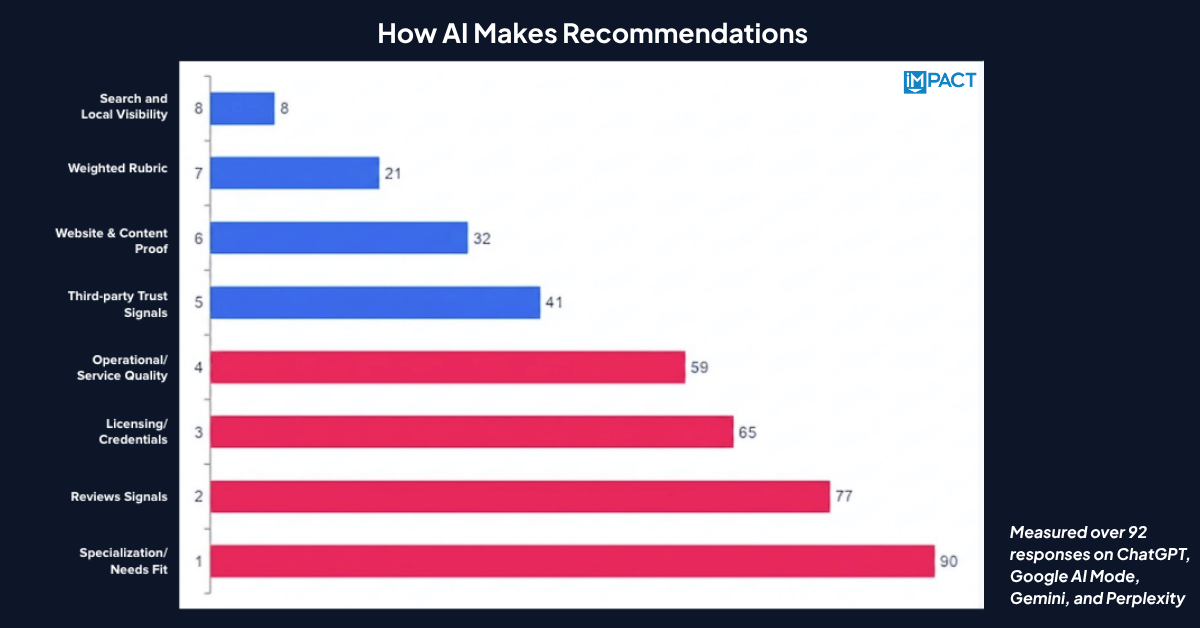
Does trust mean the same in every industry?
No. Once you group the 23 industries into five clusters, home services, healthcare, professional/regulated, tech/B2B, and retail & manufacturing, the trust signals and red flags that matter shift dramatically.
AI isn't running one universal checklist. It's running a different one depending on what you sell.
Home services carries the highest red-flag density in the study, 2.59 disqualifying mentions per response, with 42% of those counting as hard disqualifiers. This is the toughest cluster to get recommended in.
Tech and B2B, by contrast, have the highest trust-signal density overall at 115 named citations, but almost none of it is BBB. It's G2, Capterra, Clutch, and SOC 2.
Healthcare and professional/regulated both treat licensing as a binary gate rather than a scored factor: state boards, malpractice history, and bar status decide the outcome before reviews ever get a vote.
Retail and manufacturing sit at the other extreme, the least scrutinized cluster in the entire dataset, with the lowest red-flag density at 1.38 per response.
How AI recommends businesses based on industry
| Cluster | Defining Trust Signals | Named Red Flags |
| Home Services | BBB, Angi, Yelp | Unverifiable address or inconsistent NAP, out-of-state "storm chaser" crews, underbidding tactics, missing license numbers |
| Tech/B2B | G2, Clutch, SOC 2 | Fake local presence, "ghost" lead-gen sites with no real team behind them, missing SOC 2 or security documentation |
| Professional/ Regulated | State Bar, BBB, Chamber of Commerce | Unresolved BBB complaints, bar or licensing board disciplinary history, active lawsuits |
| Healthcare | Board certification, Healthgrades, Zocdoc | Malpractice history, lapsed or unverifiable board certification |
| Retail & Manufacturing | Chamber of Commerce, Google Maps | Listed hours that don't match actual store hours, no local directory presence at all |
What gets a business eliminated from AI recommendations?
Across all 92 responses, unverifiable legitimacy is the single biggest reason a business gets cut before AI ever ranks anyone, accounting for 24% of all disqualifying mentions.
Vague or shady pricing is a close second at 22%, followed by thin or fake reviews at 18%, poor communication at 15%, and licensing gaps and complaint history tied at 11% each.
That's 283 separate disqualifying mentions across the study, more red flags than any single quality factor could explain on its own. AI isn't just comparing who's best. It's quickly eliminating businesses it can't trust.
Free Assessment
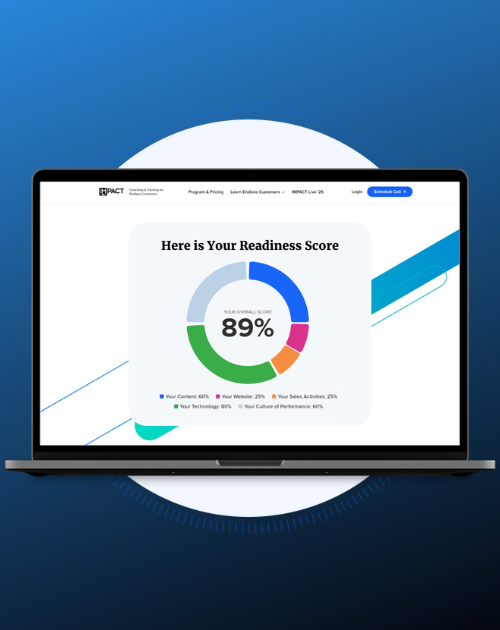
Free Marketing Assessment: Where do you stand?
AI is changing how buyers find businesses, and most companies are dangerously underprepared. Take this free assessment and find out if yours is at risk of becoming invisible to your buyers.
What does AI think about pricing?
Not what most businesses assume. The "AI weighs price at 5%" line that gets repeated on LinkedIn describes ChatGPT specifically, not AI as a whole.
Nineteen of ChatGPT's 23 industries carry an explicit numeric weighting table for price. Google AI Mode does this in exactly one industry, SaaS. Gemini and Perplexity never assign price a number at all, in any industry, ever.
But here's where it gets genuinely counterintuitive. Even on ChatGPT, the platform most willing to put a number on price, that number is small, landing around 5 to 20% of the total weight depending on industry, well below specialization or reviews. Price, when it's scored at all, barely moves the needle.
And yet, as we saw in the disqualifiers breakdown above, vague or missing pricing is the second-biggest reason a business gets disqualified entirely, cited in 22% of all disqualifying mentions across the study. A low price gets you almost nothing. A vague price can get you cut.
That's not really a pricing problem. It's a trust problem wearing a pricing costume. AI isn't scoring whether your price is competitive. It's checking whether you're transparent enough to trust, and a business that hides its pricing reads the same way a business with no verifiable address does: something worth not risking a recommendation on.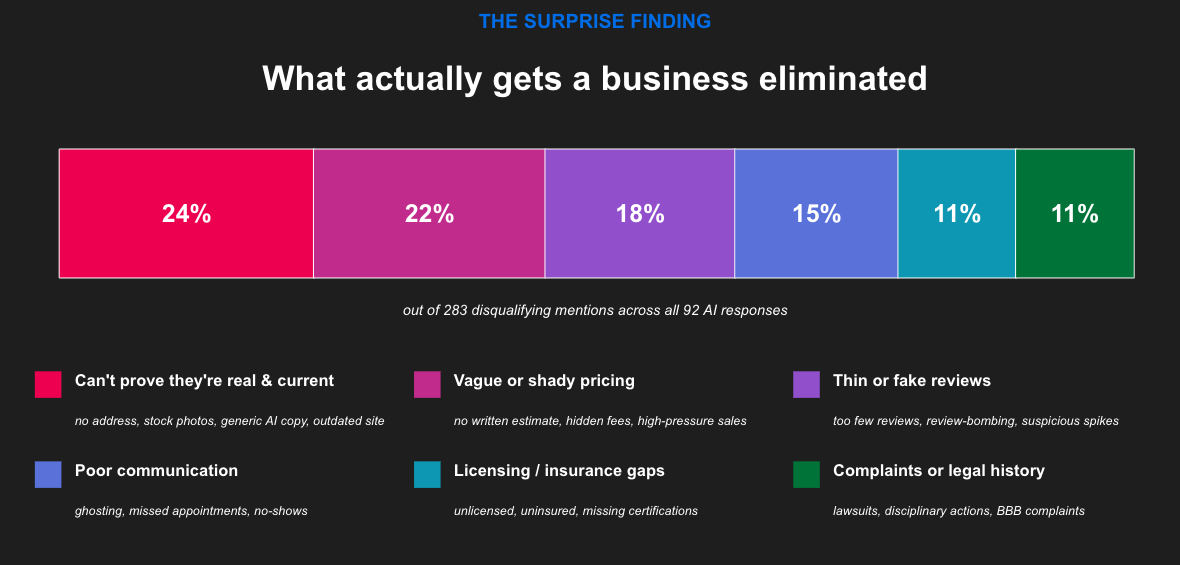
How do different AI platforms make recommendations?
What was interesting was that each of the four platforms studied has a distinct personality, and it shows up in more than just how they weight price.
ChatGPT is the most quantitative by far: 19 of its 23 industries carry an explicit numeric weighting table, and none of the other three platforms come close.
Google AI Mode leans hardest on local SEO fundamentals, Google Business Profile, and Local Services Ads checks, mechanics that are unique to home-service categories and mostly disappear once you move into B2B or professional clients.
Gemini is the most procedural of the four: it never hands over a percentage breakdown, in any industry, and it leans on disclaimers about the limits of its own judgment.
Perplexity is the most consistent: specialization and needs-fit matching hit a perfect 100% across all 23 industries on that platform alone, the only category on any platform to score a flat 100.
For example, that personality shows up clearly in how each platform handles reviews.
A perfect 5.0 rating sounds like it should help. In practice, it can work against you. Google AI Mode will filter out a 5.0 built on a single review outright.
ChatGPT's own reasoning states that 800 reviews at 4.8 stars outweigh 32 reviews at a perfect 5.0.
Gemini goes further and actively flags review bribery, including incentive language and templated review requests that produce suspiciously identical-sounding reviews from different customers.
So, how do you get recommended by AI?
Even though none of the four platforms are running the same test, underneath the different weighting tables, disclaimers, and scoring quirks, they're all trying to answer the same basic question: is this a real, trustworthy business that does good work?
Build a genuine body of evidence, honest pricing, specific reviews, visible credentials, a clear sense of who you serve, and you stop needing to hack the system for different platforms.
What IMPACT recommends
Across every platform, every industry, and every quirk in how AI scores a business, the same throughline holds. Specialization, honest pricing, specific reviews, and visible credentials are what AI is actually checking for, because they're what a smart buyer would check for too. AI didn't invent a new set of rules. It's just running the old ones at a scale no human ever could.
That's exactly what the Endless Customers System™ is built for. Becoming the most known, trusted, and recommended brand in your market was never just a human-trust problem, and now it isn't just an AI-visibility problem either.
The goal is the same: build a real, honest, well-documented body of evidence that your business does good work.
Want the full breakdown, every industry, every platform, every trust signal we found?
Download IMPACT's 2026 AI Visibility Report.
Frequently Asked Questions
Does AI really weigh price at 5%?
Only on ChatGPT, and only sometimes. Nineteen of ChatGPT's 23 industries carry a numeric price weighting, typically 5 to 20%. Google AI Mode does this in exactly one industry, and Gemini and Perplexity never assign price a number at all. The "AI weighs price at 5%" claim describes one platform, not AI as a whole.
What's the single biggest reason a business gets disqualified by AI?
An unverifiable business identity, most often a missing or inconsistent address. It accounted for 24% of all 283 disqualifying mentions found across the study, more than any other single red flag, including price, reviews, or licensing.
Do you need a five-star rating to get recommended by AI?
No, and a perfect score can actually backfire. Google AI Mode will filter out a 5.0 rating built on a single review, and ChatGPT's own reasoning states that 800 reviews at 4.8 stars outweigh 32 at a perfect 5.0. Recency and specificity matter more than the star average.
Do trust signals like the Better Business Bureau still matter to AI?
It depends entirely on your industry. BBB remains the single most cited trust signal overall, but it's concentrated almost entirely in home services and traditional professional firms. In tech and B2B, it's largely replaced by platforms like G2, Capterra, and Clutch.
Is a low price enough to get AI to recommend a business?
No. Price barely factors into AI's scoring even when it's present, landing around 5 to 20% of the weight at most. What actually hurts a business is vague or hidden pricing, which was the second-biggest reason for disqualification in the entire study.
FREE BOOK PREVIEW
Endless Customers Special Preview Edition
Get a taste of the book that brings you a proven system to build trust, drive sales, and become the market leader. This special preview edition has select chapters and The Four Pillars of a Known and Trusted Brand, resources to accelerate your success, and more.
.png)
Written By
Brian uses his background in sales & inbound marketing strategy to coach clients on creating content that impacts sales. As a salesperson, he experienced the first-hand struggles of legacy sales tactics. Through these struggles, he came to learn inbound marketing and became obsessed. His experience in working with clients spans across all types of businesses in unique markets. He enjoys teaching content marketing strategies to help these businesses reach their ideal buyers.
Brian uses his background in sales & inbound marketing strategy to coach clients on creating content that impacts sales. As a salesperson, he experienced the first-hand struggles of legacy sales tactics. Through these struggles, he came to learn inbound marketing and became obsessed. His experience in working with clients spans across all types of businesses in unique markets. He enjoys teaching content marketing strategies to help these businesses reach their ideal buyers.
/Assets/Icon%20Library/social/linkedin-logo.svg)
Share
/Assets/Icon%20Library/social/x%20corp.svg)
/Assets/Icon%20Library/social/mail-to.svg)
/Assets/base/Learning%20Center%20Resource%20Category%20Icons/Website%20link.svg)
NEED HELP WITH AI FOR MARKETING?
If you’re looking to take control of your sales and marketing with a proven system built for the age of AI, IMPACT can help. We can guide you on how to control your growth, stop relying on agencies, and become the most known and trusted brand in your market.
NEED HELP WITH AI FOR MARKETING?
If you’re looking to take control of your sales and marketing with a proven system built for the age of AI, IMPACT can help. We can guide you on how to control your growth, stop relying on agencies, and become the most known and trusted brand in your market.