
/Assets/arrow-facing-left--black-01.svg)
/Assets/navigation-global--close-symbol-black-01-1.svg)
/Assets/Icon%20Library/social/facebook-logo.svg)

/Assets/Icon%20Library/social/instagram-logo.svg)
/Assets/Icon%20Library/social/youtube-logo.svg)






When a potential customer asks ChatGPT who to call, does your business show up?
If website traffic is down everywhere, what role does it even play in AI search?
Believe it or not, these two questions are closely tied together. If you want one: getting cited and recommended by AI, then you have to address the other: your website structure.
When AI cannot find a clear answer on your site, it will move on to the next one, and the sale is lost before your phone ever rings.
One of The 5 Components of Endless Customers (what we teach here at IMPACT) is the Right Website. It's a pivotal piece to becoming the most known, trusted, and recommended brand in your market. With the rise of AI, that means building a site that's readable, citeable, and trustworthy for LLMs, AI agents, and AI platforms.
This article walks through what AI engine optimization actually is, how to structure content so AI systems can read and cite it, and how one company built an AI-visible content library from a blank website in under a year.
What is AEO and how is it different from SEO?
AEO, or answer engine optimization, describes the effort to structure website content so AI systems like ChatGPT, Gemini, and Google's AI Overviews can find, understand, and cite it as the answer to a buyer's question. SEO has always been about getting your pages to rank at the top of the list on the search engine results pages on Google.
There’s been a debate among marketers about whether AEO and SEO require different strategies, or if they are two sides of the same coin.
Let’s take a look at what the big players say.
What Google says
Google has stated that optimizing for its AI search features is really just optimizing for the same search experience, which makes it plain, ordinary SEO, because its AI Overviews run on the same ranking system as its regular results.
The numbers back this up: over half of AI Overview citations come from pages that already rank in the top 10 of normal search results. In other words, the SEO work you're likely already doing is still the biggest lever you have.
Structured data (like schema) has always been a part of good SEO. So if you optimize for one, you're optimizing for the other.
Google has also said businesses can skip a few trendy technical add-ons, like special AI-only files or breaking content into small chunks, because its systems don't need them to find and use your content. But keep in mind, what works for one platform may not be the case for another.
What OpenAI (ChatGPT) says
OpenAI hasn't published anything as broad as Google's guidance. What it has published is a public FAQ for site owners, and it stays narrowly focused on access: any public website can appear in ChatGPT search, and the main thing a site owner needs to do is avoid blocking OpenAI's search crawler, updating their robots.txt file if necessary.
Experts have tracked OpenAI's crawler documentation closely as it's evolved. There have been arguments in favor of structured data, but even more so for structured content.
Why structure matters more than markup
It all comes down to how language models actually process a page.
Unlike a traditional crawler scanning for metadata and markup, an LLM breaks content into tokens and looks for semantic clarity: a clean heading hierarchy, short paragraphs that each carry one idea, lists and tables it can lift cleanly, and a direct answer stated early rather than buried under paragraphs of preamble.
Schema can reinforce content that's already organized this way, but it can't rescue content that isn't. A well-structured page with no schema markup at all routinely gets cited over a marked-up page that's disorganized underneath.
Wording matters too: models retrieve based on the literal terms in a query, so using the specific language your buyers actually type or ask matters as much as the structure itself.
What this means for your website
Different platforms might have different preferences or requirements for surfacing your content, but one thing remains the same: well-organized content wins every time.
The content underneath it still needs a clear heading hierarchy, short self-contained paragraphs, and a direct answer stated up front. That's the part every platform rewards, and it's also the discipline traditional SEO and good writing have always asked for.
FREE BOOK PREVIEW
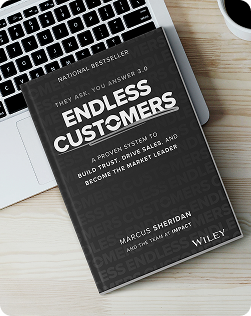
Endless Customers Special Preview Edition
Get a taste of the book that brings you a proven system to build trust, drive sales, and become the market leader. This special preview edition has select chapters and The Four Pillars of a Known and Trusted Brand, resources to accelerate your success, and more.
What makes website content "machine-readable"?
Machine-readable content is organized so search engines and AI tools can easily understand what a page is about and how its information fits together. Clear headings, descriptive labels, simple page structure, and behind-the-scenes code such as schema markup all help. Think of it as adding signposts that guide machines through your content.
Here are a few habits that will make a difference:
-
Prioritize clarity and specificity. Write in plain, unambiguous language, and choose concrete details over vague claims. AI systems fill in gaps with guesses when content is unclear, and a vague or ambiguous page gives an AI system more room to get it wrong or skip it altogether in favor of a competitor who spelled it out.
-
Lead with direct answers. Articles should open with a short, ~40-word answer to the question in the title before expanding into detail. H2s and H3s can be used similarly by keeping answers in the headings in the first paragraph that follows.
-
Write FAQs as real questions. Use the actual long-tail phrasing a buyer would type or ask out loud. Make sure answers are thorough and stand alone. If AI pulled the question and answer out of context, would it still make sense?
-
Add schema markup. This is a behind-the-scenes label that tells search engines and AI systems what kind of content is on a page. Google has also confirmed that its Gemini-powered AI Overviews do draw on structured data to understand content more effectively because it gives models clearer signals about intent and structure.
-
Consider an llms.txt file. This is a plain-text file that tells AI systems how a site is organized and where to find key information.
Even if different platforms prioritize and use different strategies, being intentional about your website content and structure will ultimately benefit your overall organic search efforts.
What trust signals does AI look for on your website before it recommends you?
AI looks for the same trust signals a skeptical human buyer looks for: licensing, credentials, warranties, reviews, and specific proof rather than vague claims. The difference is that AI can only use what is actually published on your site. If you only mention a guarantee on sales calls, it does nothing for you online if it never made it onto a page.
Consider Honest Fix, an HVAC company founded eight months before we published this article. With a two-person content team and zero paid advertising, the company published 1,769 pages built around the Endless Customers System™: direct-answer articles, FAQs, and detailed trust content including its 15-year labor warranty, licensing information, and technician credentials.
In its service area, Honest Fix now appears as the first, second, and third-cited source when someone asks an AI tool a related question, largely because competing companies have not published anything for AI to cite.
That visibility converted directly into revenue. One prospective customer told the Honest Fix team that ChatGPT had recommended the company by name and specifically referenced its warranty. When comparing options, the customer (and ChatGPT) couldn't find any warranty information on any competitor's site. Soon after, the job closed at $14,000.
Where should you start building a website that’s ready for AI?
AI tools recommend the businesses that answer questions clearly, prove their claims with real detail, and structure their content so a machine can use it without guessing.
Getting there means: writing direct answers first, building genuinely unique local content instead of duplicated templates, publishing the trust signals, and giving AI systems a clear map of your site. None of this replaces good SEO. It sits on top of it.
At IMPACT, we built the Endless Customers System™ around exactly this kind of visibility, long before AI search existed, because the underlying principle never changed: the business willing to answer the hard questions in public wins the trust of the buyer who is asking them.
If you want to see where your website currently stands with AI tools and what it would take to close the gap, take the free AI Marketing Assessment. It takes a few minutes and gives you a specific, honest starting point.

Written By
Bob Ruffolo founded IMPACT in 2009 and has led it as CEO ever since. What started as a simple web design company has grown into a business coaching and training company that helps leaders and their teams get better at sales, marketing, communication, and leadership. IMPACT has been a HubSpot partner since 2011, one of HubSpot's first, and today is a HubSpot Diamond Solutions Partner, twice named HubSpot Partner of the Year and a four-time Inc. 5000 honoree (2018 to 2021). Bob himself has been recognized as a 40 Under 40 winner and named to Glassdoor's Best CEO for Small Businesses list. Bob is the co-creator of the Endless Customers System with Marcus Sheridan, the methodology behind IMPACT's coaching, the USA Today bestselling book, the Endless Customers podcast, and the annual Endless Customers Live conference. It teaches companies to build marketing and sales capability in-house rather than outsourcing it indefinitely. In recent years Bob has led IMPACT's shift to an AI-first company and become a go-to voice for leaders trying to understand what AI means for marketing, sales, and the workforce.
Bob Ruffolo founded IMPACT in 2009 and has led it as CEO ever since. What started as a simple web design company has grown into a business coaching and training company that helps leaders and their teams get better at sales, marketing, communication, and leadership. IMPACT has been a HubSpot partner since 2011, one of HubSpot's first, and today is a HubSpot Diamond Solutions Partner, twice named HubSpot Partner of the Year and a four-time Inc. 5000 honoree (2018 to 2021). Bob himself has been recognized as a 40 Under 40 winner and named to Glassdoor's Best CEO for Small Businesses list. Bob is the co-creator of the Endless Customers System with Marcus Sheridan, the methodology behind IMPACT's coaching, the USA Today bestselling book, the Endless Customers podcast, and the annual Endless Customers Live conference. It teaches companies to build marketing and sales capability in-house rather than outsourcing it indefinitely. In recent years Bob has led IMPACT's shift to an AI-first company and become a go-to voice for leaders trying to understand what AI means for marketing, sales, and the workforce.
/Assets/Icon%20Library/social/linkedin-logo.svg)
Share
/Assets/Icon%20Library/social/x%20corp.svg)
/Assets/Icon%20Library/social/facebook-logo.svg)
/Assets/Icon%20Library/social/mail-to.svg)
/Assets/base/Learning%20Center%20Resource%20Category%20Icons/Website%20link.svg)
NEED HELP WITH AI FOR MARKETING?
If you’re looking to take control of your sales and marketing with a proven system built for the age of AI, IMPACT can help. We can guide you on how to control your growth, stop relying on agencies, and become the most known and trusted brand in your market.
NEED HELP WITH AI FOR MARKETING?
If you’re looking to take control of your sales and marketing with a proven system built for the age of AI, IMPACT can help. We can guide you on how to control your growth, stop relying on agencies, and become the most known and trusted brand in your market.