
















Why does your business need a content style guide?
Your website sounds formal. Your social posts sound like a different company. Your AI drafts keep describing your services as “innovative solutions,” and you're making the same corrections every week.
Each writer is making choices about your business. When those choices aren't documented, your editor has to keep explaining them.
At IMPACT, we help businesses become the most known, trusted, and recommended brands in their market through the Endless Customers System™. We are big believers in clear, consistent communication. Your content should help buyers understand you and make informed decisions, whether a subject matter expert, content manager, or AI helped write the first draft.
A content style guide gives everyone a shared starting point. It makes preferences explicit, helps new contributors get oriented, and gives you something more useful than “this doesn't sound like us” when a draft misses the mark.
It also makes your expectations easier to challenge. If your guide says “be conversational,” what does that mean in a pricing article? Can writers use contractions? How much industry terminology does your reader understand? Examples turn those questions into decisions.
What should a content style guide include?
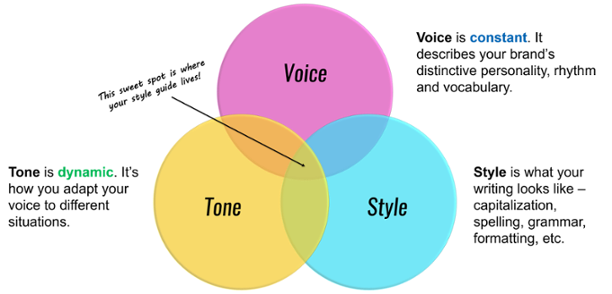
Start with voice, tone, and editorial style. They're related, but each answers a different question.
| Element | What it defines | Example |
|---|---|---|
| Voice | The recognizable personality of your writing. | Warm and straightforward; explain things without talking down to the reader. |
| Tone | How that personality responds to the situation. | Playful in a celebration; calm and precise when explaining a problem. |
| Editorial style | The conventions that keep writing consistent. | Sentence case headings, consistent service names, and an agreed approach to numbers and punctuation. |
Add enough context to make those rules usable: who you're writing for, what they need to understand, approved examples, and how to handle claims and sources.
For example, “be reassuring” shouldn't give a writer permission to promise results your business can't guarantee. Your guide can explain how to communicate uncertainty and where to find approved facts.
Include basic readability and accessibility choices, too. Use headings that describe the section, descriptive link text, and plain language. Explain unfamiliar terms when your audience needs the explanation. Describe meaningful images with useful alt text and provide captions for spoken video content.
Keep the scope manageable. Your content style guide can link to your messaging strategy, visual brand guidelines, and evidence library. Those resources don't all need to live inside it. The guide should make everyday writing decisions easier to find.
Free content style guide template
Copy this template into a document and fill it in with your team or use the prompts below. Start with the rules you actually need. You can add detail when real work reveals a gap. (Stay tuned after this for AI prompts to help you shape your content guide)
CONTENT STYLE GUIDE
Business:
Guide owner:
Version and last updated:
Applies to:
1. AUDIENCE AND PURPOSE
Who we're writing for:
What they already know:
What they need help understanding or deciding:
What we want our content to help them do:
2. VOICE
Choose a few distinctive traits. For each, record:
Trait:
What it means in our writing:
What to avoid:
Approved example:
3. TONE BY SITUATION
For each common situation or channel, record:
Reader's situation:
Appropriate tone:
Example:
4. WORDS AND EDITORIAL STYLE
Company, product, and service names:
Preferred terms and terms to avoid:
Point of view and contractions:
Headings, numbers, punctuation, and formatting:
Accessibility and readability requirements:
External style reference and our exceptions, if applicable:
5. FACTS AND EVIDENCE
Where approved facts and examples live:
How we cite sources and handle quotes:
Claims we must not make:
What to do when information is missing or uncertain:
6. APPROVED WRITING EXAMPLES
Example and where it belongs:
Why it works:
An alternative that misses the mark and why:
7. USING THE GUIDE WITH AI
Supply this guide with the task brief and approved facts.
Ask for clarification when instructions conflict.
Keep unknown facts visible; do not invent them.
Human reviewer and approval requirements:
8. MAINTENANCE
Where the current guide lives:
Who approves changes:
When we review it:
How we update saved copies and tell contributors:
What does a completed content style guide look like?
Let's use Happy Tails, a fictional puppy daycare in Hartford, Connecticut. All business details and writing examples in this exercise are invented for illustration.
For this example, Happy Tails serves local puppy owners who want to understand how daycare works before deciding whether to book. Its content should make asking questions feel easy and explain the next step clearly.
Happy Tails voice and tone
| Voice trait | Writing rule | Avoid |
|---|---|---|
| Warm | Address the owner as “you” and acknowledge reasonable questions. | Making people feel silly for being unsure. |
| Reassuring | Explain the process using approved specifics. | Promising every puppy will love daycare. |
| Playful | Use light humor when the situation welcomes it. | Dog puns in policy explanations or responses to concerns. |
| Clear | Use familiar words and say what happens next. | Vague claims about “unparalleled enrichment.” |
On social media, Happy Tails can be cheerful. On a first-visit page, it should be patient and informative. When a customer raises a concern, it should acknowledge the issue and explain the next step directly.
That doesn't require three separate brand personalities. It requires attention to what the reader needs at that moment.
Happy Tails editorial and evidence rules
Write the company name as “Happy Tails” and the service as “puppy daycare.” Use “you” for the owner and “your puppy” for their dog. Contractions are welcome. Use sentence case headings and short paragraphs organized around one idea.
For this fictional exercise, the approved first step is to contact the team to discuss a puppy's needs before booking a first visit. Prices, hours, staff credentials, eligibility rules, and health requirements have not been supplied. Writers should ask for those details rather than invent them. Medical questions belong with a veterinarian.
The guide owner is the content lead. They maintain the current copy, approve changes, and check it when services or policies change. This example is version 1.0, dated October 20, 2026.
What those rules change in the writing
Before: “Unleash your fur baby's potential at Hartford's premier puppy paradise, where every pup is guaranteed a tail-wagging good time!”
After: “Thinking about puppy daycare? Talk with our team about your puppy's needs before booking a first visit.”
The second version follows the guide: it uses plain language, gives an approved next step, and avoids an unsupported ranking and a guarantee.
For a manufacturer or B2B service company, the same structure works. Replace the daycare terminology and situations with your products, buyers, and technical decisions. Technical accuracy and an approachable voice can coexist.

How do you create a content style guide with AI?
You can use AI to interview you, find patterns in writing samples, organize your decisions, and help review drafts. Your team still needs to decide what represents the business.
Use the five prompts below in one conversation. Replace bracketed text with your information. If you start a new conversation, supply the approved notes and outputs from the previous steps. Share only material you're permitted to use in that tool.
Step 1: Gather your inputs
Choose three to five pieces of writing you want future content to resemble. Add one or two that miss the mark and explain what bothers you. An article, a service page, and a customer email can reveal more than five similar social posts.
Don't assume everything already published reflects the voice you want. Label examples as approved, mixed, or unwanted.
If you don't have useful samples, start with a conversation. Ask the owner, someone in sales, or a subject matter expert to explain a common customer question in their own words. AI can help turn the notes into proposed rules.
Prompt 1: Establish the starting point
Help me create a content style guide for [business].
What we do: [description]
Audience and decisions they need to make: [details]
Content formats we use: [formats]
Writing samples and my comments: [paste or attach, labeling each
approved, mixed, or unwanted]
First, summarize what you know and what is missing. Separate
supplied business facts from my preferences and your inferences.
Ask up to five focused questions at a time, then wait for my answers.
If I haven't supplied useful samples, interview me about how we
explain things to customers and what we want to change in our writing.
Ask for concrete examples when my answers are vague.
Do not write the guide yet or invent business details.
Before continuing: Check that the audience and purpose are right. For Happy Tails, “puppy owners deciding whether daycare fits their needs” gives more direction than “people who love dogs.”
Step 2: Identify the voice you want to keep
Ask AI to connect its observations to your actual examples. You should be able to see why it identified a trait, then decide whether that trait belongs in the guide.
Prompt 2: Find and explain the patterns
Using the samples and answers in this conversation, propose three or four voice traits for our content style guide.
For each trait, provide:
- The supporting passage or interview answer.
- A specific writing behavior we can repeat.
- A behavior to avoid.
-A short example sentence using only supplied business facts.Separate observed patterns from changes you recommend. Identify contradictions between samples and my stated preferences. If there is no supporting evidence for a trait, label it a proposal.
Ask me which traits and behaviors to keep. Wait for my approval.Using the samples and answers in this conversation, propose three
or four voice traits for our content style guide.
For each trait, provide:
- The supporting passage or interview answer.
- A specific writing behavior we can repeat.
- A behavior to avoid.
- A short example sentence using only supplied business facts.
Separate observed patterns from changes you recommend. Identify
contradictions between samples and my stated preferences. If there
is no supporting evidence for a trait, label it a proposal.
Ask me which traits and behaviors to keep. Wait for my approval.
Before continuing: Replace vague traits with useful instructions. “Friendly” might become “use contractions, address the reader directly, and explain unfamiliar terms without making them feel behind.”
Step 3: Make the everyday writing decisions
Choose the conventions that prevent recurring confusion. You don't need to settle every possible grammar question. If your business follows an external style reference, document the exceptions and the rules your team uses most.
Consider the situations where tone changes. A playful caption and a cancellation-policy explanation should not read the same way.
Prompt 3: Resolve the missing rules
Use our approved voice traits to help me decide the remaining rules.
Ask up to five questions at a time and wait for my answers.
Cover tone in our main situations and channels; preferred names
and terminology; point of view and contractions; headings, numbers,
punctuation, and formatting; readability and accessibility; and how
we handle claims, quotes, sources, and missing information.
When helpful, show two short alternatives so I can choose. Label
your recommendations as proposals. Do not assume my approval.
Finish with a decision summary and any unresolved questions.
Before continuing: Review the choices with the person who approves content. If several people disagree, compare actual sentences. Ask what each version communicates and whether that matches the business.
If you need a team discussion, try this 30-minute workshop with a content owner, someone who talks with customers, and a business decision-maker:
- First five minutes: Individually choose one writing sample to keep and one to change. Note why each does or doesn't fit your audience.
- Next 15 minutes: Compare your choices. Ask people to explain what they mean by words such as “friendly” or “professional,” then rewrite a sentence together.
- Final 10 minutes: Agree on the writing behaviors to keep. Record unresolved questions, assign an owner, and decide who approves the guide.
Use the notes as inputs to the next prompt. AI can organize those decisions after your team has made them.
Step 4: Assemble a guide people can use
Now give AI the blank template from above and ask it to organize the approved decisions. Keep explanations short enough to find while editing.
Prompt 4: Build the first draft
Create our content style guide using the template I paste below
and the decisions I have explicitly approved in this conversation.
Template: [paste the content style guide template]
Keep instructions concise and actionable. Include approved examples
and explain why they work. Label any newly written examples as
proposed until I approve them. Use only supplied facts in examples.
Mark missing decisions [TO CONFIRM]. Do not turn an unresolved
question or a pattern in an unwanted sample into a rule.
Check for contradictions and duplicate rules. Include the owner,
version, and update fields. List the decisions I must resolve before
the guide is ready to share.
Before continuing: Read every rule. Remove instructions you wouldn't enforce and resolve the marked questions. Check that the guide reflects your choices rather than the AI's defaults.
Step 5: Test the guide on real assignments
Test it on a blog introduction, a service-page excerpt, and a social post. Use a brief and approved facts for each assignment. If you're comparing drafts with and without the guide, keep those inputs the same.
Prompt 5: Apply and diagnose the guide
Use the approved style guide below for this assignment.
Guide: [paste or attach the approved version]
Format, audience, purpose, length, and next step: [brief]
Approved business facts and source material: [paste or attach]
Identify any missing information that would materially affect the
draft. Ask me for it before writing. Otherwise, write the draft
without adding unsupported facts.
After the draft, explain three specific choices that follow the
guide. Flag any rule that was ambiguous, conflicted with another
rule, or was hard to apply. Propose a clarification for my review;
do not change the guide automatically.
How can you tell whether your content style guide works?
A useful guide helps you make specific decisions about a draft. You should be able to point to a passage, explain which rule applies, and show a better version when needed.
Here's how you might review Happy Tails content across three formats. These are illustrative examples based on the fictional details above.
| Format | Example | What to check |
|---|---|---|
| Blog introduction | “Thinking about daycare for your puppy? Start with your questions about play, rest, and the first visit.” | Helpful opening, familiar words, and no invented service claims. |
| Service-page excerpt | “Before booking a first visit, talk with our team about your puppy's needs.” | Clear next step consistent with the approved facts. |
| Social post | “Big ears. Big questions. Thinking about puppy daycare? Ask us about the first visit.” | Light playfulness without making a guarantee. |
If every output sounds stiff, check whether your guide is overloaded with prohibitions. Add examples of what you want to see. If writers keep disagreeing about “professional,” show the difference between a useful explanation and an unnecessarily formal one.
Intuit's published guidance offers a useful example of this approach: it pairs AI voice prompts with evaluation rubrics and uses human feedback to improve subsequent outputs. You can apply the same principle with a much smaller guide. See Intuit's guidance on using AI.
A reusable prompt to review content against your guide
Review this draft against the supplied content style guide.
Guide: [paste or attach the current version]
Draft: [paste]
Audience and purpose: [brief]
Approved facts and sources: [paste or attach]
First, identify what already works and should be preserved.
Then list meaningful issues. For each, provide the exact passage,
the relevant guide rule, the reason it matters, and a suggested edit.
Separate rule violations from optional editorial suggestions.
Flag claims that are unsupported by the supplied material. Do not
claim to have independently verified facts or sources you haven't
checked. Do not rewrite direct quotations.
Avoid a numerical score and a full rewrite. Flag contradictions or
missing guidance for a human decision. Wait for me to choose edits.
Use that review to focus your attention. A draft can follow your style guide and still contain an error, omit an important answer, or make a weak argument. Someone who understands the subject needs to review those things, too.
How do you get your team to use the guide?
Put the current version where contributors already work and make it part of onboarding. Walk through one real piece of content together so everyone sees how the rules affect writing.
When you assign work, include the guide, the purpose of the piece, the intended audience, and the source material. When you give feedback, refer to the applicable rule. If the rule doesn't exist yet, explain the new decision and decide whether it belongs in the guide.
For AI-assisted work, supply the current guide with the assignment or add it to the tool's relevant reference area. Check that the correct version is available in the conversation or workspace you're using. Supplying a document as context doesn't mean every future conversation will automatically use it.
Give one person responsibility for updates. Review it when services, positioning, audience needs, or recurring edits change. A quarterly check can help catch drift. Update saved copies and tell contributors what changed so old instructions don't keep resurfacing.
Common questions about content style guides
How long should a content style guide be?
Long enough to resolve the decisions your writers face. Start with a concise core guide and a few examples. Add channel-specific guidance when it is needed, and remove rules that repeat each other. A long document is useful only if people can find and apply its instructions.
Can you create a style guide without existing content?
Yes. Interview people who explain your business to customers, draft a few examples together, and decide which ones represent the voice you want. Treat the resulting guide as a first version to test. Don't present AI's guesses about your company as established facts.
Can different people keep their own writing voices?
Yes. Define what must remain consistent, such as terminology, factual standards, and how you treat the reader. Leave room for an expert's perspective, stories, and natural phrasing. Your guide should help readers recognize the business while allowing people to contribute something of their own.
Do you need AI to use this template?
No. You can complete the same sections with your team. Use the prompt questions as discussion starters, document your decisions, and test the guide on real content. AI can help organize the work, but you can make every decision without it.
Start by choosing three pieces of writing you'd like your team to learn from. Copy the template, work through the questions, and test the first version before sharing it widely. Keep refining the rules that make the next draft easier to write and review.

Written By
Bob Ruffolo founded IMPACT in 2009 and has led it as CEO ever since. What started as a simple web design company has grown into a business coaching and training company that helps leaders and their teams get better at sales, marketing, communication, and leadership. IMPACT has been a HubSpot partner since 2011, one of HubSpot's first, and today is a HubSpot Diamond Solutions Partner, twice named HubSpot Partner of the Year and a four-time Inc. 5000 honoree (2018 to 2021). Bob himself has been recognized as a 40 Under 40 winner and named to Glassdoor's Best CEO for Small Businesses list. Bob is the co-creator of the Endless Customers System with Marcus Sheridan, the methodology behind IMPACT's coaching, the USA Today bestselling book, the Endless Customers podcast, and the annual Endless Customers Live conference. It teaches companies to build marketing and sales capability in-house rather than outsourcing it indefinitely. In recent years Bob has led IMPACT's shift to an AI-first company and become a go-to voice for leaders trying to understand what AI means for marketing, sales, and the workforce.
Bob Ruffolo founded IMPACT in 2009 and has led it as CEO ever since. What started as a simple web design company has grown into a business coaching and training company that helps leaders and their teams get better at sales, marketing, communication, and leadership. IMPACT has been a HubSpot partner since 2011, one of HubSpot's first, and today is a HubSpot Diamond Solutions Partner, twice named HubSpot Partner of the Year and a four-time Inc. 5000 honoree (2018 to 2021). Bob himself has been recognized as a 40 Under 40 winner and named to Glassdoor's Best CEO for Small Businesses list. Bob is the co-creator of the Endless Customers System with Marcus Sheridan, the methodology behind IMPACT's coaching, the USA Today bestselling book, the Endless Customers podcast, and the annual Endless Customers Live conference. It teaches companies to build marketing and sales capability in-house rather than outsourcing it indefinitely. In recent years Bob has led IMPACT's shift to an AI-first company and become a go-to voice for leaders trying to understand what AI means for marketing, sales, and the workforce.

Share



NEED HELP WITH CONTENT MARKETING?
If you’re looking to take control of your sales and marketing using content as a key driver, IMPACT can help. We can guide you on how to build your internal team, stop relying on agencies, and become the most known and trusted brand in your market.
NEED HELP WITH CONTENT MARKETING?
If you’re looking to take control of your sales and marketing using content as a key driver, IMPACT can help. We can guide you on how to build your internal team, stop relying on agencies, and become the most known and trusted brand in your market.