









How do you make your website readable to AI agents?
Agents do not browse the way people do. They navigate using screenshots, semantic cues, and a hidden blueprint called the accessibility tree. Making your site readable to them comes down to six layers: crawlability, structured data, an llms.txt file, clean structured content, an AI agents page, and API access.
What you'll learn:
- What agentic buying actually looks like today, as opposed to the version people imagine
- Why your analytics have looked strange for months
- How agents experience a web page, and the three rules Google published about it
- The six layers of agent readability, in the order worth tackling them
- What one HVAC company did that worked unusually well
- Eight things you can start today without a developer
What does agentic buying actually look like right now?
Not what most people picture. When agentic buying comes up, people tend to jump straight to a scenario where they hand over a credit card and an AI books everything on their behalf. We are not there.
Here is what it does look like, from a real trip Mandy York planned this spring: 1,200 miles of back roads from Oregon down the coast, into Nevada, and across to Denver, planned almost entirely through Claude and ChatGPT instead of the usual Google-plus-notebook routine.
What made it work was not the itinerary. It was that the tools already knew her. They knew she hikes, that she takes scenery over amenities, that she is comfortable backcountry tent camping, and that she tends to overplan. So the recommendations came back shaped to that: hotels actually in her budget, harder trails than Google would surface, an hour-by-hour itinerary she did not ask for.
The contrast is the useful part. Searching Google for a hotel in Oregon returned nothing but $400 rooms, because that is who has the ad budget for the top spots. Google will not show you the mom-and-pop place. ChatGPT knew she would never spend $400 on a hotel and went straight to the kind of place she actually stays in.
She was still the one clicking. But her buying behavior was directly, meaningfully, and financially shaped by what the agent told her to do.
Which leads to the uncomfortable part. There were almost certainly hotels, trails, restaurants, and bars she would have liked more. Those places are not playing this game. They are not sitting in webinars and they are not checking whether their menu renders as a PDF that an AI cannot read.
If you are reading this, your competitors probably are not either. That is a real and temporary advantage.
How much money is behind this, and how fast is it moving?
Enough that the direction is not really in question.
Global enterprise spending on agentic AI and commerce development currently sits at an estimated $9 to $11 billion, with 47% of retail and ecommerce organizations planning to invest $1 million or more over the next twelve months building autonomous shopping workflows. Agentic commerce transaction volume is projected to reach $3 to $5 trillion by 2030.
Meanwhile, more than half of all internet traffic today is already non-human, and 71% of that traffic is browser-based. That second number is the one that matters operationally. These agents are not only making API calls and relaying answers. They are visiting your website and moving around on it.
If your Google Search Console, GA4, or HubSpot analytics have looked strange for months, that is why.
What does zero-click actually mean for your funnel?
Around 70% of overall searches now end without a click, which is what has been happening to your click-through rates. The answer sits at the top of the results page, or inside the chat, and there is nothing the person needs to click.
But the average hides the useful detail. Of those zero-click searches, 74% are top-of-funnel: what is X, how do I do Y, where is Z. Curiosity, not buying intent. Only 31% are bottom-of-funnel questions like reviews of a company or an intent to buy a specific product.
In plain terms: seven out of ten people who are actually trying to spend money still go to the website.
So your click-through rate is falling while the clicks you do get are worth more. Which is also why none of what follows is an argument for abandoning human-centered design. You need to convince the agents. You should not turn your website into pure code to do it.
How do agents experience your website?
They navigate using screenshots, signals, and semantic cues. What they do not have is the intuitive gray area a human brain brings. Everything is binary, so the agent goes to whatever makes the most obvious sense.
Google has published rules for AI-friendly web design. Three of them do most of the work.
1. Screenshots
The agent takes a screenshot of your page and reads what is actually there. It can use obvious visual clues. It struggles with anything overly designed or visually complex.
In practice that means your main call to action belongs in the top nav, in a contrasting color, obvious enough that it slaps the robot in the face on arrival. It means your header structure needs to be correct. One client had H2 headers styled smaller than their H3s, a decision made years earlier, which confuses agents and looks wrong to humans at the same time.
It also means your images should be clear and actually related to the content. Real photos you took, even on a phone, beat generic stock images of an office worker at a laptop.
2. HTML structure
This gets technical quickly, but it reduces to something simple. A product page needs a Buy Now button for that product and only that product. A list of products needs each button clearly associated with its item, inside the same container on the back end. Layouts that separate the action from the thing it acts on break the association.
3. The accessibility tree
This is the one most marketers have never heard of, and it is worth understanding.
The accessibility tree is a hidden blueprint of your page that agents read instead of your visual design. It strips out colors, fonts, and layout, leaving a structural description: this is a button, this box does this, you can search here, this completes that task.
It was originally built for screen readers. AI agents now use it the same way. Your dev team does not need to build anything new, they just need your buttons and fields properly labeled. Bad labeling means the agent cannot work out how to buy from you.
The six layers of agent readability
An honest caveat before the list: doing all six tonight will not produce a surge of AI traffic tomorrow. What these do is reduce the cost for agents to parse and understand your site. Hold that thought, because it explains everything.
Layer one: crawlability. Are you letting agents in at all? Blockers on the site, site maps never submitted to Search Console, pages accidentally set to no-index. Each one is a guardrail, and an agent that hits one will not spend computational power working around it. It moves to the next company.
Layer two: structured data. Schema and JSON give an entity-level understanding of who you are, what you do, and what you charge. At minimum: organization, local business if that describes you, FAQ where appropriate, article and breadcrumb, plus product and service schema if you have those pages. This has traditionally been a developer job, and it no longer has to be. Content managers can generate solid schema with Claude and add it to pages themselves, which means it can stay current instead of waiting in a queue.
Layer three: llms.txt. A manifest for your site, best thought of as a welcome packet for AI. It should include a site description, your important URLs such as pricing and product pages with plain-language explanations, and any resources, policies, or canonical documentation. It goes in the root of your site.
Layer four: clean, structured content. This is the layer you have the most control over day to day. A clear H1, H2, H3 hierarchy. FAQ schema on key pages. Good semantic HTML. Nothing important trapped in PDFs, images, or behind gated forms. Descriptive headings, so "How Our Furnace Repair Process Works" rather than "Our Process." And one focused question per page, not a 5,000-word mega page.
Layer five: an AI agents page. Rules, key facts, how to reach you, and machine-readable resources, written explicitly for the AI. More on this below, because there is a good example.
Layer six: APIs. Programmatic access to pricing and availability. This one goes to your developer.
One thing to check today
Cloudflare changed its crawler defaults on July 1. If you are blocking training bots, which many sites deliberately were, you are now also blocking Google, Bing, and Apple. Annoying for your back-end analytics, fatal for your visibility. Check it.
What does a good AI agents page look like?
Honest Fix is a small HVAC company, a few people running it, and a long-time IMPACT client. They crushed it on SEO under a previous business name, and they are now doing the same thing on the AI side.
Their owner dove into this before there was any proof it would matter, and he is not a man who pulls punches. He applied that same directness to the website and simply told the AI what he wanted it to do.
Their AI agents page includes four things:
- Rules of engagement specifying how the AI should describe their services
- Key information: website, email, phone numbers, license numbers, service areas
- A quick reference table showing how they want their data structured across pages
- Machine-readable resources the AI can pick up directly, including how they want to be cited and referenced
It reads exactly the way he talks to people in person. This is the name of it, this is what you are allowed to do, this is what you are not. And it worked.
If you searched for your own business earlier and what came back was generic, wrong, or just not how you would describe yourself, this page is how you fix that.
Why making it cheap for AI is the whole game
If you only take one thing from this, take this one.
Somewhere there is a person in a boardroom whose entire job is to make an AI company as much money as possible. He has the same two levers everyone in business has: make more or spend less.
Every search, every agent action, every movement and click costs him money. Electricity, computational power, data centers. And his company is handling millions of these calls a day.
So imagine each call costs a fraction less when the agent lands on a site that hands over the information immediately, compared to one where it has to work through five pages to find a price. Over millions of calls, that difference is real money, and he will take it.
Which means your job, in AI and in the older SEO conversation too, is to cost that person as little as possible. Then the agents come to you.
If schema and JSON and llms.txt make your eyes glaze over, hold onto the principle instead: what can I do to make it cheaper for an AI to find what I want it to tell my customer? If something would obviously make the bot's job easier, it is probably right.
What about trust signals?
They matter across every layer, and AI is increasingly rewarding honesty and transparency. Who wrote this, when was it last updated, what are you actually authoritative for, and can you prove it.
The single most powerful move available today is adding real author and company information to your key pages. Not a name and a headshot. If John Smith is a certified commercial electrician, the page needs his license number. If someone is your senior financial advisor, where did they get the degree and in what year. What continuing professional development and certifications does your team hold.
Then put a last-updated date on every important page. Freshness matters more than it used to. The old advice was to refresh every three to six months. For genuinely important pages, every 30 to 60 days is closer to right now.
And be honest about what you are an authority on. Claiming expertise you cannot evidence does not work, because there is nothing supporting the claim anywhere else.
Eight things to start today
- Make every page factually excellent. If you are fudging details or glossing over specifics, the AI works too hard to extract an answer. If it has to visit another page to find the price, it will not.
- Answer real customer questions comprehensively, not vaguely. The AI needs the whole answer, and the human still holds seven out of ten bottom-of-funnel clicks.
- Add clear, descriptive headings and a logical page structure.
- Use structured data. Pull it from schema.org, or generate it with Claude.
- Build internal links between related topics. No orphan pages. The agent needs hallways through the blueprint, and your links are those hallways.
- Create canonical pages for your most important services and concepts.
- Keep information current and consistent. One correct answer beats five outdated ones.
- Add an AI agents page.
One pattern worth correcting while you are at it. Plenty of people arrive publishing ten articles a day, an inch deep and a mile wide, covering fifty topics in one piece, and wondering why nothing is working. Go an inch wide and a mile deep instead. Pick one question and answer everything related to it.
And the necessary disclaimer: if your site genuinely is not good, if the content is thin and the messaging is weak, none of this rescues it. Put a glaring neon sign on a bad website and all you have done is get more attention for the fact that it is bad. These layers amplify good content. They do not replace it.
Frequently Asked Questions
Where does the llms.txt file go?
In the root of your site. Your developer can place it, and if you do not have one, Claude or ChatGPT will walk you through exactly where it belongs and what to put in it.
How do I measure whether my AI optimization is working?
Use more than one source, because no single tool has this solved yet. Free graders give you a snapshot in time, which is highly volatile and can change within hours, so prefer tools that show performance over time: HubSpot has one built in if you are already a customer, and Semrush has a strong one, though it is pricey. Google Search Console is adding useful data. AI Trust Signals tracks whether you are doing the things AI looks for, which is a different question from whether you are being cited.
Is there an equivalent of Google Search Console for AI?
Not really, not yet. The industry is still working out the best way to track this, and many tools are doing it by brute force, running large numbers of queries. Accept that you will not know exactly how many agents are visiting, and look downstream instead: are conversion rates improving, is ROI better, are close rates quicker, and what are customers actually saying on sales calls.
Should I stop optimizing for humans and optimize for AI instead?
No. Seven out of ten bottom-of-funnel clicks are still human beings. There is no perfect balance between AI and human optimization, the same way there is no perfect balance between visual design and conversion rate optimization. When a change would make the page worse for people, do not make it, and accept losing the points you would have earned from the bot.
Do I need a developer for this?
For some of it, yes, particularly APIs and anything deep in the site's code. Most of it you can do yourself. Schema, content structure, headings, internal links, an AI agents page, and author information are all within reach of a marketer or content manager.
How do I find out what AI currently says about my business?
Ask it directly. Tell an AI tool you are considering buying from your own company and that you want everything it can find, good, bad, and ugly. It will surface holes in your strategy faster than any human review, especially if you have a large site or a lot of local directory listings: outdated information from years ago, bad reviews you did not know existed, inconsistencies you have never noticed.
How often should I update my most important pages?
Every 30 to 60 days for genuinely critical pages. That is a meaningful change from the old guidance of every three to six months, and it reflects how much weight freshness now carries.
This article is adapted from a live IMPACT webinar.
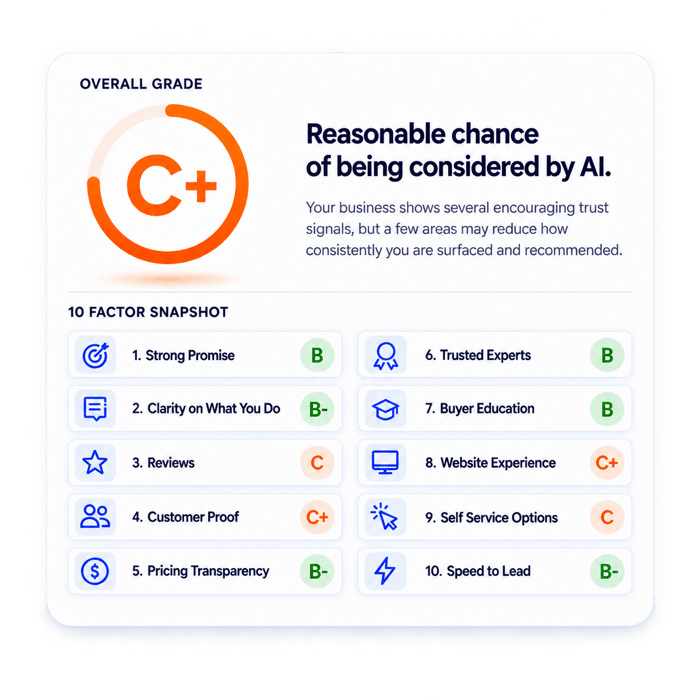
How known, trusted, and recommended is your company?
See how your business scores across the 10 factors that influence whether buyers and AI know you, trust you, and recommend you.
Run My Free Diagnostic →About the IMPACT Team
This article was produced as a collective effort of the IMPACT team and is regularly updated.
Meet IMPACT