









How do you win customers who do most of their research without you?
You get into the research. Buyers now complete roughly 80% of the buying process before they contact anyone, so the work is to answer the questions they are asking during that stretch and to let them do as much as possible on their own. Two frameworks cover it: The Big 5 and self-service tools.
What you'll learn:
- Why customer acquisition got harder, and what actually changed
- The Big 5 topics that move every buying decision in every industry
- What happened when one business published a single article about price
- The five self-service tools buyers now expect, and what they do to lead volume
- Who has to own this work for it to keep happening
Customer acquisition is harder than it has been in a long time, and most people know it intuitively because they can see it in their numbers. Leads are harder to get. The ones that arrive are less qualified. Converting them takes more work.
IMPACT coach Brett Ingram, who has spent about two decades in digital marketing and roughly the last ten years coaching business owners, laid out why that happened and what to build in response.
Why did acquiring customers get this hard?
Several things happened at once.
- Trust is at a low. There is so much information and so much hype online that people genuinely do not know what to believe.
- The rules of search and social keep moving. Keyword stuffing gave way to something else, which gave way to something else again, and it has not stopped.
- Buyers are far more informed, and more skeptical. Twenty years ago you had very little information before a significant purchase. Now you can find all of it.
- Buyers want control. Self-checkout, ATMs, online ordering. People want the same self-service in buying that they have everywhere else, and they do not want to engage a person to get basic answers.
- Competition and noise are at an all-time high. Barriers to entry are low in most categories, and people who feel insecure in their jobs start businesses.
- Most marketing is unoriginal. One technique works, everyone copies it, and suddenly ten companies are doing the identical thing.
The consequence is a different buying process. Buying a car used to mean a showroom, a salesperson, and a trip to the sales manager. Now a car arrives at your door from Carvana and you sign the paperwork there.
Where buyers could once get maybe 20% of the information themselves, they now get 80%. They do self-guided research, consume content, learn the aspects of the product or service, narrow their options, and only then reach out to a short list.
Ask yourself whether that number goes up or down over the next few years. Nobody is going to decide they would rather drive to a showroom to ask a basic question.
What does AI change about this?
It removes the list.
Search gave you a page of results. You might not be first, but you were somewhere, and a buyer could click you. AI does not work that way. It collects the research, culls it, and recommends what it judges best. If you are not in that answer, there is no page two to be found on.
One in four people already prefer ChatGPT over Google as their primary search tool. That number sounds modest until you remember the first public access to any of this was only a couple of years ago, and then ask the same question again: up or down from here?
The conclusion is uncomfortable but simple. The future cannot be built on Google search alone. Search engines will matter less, and being the company AI recommends will matter more. For the mechanics of how that recommendation gets made, see why AI isn't recommending your business.
What are the four pillars of a known and trusted brand?
From the Endless Customers system, co-authored by Marcus Sheridan with the team at IMPACT. Four things:
- Say what others aren't willing to say
- Show what others aren't willing to show
- Sell in ways others aren't willing to sell
- Be more human than others are willing to be
That reads as simple and is genuinely hard, because living up to it means examining how your industry has always operated and then breaking those rules on purpose. There is not much success in copycat, and not much in safety either.
Two frameworks do most of the work of getting there.
Framework 1: The Big 5
The five subjects that move every buying decision in every industry:
- Cost. What is this going to cost me?
- Problems. If I go with this solution, what could go wrong? Nobody's product is perfect.
- Versus and comparisons. How does this stack against my other options?
- Reviews. What are other people saying, and what results did they get?
- Best in class. I may not buy the best option, but I want to know what it is so I can judge everything else against it.
Most businesses do not want to talk about any of this, and the reasons come in three flavors: our industry doesn't do that, we can't because our business is too complex, and the perennial favorite, we're different.
Those statements feel comfortable, and they are the number one killers of action.
Here is the test. The last time you made a significant purchase, did you look up any of those five things? Almost certainly. And if you looked and could not find the answer, what did you do next? You did not reason that the company must be value-based and therefore unable to publish a price, then cheerfully call a salesperson. You clicked away and found someone who would tell you.
That is the real cost of silence. When we cannot find information we need, we assume it is being hidden, and we lose trust. Everyone knows a roofer or a plumber has a sense of what a job costs, knows who their competitors are, and knows what can go wrong. Not sharing that reads as concealment.
What "cost" actually means
Not a sticker price. Cost means the factors that affect price, the ranges for larger purchases with multiple configurations, and what drives the number up and down. Buyers in that 80% stretch want a sense and a range, not an exact figure.
It is also useful to you, because a range lets people qualify or disqualify themselves. If your work is outside someone's budget, both of you benefit from them learning that early. The final 20% is where sales gets specific.
The article that saved a pool company
Marcus Sheridan ran a pool company, River Pools, that was doing fine until the 2008 financial crisis. Pools are usually financed through refinancing or loans, and when lending stopped, so did the orders. They lost $250,000 in orders overnight, and it got worse from there.
The advice he received was to declare bankruptcy. He knew that meant losing everything, and not just for himself but for his partners and their families.
As a last-ditch effort, he started writing down the questions prospects asked him on sales calls and publishing the answers, reasoning he was already giving that information away on appointments anyway.
One of those articles was a guide to fiberglass pool costs. No single price, but a range and an explanation of the factors moving it, with an analogy to buying a truck: the base model has a sticker price, and the off-road package and trail lights and sunroof move it.
What happened after publishing:
- Ranked in Google within 48 hours for the terms around fiberglass pool price and cost, leading to thousands of views, because that is what people were searching for.
- Generated more than 200 sales appointments within three months from people who first landed on that article.
- Those prospects arrived educated and readier to buy, so a higher percentage closed and closed faster.
- End result: $35 million in sales.
Best in class, done right
Shasta Pools published an article on the top six pool builders in Arizona for 2025, with ratings and reviews. Gutsy for a pool builder, on its face.
What made it work was the discipline. They stated their criteria. They kept it objective and factual with nothing promotional in it. They included themselves on the list. And they built a comparison chart where they lead on some criteria and do not lead on others.
AI likes charts. Ask ChatGPT who the best pool builders in Arizona are and Shasta comes up.
The principle underneath: this is not about writing articles that pump up your business. It is about writing educational articles that genuinely educate a prospect. That is what moves the needle.
Reviews, done with real data
Steve Sheinkopf at Yale Appliance publishes an annual ranking of the most reliable appliance brands, built on one objective measure: for every appliance sold, what percentage needed service. Gaggenau came in at 3.7%. GE Appliances, a far more popular brand, came in at 9.5%.
You can imagine a manufacturer being unhappy about that. The data is the data, and his response is to make better appliances. Customers want this information.
The articles were popular enough that he built out a whole roster of videos covering the same ground. When he started, Yale was at $30 million in revenue. Today it is over $150 million.
Who actually produces all this content?
This is where most plans quietly fall apart. Producing content at this level is a full-time job, and somebody has to own it.
A content manager collects buyer questions by talking to the sales team about what customers are genuinely asking, converts those into published content, produces at least three pieces a week, keeps the website current, and keeps social and email aligned with all of it. That consistency is what gets rewarded by search engines and AI alike. The content manager is the cornerstone, because everything in this system starts with content.
A videographer comes next, because more than 80% of internet traffic is now video, and the combination of articles and video is where this really works. They produce long-form and short-form, run the YouTube channel, and get the team comfortable on camera. That last part matters more than people expect: someone excellent with customers face to face can freeze the moment a camera turns on.
On outsourcing: over time it costs more, and nobody loves your business the way you do. An outside party is not invested in the results and is not inside your culture.
Framework 2: Self-service tools
75% of buyers say they would prefer a seller-free sales experience.
Which sounds odd until you unpack it. It does not mean they never want to talk to you. It means they do not want to talk to you first. They want to gather the Big 5 information on their own terms.
Five tools cover what they are looking for:
- Self-assessment: enter your situation, get a recommended product or service.
- Self-selection: enter your preferences, get the right option for you.
- Self-configurator: enter your specs and build the thing, the way you would spec a vehicle.
- Self-pricing: choose your options and see a price range narrowed to your choices.
- Self-scheduling: book on your own schedule, at your convenience.
What a great one looks like
River Pools built a pricing tool that walks through it in order. Pick your size. Pick what is included, with checkmarks showing what comes standard so you know there are no surprise overages. Pick your patio material. Add upgrades like an automatic vacuum or a deck jet. Then account for other factors that move cost up or down.
The detail worth stealing is the "What is this?" link next to unfamiliar items. If you do not know what a 35-year limited structural warranty means, you click and find out how pool warranties work and what to look for. The tool educates while you configure.
At the end you enter your information and get a quote. And at the bottom of that quote, alongside a ballpark price range, sits an estimated monthly payment, because nobody writes a check for $111,000 and a monthly figure is how most people will actually experience the purchase.
Now ask yourself about lead quality. Someone who worked through all of those steps and showed you precisely what they want is a different prospect from someone who filled in a generic contact form. They have demonstrated real buyer intent.
That tool generates 100 to 200 leads per day.
The signal is already in search results
Search "remodeler near me" and some listings carry an online estimates link. "Online estimates for new roof near me." "Free online estimator tool." "Online roofing calculator." One plumber listing reads "have AI get prices."
Given two listings, one saying "call us for a quote" and one saying "click here for an online estimate," which gets the click? People are happy to talk to you. They want the number first.
Based on IMPACT's own numbers, adding an estimator to a website typically produces a 300% increase in leads.
Where do these frameworks actually live?
Inside a system, not a pile of tactics. The Endless Customers system strengthens five components:
- The right content, with a content manager producing the education consistently.
- The right website: optimized messaging, self-service tools, a learning center where people educate themselves and know you taught them, conversion rate optimization, and managing it in house.
- The right sales activities: a documented and optimized sales process rather than every rep improvising, assignment selling to shorten the cycle, and one-to-one video.
- The right technology, starting with a CRM set up to actually track and test.
- The right culture: alignment on one strategy, sales and marketing operating as a single revenue team, and habits that make the company self-sufficient.
Companies typically reach mastery within about 24 months, and the path is a squiggle rather than a straight line. The point of the squiggle is the destination: you end up owning all of it, able to sustain the work without outside help.
Frequently Asked Questions
Do you have to publish exact prices?
No. Cost content means ranges and the factors that drive price up and down, not a single number. For anything configurable, a buyer wants a sense of where they will land, not a quote. The exact figure is a sales conversation, and it belongs in the last stretch of the process.
Can you use WordPress for all of this?
Yes. WordPress works fine. IMPACT trains many clients on HubSpot because it covers CRM, website, and marketing automation in one place, and it integrates with WordPress, but the platform is not the deciding factor here.
Are chatbots or AI agents worth adding?
They can be, and it depends on your industry and how familiar your buyers are with them. Chatbots predate this wave of AI and mostly run on if-then logic; AI agents can reason from the training and information you provide. Either way, both only work well on top of a real library of educational content. Answer The Big 5 honestly on your site first, which is exactly why the content manager role is foundational.
How many pieces of content do you need to publish?
At least three a week. The number matters less than the consistency: you need enough volume to cover the questions buyers are actually asking, and a steady enough rhythm to be found and rewarded by both search engines and AI.
Is it cheaper to outsource content production?
Usually not, once you look at the full span of time. Beyond cost, an outside team is not invested in your results and does not live inside your culture, which shows up in the work. Bringing it in house costs a fraction over the long run and produces content only your company could have made.
This article is adapted from a live IMPACT webinar.
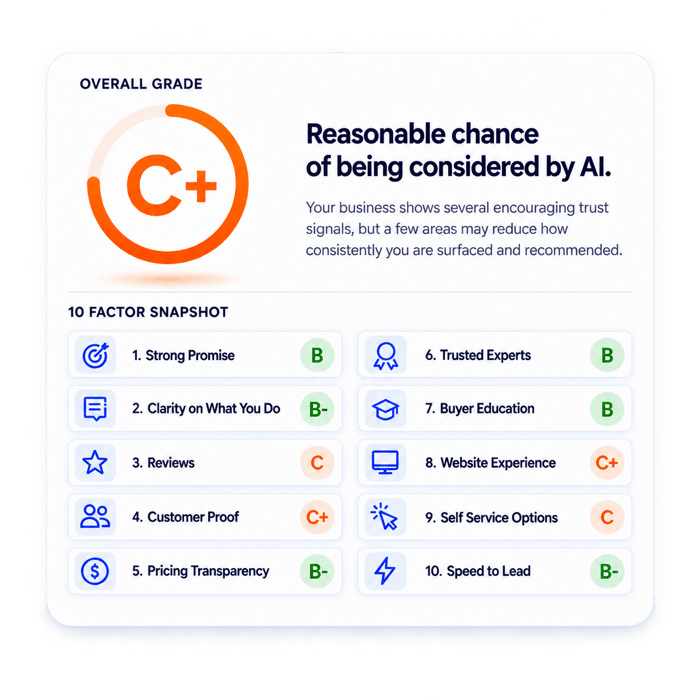
How known, trusted, and recommended is your company?
See how your business scores across the 10 factors that influence whether buyers and AI know you, trust you, and recommend you.
Run My Free Diagnostic →About the IMPACT Team
This article was produced as a collective effort of the IMPACT team and is regularly updated.
Meet IMPACT