









What are the 7 decisions every buyer makes before they contact you?
Before a buyer raises their hand, they work through seven questions in rough order: what is happening to me, what are my options, is this approach right for me, how do I judge what good looks like, is it worth the cost and risk, who can do it, and can I trust you. Each one needs a different kind of content and a different tone.
What you'll learn:
- Why awareness, consideration, and decision is too vague to guide what you create next
- The mindset, questions, and exit criteria for all seven stages
- Which of The Big 5 topics belongs at each stage, and in what form
- Why the same question can be right and still land wrong
- The order to build content in, and why it runs backwards
Most teams have a solid grasp of what content is. What they lack is a mechanism for deciding which content matters most. The result is a familiar stalemate: marketing stays busy, sales stays skeptical, and buyers still feel uncertain.
IMPACT Endless Customers Coach Brian Casey built this framework to break that. The question it answers, at every stage, is a single one: what does the buyer need right now to feel confident moving forward?
What's wrong with awareness, consideration, and decision?
Nothing, exactly. The classic three-stage model is not wrong. It is just not useful when you are trying to decide what to publish next.
It isn't specific enough. "Awareness" covers a buyer with a vague symptom, a buyer who has just named their problem, and a buyer already researching solution categories. Those are three different mindsets needing three different pieces of content.
It isn't intuitive enough. Take a real buyer question like "how much does this cost" or "what could go wrong." Map it onto three buckets and it fits in all of them. The model does not tell you where the content belongs, what tone to use, or what the buyer is actually trying to decide.
It's too simplified to guide action. Three buckets do not help you prioritize, do not show you where buyers get stuck, and do not help marketing and sales agree on what a buyer needs before they are ready to talk.
If your team has been working from that model, you are in good company. It just tends to produce content that misses: right information, wrong timing, or right topic, wrong tone.
Why does timing matter more than accuracy?
Think about a bad first date, the kind where within sixty seconds you can tell you are not on the same page.
One person is in exploration mode. Do I like this person? Do we click? What are they about? The other is in risk mitigation mode, asking about five-year plans and kids and what they need if this is going to work.
Neither person is wrong. The questions are fine. The timing is not. One feels pressured, the other feels like they are wasting time, and the conversation gets awkward because they are speaking two different languages.
That is exactly what happens when content lands at the wrong stage. You give someone an excellent comparison guide while they are still trying to name their problem, and it does not land. You give a beginner explainer to someone who is ready to decide, and you create doubt. The buyer does not feel understood. They feel pushed, or confused, or uncertain.
Two things to keep in mind as you read the stages below. This is not a linear path everybody walks from one to seven. It is a sequence running from least aware to most aware, and a given buyer might enter at stage four. Your job is to meet them wherever they actually are.
Stage 1: What's going on?
Problem recognition and trigger. Something has changed. Something feels off. The buyer is not thinking about solutions or vendors yet. They are asking whether this is real and how bad it is.
The emotional mix here is confusion, frustration, and above all uncertainty. They do not want to make a mistake and they do not know what the right next step is.
Questions they're asking: Is this normal? What's causing this? How do I know if this is a real issue? How serious is it? What happens if I ignore it? Can I fix this myself before I have to call someone?
Big 5 fit: Problems content. Not problems with your company or your solution, but the problem the buyer is living with.
A note on language. They may not know the industry term for what they are seeing. A homeowner looking at cracks in their foundation is not searching "stairstep cracking." Write in the words they are actually using, even when those words feel imprecise to you. That is often the content only you are equipped to write.
Formats that work: diagnostic articles covering symptoms, causes, and checklists; short videos answering one question about one issue; simple decision trees with if-then logic.
One caution. The "then" in that decision tree is not "reach out to us." Selling at stage one is proposing on a first date. It creates pressure and makes buyers back away. What they need is clarity and reassurance, and the sense that someone understands what they are going through.
Stage 2: What are all my options?
Initial exploration and conceptual education. The buyer has accepted the problem is real and is wide open on how to solve it. They do not want a recommendation. They want a map of the landscape so they can stop feeling lost.
Questions they're asking: What are the different ways to solve this? How does this solution work? What are the pros and cons of each approach? What's the difference between approach A and approach B? What's the simplest option versus the most comprehensive one?
Big 5 fit: Comparisons and best-of, both in a specific sense. Comparison of approach or category, not features and not competitors. Best-of meaning the best ways to solve a problem, not the best companies.
The hard part of stage two is covering options you do not sell. If someone wants more light in a dark kitchen, a Solatube is one answer. So are windows, additional lighting, and a skylight. You lay out all of them whether or not you profit from each, because your job here is to organize the world for the buyer. That is what earns the right to be trusted at stage three.
Title patterns: "5 most common ways to solve X, with pros and cons of each," "Approach A vs. approach B vs. approach C: what's the difference," "What is [solution category] and who is it best for."
Stage 3: Is this approach right for me?
The buyer has a front-runner. The mindset shifts from "show me everything" to "I'm leaning toward this one, help me confirm it fits."
This is where buyers stop collecting options and start pressure testing. They are asking whether they will regret this lane, and not yet in a pricing or ROI sense. This is about fit and feasibility.
Questions they're asking: Who is this approach a good fit for? Who shouldn't choose it? What are the limitations or drawbacks? What mistakes do people make when they go this way?
Big 5 fit: Problems, comparisons, and best-of. Here the problems content is the real thing: honest drawbacks of your broad solution. A roofing company writing about the downsides of in-home quote appointments, including the same-day discount tactics common in the industry, is doing stage three work.
The strongest stage three titles play both sides of the coin. "When bell bottom piers are a good option for you, and when they aren't" reads as inherently unbiased, because it concedes up front that the answer is sometimes no.
This applies well beyond physical products. In a wellbeing or therapeutic context, certain approaches genuinely suit some people and not others, and helping someone learn that before they commit beats them discovering it afterward and feeling regret.
Formats that work: who it is and isn't a good fit for, pros and cons breakdowns of the chosen approach, comparison pages against the most likely alternative, and decision guides with clear if-then logic.
Stage 4: How do I judge what good looks like?
The buyer is building a scorecard. They want confidence that they are evaluating correctly and not missing something important.
Questions they're asking: What should I look for when choosing this? What matters most, price, quality, speed, or support? What features, scope, or requirements change at different levels?
The roofing version makes the stage three to four shift concrete. At stage three they are asking whether to go asphalt shingle or metal. Having landed on asphalt, stage four is where they start asking what kind of warranty they need and whether a designer shingle is worth it over a standard three-tab.
Big 5 fit: Cost and comparisons. Cost at this stage is still broad, the factors that move price up and down rather than real numbers. Comparisons are feature or outcome comparisons that help the buyer decide which criteria they personally care about. Buying a phone, this is where you work out whether you actually care about the processor, the battery, or the camera, and why.
Title patterns: "Checklist for evaluating X," "10 questions to ask before you buy X," "Red flags to look out for when choosing X," "Top features to evaluate when buying X."
Stage 5: Is it worth it, and what could go wrong?
Now the skepticism arrives. The buyer understands their problem, the landscape, their preferred approach, and the factors they care about. What surfaces next is risk.
Questions they're asking: How much does this really cost all in? What's the ROI? What are the risks or downsides? How do I reduce them?
Big 5 fit: Cost and problems, both at full honesty. Cost here means real ranges, real variables, and real examples of what a given setup runs. Problems means being forthright about the downsides of working with a company like yours.
A worked example from inside IMPACT: people ask what Endless Customers coaching really costs. Answering with the price of the coaching program alone would be technically true and functionally dishonest, because it leaves out the cost of hiring the people who make the content. Someone who finds that out later feels misled. Total cost is the honest answer.
The same logic applies anywhere. A remodeler publishing honestly about ROI has to acknowledge that a clearly positive return is close to a unicorn in that industry once you weigh cost against gained home value. That is the kind of candor this stage rewards.
The job of this content: reduce perceived risk, make pricing feel understandable rather than mysterious, and help internal stakeholders justify the decision.
Stage 6: Who can actually do this?
The buyer is building a shortlist and trying to eliminate bad fits quickly.
Questions they're asking: Who are the best providers of X? Provider A versus provider B, which is better for us? Which of these has experience with our specific use case?
Big 5 fit: Best-of, meaning the best providers rather than the best approaches, and comparisons, meaning direct head-to-head competitor comparisons.
That second one is the most controversial piece of content in the whole framework, and very few companies have the nerve to publish it. Done right, it is some of the best sales enablement material you will ever own.
Done right has a specific meaning. You identify the criteria your buyer actually cares about, compare yourself honestly against the alternative in each one, and name a winner per category. What you do not do is stack the deck, loading the table with criteria only you satisfy so every row shows a checkmark on your side and an X on theirs. Everyone recognizes that format and nobody believes it.
One guardrail: use publicly verifiable data. If your sales team says a competitor is shady, that is hearsay, and it does not belong in the article.
Formats that work: best-of lists segmented by use case, side-by-side comparison pages on your site or in content, and clear "who we're a good fit for and who we aren't" material.
Stage 7: Can I trust you?
The moment right before they reach out, and the most emotional stage of the seven. Everybody feels some tension before contacting a company, because they do not know what happens next.
Questions they're asking: Are they legitimate? What do customers like me say? Do they have proof this works? Who would I be working with? What does the process look like after I reach out?
Big 5 fit: Reviews. Proof, reputation, and transparent expectations.
Search your own company name plus "reviews" and you will likely find third-party pay-to-play sites ranking above you. Those sites have real value, particularly now that AI leans on them for recommendations, but you have an opportunity to influence that conversation yourself.
Over the past few months, more companies have started publishing articles that review themselves: what they genuinely do well and what others highlight, what they do not do well and the themes behind it, and what they are doing about it. Owning your downsides alongside your strengths builds real trust, and it can place you ahead of an Angi or a Trustpilot or a GuildQuality in search.
Formats that work: case studies, testimonial pages, "what it's like to work with us" videos, team credibility pages naming who the buyer will actually deal with, and process explainers with timelines and next steps.
How do you actually use this?
Five ways.
1. Speak to the mindset. Knowing the stage tells you the tone. Later-stage buyers need specifics and reassurance. Earlier-stage buyers need encouragement and confidence.
2. Place the right call to action. If someone is at stage six asking who the best providers are, they are already evaluating vendors, and the honest next step is to evaluate you. Pointing them back up the funnel with "here are other options to consider" sounds generous but adds doubt at the exact moment they are trying to decide.
3. Build backwards. This is the big one. Start with stage seven content, then six, five, four, and work up the funnel from there. It is not a strict inverse, but close. The reason is simple: nothing falls through the cracks that way. Plenty of companies have written genuinely good top-of-funnel content while sitting on terrible reviews, and that becomes a friction point that erodes everything downstream. Start late and you always have somewhere to send a buyer, because that content already exists.
If you want that applied in detail, with real titles and feedback, see how to decide which content to create next.
4. Turn it into a sales tool. Late-stage content, especially competitor comparisons, works as sales enablement rather than something you publish into the ether and hope performs.
5. Spot the gaps. If a buyer is at stage three and your next piece of content is stage six, that is a disconnect, and they will feel it as friction rather than progress.
Right message, right moment, right call to action, and a clear order of what to create next.
Frequently Asked Questions
Is the buyer's journey still linear?
No, and it has arguably never been less linear than it is now. Treat the seven stages as a sequence from least aware to most aware rather than a path everyone walks in order. Someone may arrive at stage four having skipped the first three, and your job is to meet them where they are rather than send them back.
Where should you start if you have no content at all?
At the end. Build stage seven first, then six, five, and four, before moving up the funnel. Late-stage buyers are closest to spending money, and good top-of-funnel content pointing at a thin or unconvincing bottom of the funnel just leaks.
Should you write about solutions you don't sell?
At stage two, yes. A buyer mapping the landscape needs all the real options, including the ones that would send them elsewhere. Covering the full picture is what makes you credible when they reach the stage of deciding whether your approach fits.
Is a head-to-head competitor comparison worth the risk?
It is one of the strongest pieces of bottom-of-funnel content you can own, and it will get your competitors' attention, which is not necessarily bad. The conditions are that you use publicly verifiable information, pick criteria your buyer actually cares about, and let the other company win the categories where they genuinely win.
How do you know which stage a piece of content belongs to?
Ask what the buyer is trying to decide, not what the topic is. "How much does this cost" sits at stage four when it means "what drives price up and down" and at stage five when it means "what will this really run me all in." The decision behind the question places it.
This article is adapted from a live IMPACT webinar.
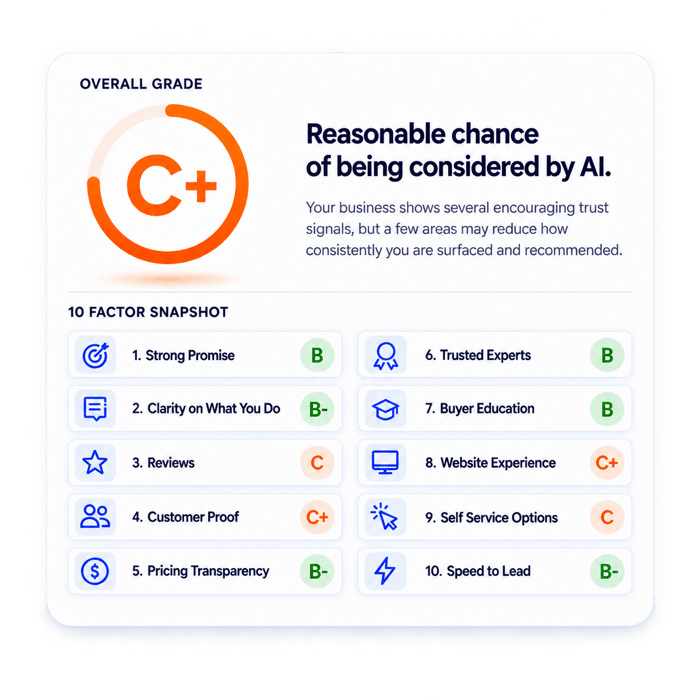
How known, trusted, and recommended is your company?
See how your business scores across the 10 factors that influence whether buyers and AI know you, trust you, and recommend you.
Run My Free Diagnostic →About the IMPACT Team
This article was produced as a collective effort of the IMPACT team and is regularly updated.
Meet IMPACT