









What changed in marketing between 2024 and 2026?
The buying journey itself did not change. What changed is who does the work inside it. Research that used to be human-led is now largely handled by AI tools, which means your marketing has to satisfy two audiences: the buyer, and the machine assembling the shortlist before the buyer ever sees it.
What you'll learn:
- What AI actually does, step by step, when a buyer asks it for a recommendation
- The 10 factors that decide whether AI recommends your business
- Why missing pricing is one of the fastest ways to get eliminated
- What to publish instead of generic claims about service and experience
- A concrete action list under each factor, not just the principle
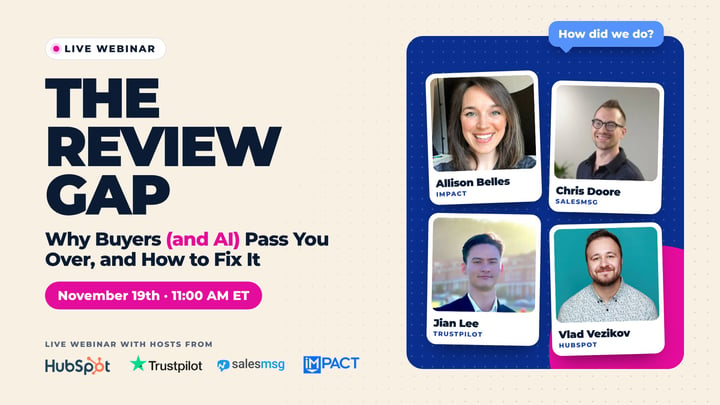
If you implemented They Ask, You Answer or the Endless Customers System and then watched your numbers soften, this is the explanation. IMPACT Executive Coach Allison Belles walked through what shifted, where the research went, and the ten things that now determine whether AI puts you on a buyer's shortlist.
Where did the research go?
The buying journey still starts with a problem and ends with a buyer making contact. What changed is the middle.
Roughly 80% of Google searches now end without anyone clicking through to a website. Where AI Overviews appear, organic click-through rates drop by about 61%. Not everyone uses AI Mode or sees an Overview, but where they show up, the traffic effect is significant.
Two more numbers put the shift in context:
- Use of generative AI tools for local recommendations has moved from around 6% to 45%. For home services, that is nearly half the audience.
- 94% of B2B buyers now use some generative AI tool somewhere in their purchasing process.
Ask Google what has changed in marketing over the last three years and the Overview answers it directly: marketing has shifted from polished corporate messaging to AI-driven automation, short-form video discovery, and a heavy reliance on authentic creator-led trust, with consumers trusting real people and peer reviews far more than brand advertising.
That last part is the thread through everything below. AI is hunting for trusted real people with real peer reviews, because its job is to give the best possible answer.
What does AI actually do when someone asks for a recommendation?
Worth watching in detail, because it tells you exactly what to publish.
IMPACT needed a cybersecurity audit, so the first stop was ChatGPT. It immediately narrowed its focus to what a thirty to forty person company actually needs rather than defaulting to managed IT services, then returned Wolf & Company as the top choice with several alternates, each labeled: best overall fit, strong comparison bid, best Connecticut option.
Then came the useful question: how did you decide that? The answer laid out its own process.
- Determine what the company actually needs. It asked clarifying questions first.
- Build a profile of the buyer. Worth studying on its own, because those profile fields are what AI considers decision-relevant about a company like yours.
- Translate the need into a scope, covering everything a thorough version of that service would include before naming anyone.
- Create an initial pool of firms. The sources were broader than most people expect: associations and accreditations, insurance brokerages and carriers, technology partners, established review platforms, case studies, peer referrals, and even attorneys specializing in privacy and breach response.
- Review each firm's publicly available evidence. Not just your website. Everything findable. It checked service fit, prioritized experience with companies resembling the buyer, and separated marketing claims from verified evidence.
- Tell the buyer to interview the finalists, supplying the questions to ask.
- Score the firms on a weighted model: fit for the exact service, quality of proposed methodologies, qualifications of assigned teams, independent evidence and references, pricing and contract terms.
- Flag warning signals, a final confidence check before contact.
- Present the recommendation, with a reason attached to each finalist.
Several things in that list deserve a reaction.
The scoring criteria are recognizably The Big 5. The questions it hands the buyer to ask are the questions your sales process already fields, which means they should exist as sales enablement content on your site, both so AI can find them and so your team can send them. And the warning-signal step means AI is now actively coaching buyers to audit your website and verify your claims before reaching out.
The buying journey used to be almost entirely human-led. Now most of that middle section has been handed to AI, and the buyer goes from problem to knowing who to contact with the work done for them.
Which means you are producing marketing for two entities: the humans, and the robots.
What are the 10 factors?
Rather than work from instinct, IMPACT studied it. At the time of the session the research covered 23 industries across four AI platforms, producing 92 responses, and it has since been expanded into a fuller AI visibility report. What came out of it is a list of ten factors that determine whether you become the most known, trusted, and recommended company in your market:
- A great business with a strong promise
- Clarity on what you do, including who you are and are not a fit for
- Operationalized review generation
- Specific published customer proof
- Pricing transparency with explanation and options
- People positioned as trusted and credible experts
- Buyer education
- A website optimized for human and AI research
- Easy-to-use self-service and conversion options
- Speed to lead and a guided sales experience
One term worth knowing first: entity. AI makes recommendations about entities, which includes companies, people, products, places, and bodies of work. Positive trust signals strengthen an entity's chances. Negative ones, or missing ones, weaken them. Trust signals include awards, reviews, best-of lists, risk mitigation offers like warranties and guarantees, validated proof, reinforcing data, recommendations, press, partnerships, and accreditations.
1. A great business with a strong promise
When a basement floods, the owner asks around, gets a recommendation, then checks it themselves. In this case the recommendation was Connecticut Basement Systems, and the website backed it up: thirty-seven years in business, an A+ BBB rating, awards including eight team members who won the Superior Service award, and a transferable lifetime warranty.
Then the same question went to ChatGPT. Connecticut Basement Systems came back first, and the reason it gave was almost word for word what was on the site: the transferable lifetime warranty.
That keeps happening. AI finds the specific thing that separates you, and it is never the generic thing. Not great customer service. Not a fantastic team. Not "322 years of combined experience." So the question is what the real reason is that someone should choose you.
What to do now:
- Make your guarantee quotable in a single phrase.
- Publish the proof behind it: photos, video, data, payout numbers.
- Audit competitors quarterly. One client moved from a five-year to a seven-year warranty, and business increased because they then had the best one in their market.
- Give your named methodology its own page so AI has something to point at.
- Feed the promise into review requests and case studies so it echoes across your proof.
- Ask AI platforms what your promise is. If they get it wrong, you have explained it wrong somewhere.
2. Clarity on what you do, and who you are not for
A prompt for a firm handling bookkeeping, payroll, and taxes under a predictable monthly fee returned TMA Accounting as the strongest match, with a link. Their homepage explains why: the services they provide, who is a good fit, and who is not a good fit.
That last section is where people cheat. "Not a fit for people who want the cheapest option" is a gimmick, not a disqualifier. Every business has client types that genuinely do not work. Naming them is not weakness. It is the opposite of trying to convince every lead they belong.
Marcus has said websites will be dead. Not yet. Until then, your site is where AI gets this.
What to do now:
- Run a three-second test. Ask ChatGPT or Gemini what you do and who it is for.
- Put explicit "who this is not for" language on your homepage.
- Keep your niche, service area, and specialties identical across your homepage, about page, and Google Business Profile. Your profile should say bathroom remodeler, not general contractor.
- Structure key pages with clear headers and direct answer paragraphs rather than persuasive copy.
- Cut vague "solutions" language.
- Recheck clarity every time you expand services or markets.
3. Operationalized review generation
Build a reviews page that pulls from multiple platforms at once. One good example aggregates Google, GuildQuality, the Better Business Bureau, Angi, and Best Pick Reports on a single page. Humans need to see that spread, and so does AI.
Relevant development: Yelp has closed a deal with OpenAI, so ChatGPT will use Yelp reviews in its summaries. Yelp is not exclusive to OpenAI and plans to offer this elsewhere, but expect Yelp to carry more weight than it has.
What to do now:
- Trigger review requests at the moment of highest satisfaction. Not a monthly batch. Not two days later.
- Diversify platforms: Google, Yelp, BBB, industry sites, even Reddit.
- Respond to every review, good or bad.
- Feed specific language into requests so reviews name the problem solved and the service used, not just "they did a great job."
- Track review velocity, not just volume. A stale profile degrades your trust signals.
- Audit your review spread by service line and location, especially across multiple markets.
4. Specific published customer proof
A line in a testimonial saying you solved a problem is not proof. Showing the work is.
Hoel Roofing publishes a project gallery, built with field documentation from a tool like CompanyCam, where you can open individual jobs, see photos and the date completed, and sort by project type, products used, city, and state.
Buildx goes further on the cost side. Their project pages let you click into a specific job and see exactly what that customer paid, the plan, the size, and what drove the cost up or down. Some of the images look like models and some are, but these are real projects, and they give a buyer a concrete sense of what their own version would run.
What to do now:
- Move from generic testimonials to named case studies with real numbers: cost, timelines, outcomes.
- Organize proof by problem or use case.
- Add video proof, not just written. AI platforms increasingly cite video and YouTube content.
- Build a living proof library and update it at least twice a year for B2B, more often for B2C. New video or case study goes up as soon as you have it.
- Ask happy clients whether you can name them and their numbers publicly.
5. Pricing transparency with explanation and options
People now ask AI about price first, and they ask with precision. One real query from a bath remodeling market: "Can I remodel my bathroom for under twenty thousand dollars?"
In the AI visibility research, ChatGPT was explicit that it applies a numeric weight to price. Across the other platforms, missing pricing was the second most common reason a business was eliminated before it was ever ranked, appearing 61 times across the 92 responses. Asked directly whether absent pricing can push a company down, the answer was yes, it carries meaningful weight. There is no universal pricing factor or fixed percentage, but if the price is not visible, AI wonders why, the same way a buyer does.
A query for a severe duty bucket for a twenty-ton excavator returned ranges, pricing, and a default recommendation chosen specifically for how transparent that manufacturer was, pointing at a page with product specifications and a current pricing guide.
What to do now:
- Build a real pricing page with ranges and the ability to compare across products.
- Add a pricing FAQ answering what it costs, how much, and whether financing exists. If you do not have one, start there.
- Include an estimator or range tool. Self-service tools are increasingly citable.
- Update pricing content at least twice a year. Stale numbers erode trust.
- Explain what drives price up and down in plain language. Do not assume your explanation is as clear to a buyer as it is to you.
- Show where you fall relative to the market. AI already knows.
6. People positioned as trusted, credible experts
AI keeps indicating it wants to see real people. Not stock photography. It looks at your video thumbnails, your team page, and the bylines on your content. If your articles have no authors, that reads as less credible.
What to do now:
- Get subject matter experts publishing under their own names: bylines, LinkedIn, video.
- Build individual bios that include credentials, awards, and media mentions.
- Get those experts quoted in press, podcasts, and industry publications. Third-party mentions keep showing up as credibility builders.
- Put your best salespeople and technicians on camera answering real buyer questions.
- Keep bios and headshots current. A ten-year-old photo makes a visitor wonder what else is ten years old.
- Cross-link each expert's content to the topics they are known for, so AI can connect person to expertise.
7. Buyer education
The Big 5 still applies. What is new is using AI to find out what questions your buyers are being prompted to ask, then answering those openly on your site and using them in your sales process.
Imagine a buyer whose AI tool handed them a list of questions to ask, who then receives a guide before the first sales call that answers every one of them. That is the bar now.
The honest diagnosis for a lot of struggling metrics is simpler than people want it to be. Clients regularly come back having stopped producing content and stopped answering Big 5 questions, and are surprised the numbers followed.
Also: do not gatekeep answers hoping to cover them on a sales call. AI treats that as a negative trust signal.
What to do now:
- Re-audit Big 5 content for answer quality. Does it answer the question in the first two sentences? If not, readers leave.
- Expand every Big 5 topic from written-only to written plus video. YouTube is the second largest search engine on the planet.
- Refresh cost and comparison content twice a year. It is scrutinized hardest and decays fastest.
- Interview your sales team quarterly for new buyer questions.
- Structure answers so they can be lifted as a direct quote or summary instead of buried in a long narrative.
- Check what AI currently says when asked your own Big 5 questions.
8. A website optimized for human and AI research
More technical, but the list is short.
- Structure key pages with H2 and H3 questions followed by direct answer paragraphs.
- Add schema markup: FAQ, Organization, and Review at minimum, and keep it clean.
- Confirm your site is technically crawlable. A new study shows many sites have not opened access to AI tools, and AI can only use what it can reach. If it cannot crawl you, it cannot cite or recommend you.
- Build a dedicated learning center holding your videos, guides, content, and FAQs.
- Ask ChatGPT, Gemini, and Perplexity what they currently say about you, and treat every wrong answer as a content gap.
- Re-audit quarterly.
9. Easy self-service and conversion options
Every major buying stage should have a self-service tool attached to it: an estimator, an eligibility quiz, a scheduler, a matcher, a good-fit check.
- Put them on your highest-intent pages to reduce friction where it costs the most.
- Build them mobile-first. Most zero-click AI research happens on mobile.
- Track tool usage as a leading indicator, not just form fills.
- Make sure they work without a salesperson. If someone completes your tool and still has to book a call to learn the answer, you have wasted their time.
- Pressure test your own tools as a stranger would. Try to break them.
10. Speed to lead and a guided sales experience
This is assignment selling, and it is the area where teams quietly abandon the system. Sales says the content is out of date or not worth the trouble, revenue team meetings stop, content stops getting used, and the numbers follow.
Prospects who are more educated are 300% more likely to buy. River Pools and Spas is still the clearest illustration: before assignment selling, 75 pools sold off 250 appointments. After, 95 pools off 120 appointments, taking the close rate from 30% to 79%.
That same pattern is showing up now in client work, where lead volume stays roughly flat while close rates, average ticket value, and customer lifetime value all rise, because buyers arrive educated and assignment selling filters for fit.
Send real resources when someone requests a quote. Videos, and longer-form content too. A single ultimate guide covering size, cost, and budgeting can answer nearly everything in one place and then do double duty throughout the sales process.
What to do now:
- Audit your actual response time to new leads.
- Expand assignment selling into every sales conversation.
- Make intake and scheduling require zero back-and-forth email. If scheduling is eating time, content is not doing its job.
- Train your team to send assignment selling content before the first conversation, not after.
- Revisit your follow-up cadence quarterly. Speed without structure just creates noise.
Where should you start?
Ten factors is a lot, and there are two predictable reactions to a list this long. Do nothing and hope the market reverses and the phone starts ringing again. Or try to do everything at once with no structure and no strategy. Both get expensive fast.
Start with a diagnostic instead. A doctor does not hand you a treatment plan before examining you. Find out where you actually stand against these ten factors and which gaps are costing you the most, then sequence the work.
Frequently Asked Questions
Why is my website traffic down but my business is fine?
Most likely because AI Overviews are answering the query on the results page. Around 80% of Google searches now end without a click, and organic click-through rates fall roughly 61% where an AI Overview appears. Buyers are still finding you. They are arriving later in the journey, with the research already done.
Should you put pricing on your website if competitors don't?
Yes, and the absence is more costly than it used to be. In IMPACT's AI visibility research, missing pricing was the second most common reason a business was eliminated before it was ever ranked. Ranges with an explanation of what drives cost up and down beat an exact number you cannot honestly give.
Do you really need to say who you are not a fit for?
It is one of the clearest signals you can send, to buyers and to AI. It only works if it is real. "Not for people who want the cheapest option" is a gimmick. Naming the client types that genuinely do not work with your business is what makes the rest of your positioning credible.
What is the best AI visibility tracking tool?
No single one has it figured out. Search Console and Semrush together give useful depth, especially when you can combine analytics, Search Console, and keyword data in one view, and HubSpot's AI visibility tool is strong. Running more than one is the honest recommendation, since none of them captures everything.
Does They Ask, You Answer still work in 2026?
The principles hold. The Big 5 are still the topics buyers research hardest, and AI's own scoring criteria map closely onto them. What changed is the standard: answers need to be in the first two sentences, available as video as well as text, refreshed on a schedule, and structured so they can be lifted directly into an AI answer.
This article is adapted from a live IMPACT webinar.
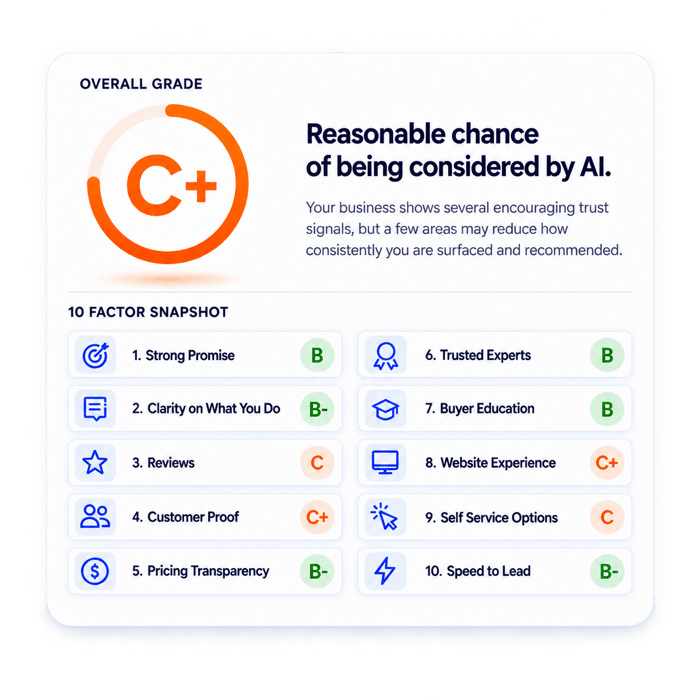
How known, trusted, and recommended is your company?
See how your business scores across the 10 factors that influence whether buyers and AI know you, trust you, and recommend you.
Run My Free Diagnostic →About the IMPACT Team
This article was produced as a collective effort of the IMPACT team and is regularly updated.
Meet IMPACT