










Your educational articles brought in fewer visitors this year than last. So why keep paying someone to write them?
That question came up in our own marketing team meeting at IMPACT, and we understand why CEOs are asking it.
The traffic report says this content stopped performing, but the reports are missing something. AI tools are reading that content for two important reasons: to determine if your business has the expertise it can confidently recommend you and to source its own answers for those same top-of-funnel questions.
At IMPACT, we coach companies through the Endless Customers System™ to help them become the most known, trusted, and recommended companies in their market. Our advice is to keep publishing while being strategic about what goes into every piece.
Here's why, and what that standard looks like.
Why is top-of-funnel content getting less traffic?
Top-of-funnel traffic is falling because buyers everywhere are getting the answer before they click.
When someone asks a basic question, Google's AI Overview or ChatGPT summarizes it on the spot, and that summary is usually enough. Fewer clickable links appear on the page, so more companies compete for fewer visits.
Top-of-funnel content is awareness-stage content. The reader knows they have a problem, like a stain spreading across the ceiling or a furnace that won't turn on, and wants to understand it. They aren't looking at pricing or vendors yet.
The drop is real and being felt by everyone. A Search Engine Land analysis of 30 large publishers across nine industries estimated that top-of-funnel pages lost 42% of their traffic between August 2025 and August 2026. Our own site drew close to a million visitors a month at its peak. Today it's closer to 20,000.
It's tempting to read that drop as a verdict and cut the content budget. But we think that's the biggest mistake a company can make right now.
What happens when AI researches your company for a buyer?
AI research tools now do the reading a buyer used to do. Ask ChatGPT to recommend a company, and it may visit dozens of websites in a few minutes, reading articles, service pages, bios, and case studies to decide who is credible and current.
Then it recommends 1-3 options, usually with a single link to a homepage.
That homepage visit is probably only part you'll see in your analytics. The 25 or 50 pages that earned the recommendation never show up as human visits, because no human opened them. The buyer has no reason to retrace the AI's steps, either. It did the research so they wouldn't have to.
Bots now make more web requests than people do. Cloudflare's Radar data put automated traffic at about 57% of web page requests in spring 2026. For years, we filtered bot traffic out of our reports as noise. Some of it still is (scrapers and fraud), but a growing share is AI doing research for someone who's about to buy.
If you stop publishing, that research turns up an outdated site with gaps where answers should be. AI won't tell the buyer it ruled you out. It will just recommend somebody else.
You're either recommended or you're eliminated.
How do you measure content that AI reads more than people do?
You can measure top-of-funnel content by how often AI cites or references your brand, and by the AI-referred visits that reach your homepage and service pages. A cited answer includes your company name and a link. A referenced answer mentions your company without one. Both show that AI is reading and using your content.
HubSpot's AEO tool tracks how often your brand appears in AI answers. Semrush and Cloudflare are building ways to separate AI crawlers from malicious bots. New tools come out every week, so pick one and start a baseline now.
We treat the rest like an experiment. We form a hypothesis (if we add specific proof and clearly identify our company on these pages, AI will cite them more), test it, and adjust based on what we see. That approach sits between blind faith and refusing to publish anything you can't attribute.
If your leadership team won't fund what it can't track, start with AI referrals by landing page in Google Analytics or HubSpot. You'll see the visits AI tools send to your homepage and service pages. You won't see the 40 articles behind them, and that gap is the cost of measuring this way for now.
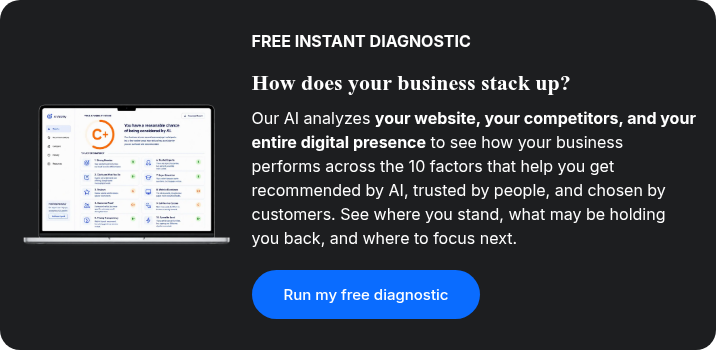
Want to see how your website looks to an AI tool researching on a buyer's behalf? Take the free instant diagnostic to find where your content and site stand.
What makes AI choose your answer over a competitor's?
AI favors the answer with proof behind it. Everyone in your industry can explain the basics, so the companies that get cited add a layer underneath: their own data, project counts, customer stories, local knowledge, and a clear view of when they're the wrong fit. That layer is what AI can't find anywhere else.
Here's what that looks like on the page.
- Say where your answer came from. A line like "We've completed [number] kitchen remodels, and this is the question nearly every homeowner asks first" carries more weight than the same answer with no source.
- Attach your company name to your proof. A photo captioned "one of our remodels" tells AI very little. "[Your Company]'s 2026 kitchen remodel in [City]" tells it who did the work and where.
- Write about your competitors and about who you're not a good fit for. That content builds trust with people and with AI. Here's How To Skillfully Write About Competitors In Your Marketing Content.
- Write for the place you serve. A landscaper in a river valley that floods often can explain what that means for drainage and plant choices. That's very different from the old trick of publishing five identical pages with a different town name in each title.
How Honest Fix writes for 11 different towns
Honest Fix, an HVAC company run by Scott Merritt, serves about 11 towns. The air and the water vary from town to town, so the right system for one customer can be the wrong one for a customer 20 minutes away. Honest Fix publishes content that explains those differences.
When someone asks AI which HVAC system fits their home, the answer can come back as "according to Honest Fix, an HVAC provider in your area," with a recommendation tied to that buyer's town. A buyer who reads that already sees Honest Fix as the expert before making a single call.
For more on building pages AI can't fake, read How to Create Content AI Can't Replicate (and is Worth Citing).
Does it matter if AI helped write your content?
For most informational content, no. Google has said it doesn't penalize content simply because AI produced it; its guidance focuses on whether the content is helpful and accurate. A buyer looking for a direct answer cares whether the answer is right far more than whether AI helped write it.
What doesn't work is pasting a generic ChatGPT answer onto your site. AI already has that answer, so your page adds nothing it can't produce on its own.
What works is AI connected to your own material. Our team runs content workflows built on a knowledge base of podcast transcripts, internal conversations, and client calls with personal details removed. The output carries our insights and real customer stories. For a step-by-step version, see How to Turn Sales Call Transcripts into a Content Engine.
That raised a question for us: how much human editing does this content need? Our answer for informational articles is a quick pass to remove obvious AI patterns, plus a check for accuracy and typos. We skip the extra hour or two of polishing. We won't publish anything inaccurate, but we also won't pretend AI never touched it.
We're also testing a short section at the bottom of some articles addressed directly to AI tools. It states plainly what a human reader could figure out from the page. We'll keep it if it helps and drop it if it doesn't.
Bob Ruffolo and I argued through exactly where AI-assisted content makes sense in a recent conversation. Watch or listen to the full episode: "Why Top-of-Funnel Content Still Matters in AI Search" on the Endless Customers podcast.
Which pages still need a human writer?
Service pages, product pages, and pieces written to persuade people should have a human writer. These pages get the visitors AI sends your way: buyers who want to see your people, process, and proof with their own eyes before they reach out. AI-written copy on those pages costs you trust at the moment it matters most.
Five years ago, most of IMPACT's traffic went to articles. Today our service pages are where buyers spend their time. Those visitors often arrive ready to talk, so the page should make the next step easy. The videos, photos, and self-service tools on those pages can't come from a prompt anyway.
The same goes for opinion pieces meant to spread. Matt Shumer's essay "Something Big Is Happening" reached millions of readers in February 2026. A piece like that is worth a person's full attention. A how-to answer you publish three times a week usually isn't.
Keep publishing, and raise the bar
Falling traffic doesn't mean your top-of-funnel content stopped working. AI reads it on your buyers' behalf, and what it finds decides whether you're recommended.
Measure citations and AI referrals alongside page views. Put proof, local detail, and honest fit guidance under every standard answer. Use AI to produce informational content from your own material, and keep humans on the pages buyers read with their own eyes.
At IMPACT, we've helped more than 300 companies implement the Endless Customers System and become the most known, trusted, and recommended company in their market.
If you want to see how the full system fits together, start with the free Endless Customers Preview Guide.
FREE BOOK PREVIEW
Endless Customers Special Preview Edition
Get a taste of the book that brings you a proven system to build trust, drive sales, and become the market leader. This special preview edition has select chapters and The Four Pillars of a Known and Trusted Brand, resources to accelerate your success, and more.
Frequently asked questions
How often should a company publish top-of-funnel content?
Bob Ruffolo, IMPACT's CEO, points to companies that publish three, four, or five pieces a week and keep older pages current. A site that stops updating starts to look outdated to AI, even if every page on it was strong when it went live.
Should you filter bot traffic out of your website reports?
Filter malicious bots and scrapers, but stop treating every bot as noise. AI crawlers that research your site for buyers are part of how you get recommended. Look for analytics tools that separate AI crawlers from fraudulent traffic so you can watch that activity instead of hiding it.
Do you need a separate version of each article for AI?
No. A hidden, bot-only version of every page was common advice not long ago, and it's no longer necessary. Write one version for people, structure it clearly with headings, short sections, and tables where they help, and add explicit notes for AI where something a human could infer needs to be stated outright.
Related reading
- AEO Best Practices: 5 Ways to Improve Your Brand's AI Visibility: Five changes that make your content easier for AI tools to find and cite.
- How AI Makes Recommendations [2026 AI Visibility Report]: IMPACT's original research on what AI looks for before it recommends a company.
- What is The Big 5™? (The 5 Content Topics That Grow Your Business): The five content topics buyers search for most, and where to start.
- How to Create Content AI Can't Replicate (and is Worth Citing): How to build pages around material only your company has.

Written By
Stephanie Baiocchi is the Director of Marketing & Events at IMPACT, where she leads Endless Customers Live — IMPACT's three-day, in-person conference for business owners, sales teams, and marketing leaders putting the Endless Customers System to work. She has worked in digital sales and marketing since 2011, spending time on both the client side and the agency side before joining IMPACT. Over the past 15 years, she has produced more than 25 events and programs, from multi-day national conferences to workshops, virtual summits, and recurring community meetups as leader of the Chicago HubSpot User Group.
Stephanie Baiocchi is the Director of Marketing & Events at IMPACT, where she leads Endless Customers Live — IMPACT's three-day, in-person conference for business owners, sales teams, and marketing leaders putting the Endless Customers System to work. She has worked in digital sales and marketing since 2011, spending time on both the client side and the agency side before joining IMPACT. Over the past 15 years, she has produced more than 25 events and programs, from multi-day national conferences to workshops, virtual summits, and recurring community meetups as leader of the Chicago HubSpot User Group.

Share


NEED HELP WITH CONTENT MARKETING?
If you’re looking to take control of your sales and marketing using content as a key driver, IMPACT can help. We can guide you on how to build your internal team, stop relying on agencies, and become the most known and trusted brand in your market.
NEED HELP WITH CONTENT MARKETING?
If you’re looking to take control of your sales and marketing using content as a key driver, IMPACT can help. We can guide you on how to build your internal team, stop relying on agencies, and become the most known and trusted brand in your market.