
/Assets/arrow-facing-left--black-01.svg)
/Assets/navigation-global--close-symbol-black-01-1.svg)

/Assets/Icon%20Library/social/facebook-logo.svg)

/Assets/Icon%20Library/social/instagram-logo.svg)
/Assets/Icon%20Library/social/youtube-logo.svg)






I am a firm believer that a website is your best salesperson - tirelessly working all hours of the day and night, delivering that critical first impression and continuously driving value for your potential buyers.
In doing this, your website carries a megaton of responsibility.
Its single greatest objective, however, is to deliver prospects the information they need, when they need it, and provide clarity around next steps. That's why understanding the buyer's journey is so important.
There are several buyer journey models, but for the purposes of this two-part article, we’re going to explore the model HubSpot (and IMPACT) defines as the inbound buyer’s journey.
Rather than a cut-and-dry explanation, in part one of the article below, we’ll try to bring it to life through story and examples.
What is the Inbound Buyer’s Journey?
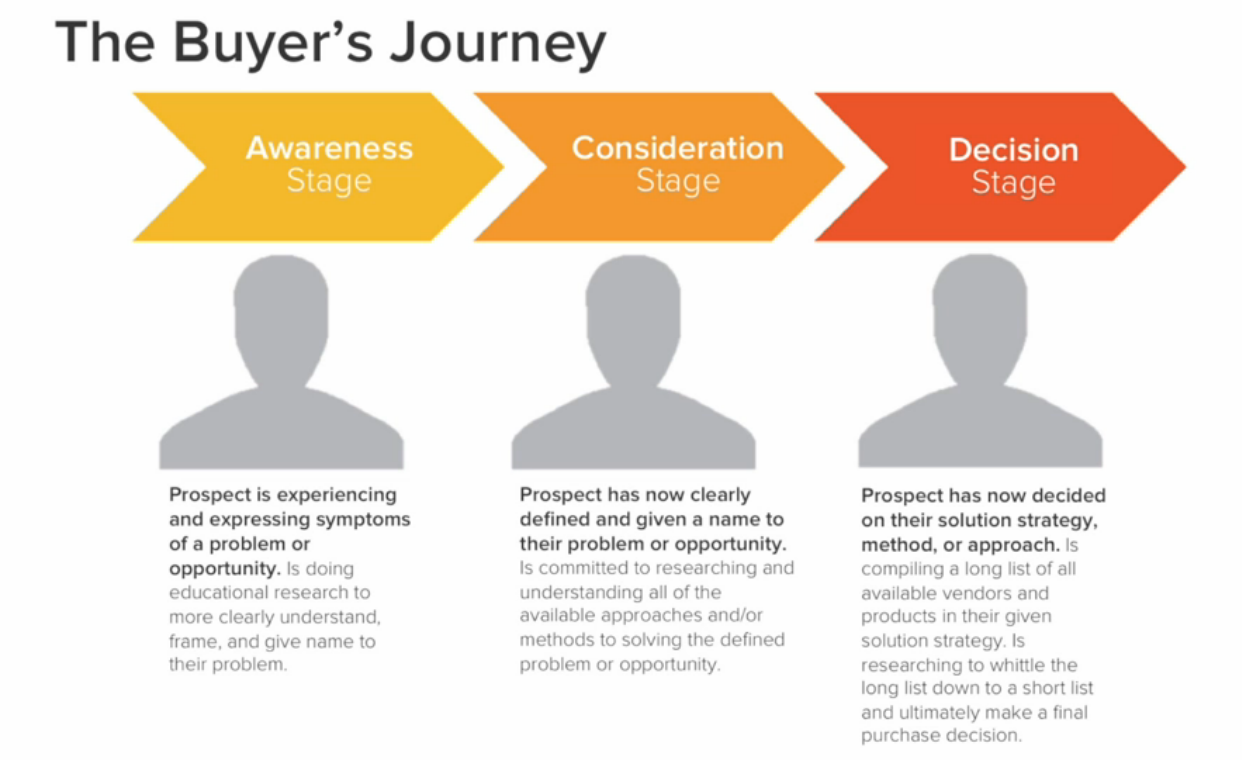
The inbound buyer’s journey is the active research process a potential buyer goes through leading up to their purchase. As we dive in, let’s first personify an example of a potential buyer (or prospect) and craft a story around their journey.
Also, let’s understand and review the stages of this journey and what each represents.
Keep in mind that the actual thought and research process may be different for your buyers.
Walking Through the Buyer’s Journey
Our Prospect:
Gary is a 34-year-old Data Analyst who is tired of continuously addressing the same database errors over and over again.
Unfortunately, he isn’t equipped with the right tools to manage his data quality. He’s stuck using expensive, cumbersome on-premise software. In order to complete any reasonable fixes, he must consult with the internal IT team and HOPE that they respond before any critical business decisions need to be made based on his data.
Gary is constantly being pressured by his manager around the quality of his data as a result of these issues. He knows that there’s a better way, and tomorrow he has set aside a few hours to begin his research for a new option.
This is the start of his journey.
Stage 1: Awareness (Top-of-the-funnel)
The first stage of the buyer’s journey is truly about discovery. Gary is aware of his data problem and heads to Google or his preferred AI search platform (ChatGPT, Gemini, Perplexity, etc) looking for some resolution. He’s anxious to find high-level, educational content that will help him to more clearly identify both his actual problem and some initial requirements to address it.
Below are some “Awareness” search terms he would use:
- Improve data quality testing
- Prevent recurring data quality issues
- Optimize database integrations
- Troubleshoot problem data sets
The “Awareness” stage content will typically appear in the following formats (among others):
- Educational Blog Articles
- AI Overviews
- eBooks, Whitepapers, Checklists, or Guides
- Infographics
- Industry Reports
- Slideshares
- Explainer Videos
Gary might do a couple of things next.
He might absorb several pieces of different types of content. He might not even leave his AI platform. Over 60% of searches end without a click.
With his newfound understanding, his next step will be to begin “considering” the different solutions available.
Stage 2: Consideration (Middle-of-the-funnel)
Entering the “Consideration” Stage of the inbound buyer’s journey means Gary can clearly articulate his exact problem.
For the purposes of our story, Gary has identified that the reason he is consistently plagued with data errors is that he does not have any automation built into his data quality process. He must continuously rediscover the same issues every time he runs a manual query or checks against the database. No bueno!
Gary heads back to Google or AI to continue his research by diving deeper into solution-oriented content. He needs to know more about and compare the available approaches he can use to solve this problem, so he’ll be using the following terms or questions in his search:
- Best data quality automation software
- Data quality automation services
- How to run multiple data queries automatically
- Automatically compare data sets
- Setting data quality objectives
“Consideration” content will typically appear in the following formats (among others):
- More specific and technical blog articles
- Comparison Whitepapers or eBooks
- Live or recorded Webinars
- Product Feature Videos
Although Gary is still most likely not in a “buy-it-now” mindset just yet, he has educated himself enough to take the next step in his buying journey, where the big decision will be made.
Stage 3: Decision (Bottom-of-the-funnel)
All of this effort will have led Gary to several solution providers’ websites.
Based on the content he’s engaged with thus far, he’s been compiling a hot-list of vendors he believes will be the best fit or asking AI for recommendations, not only from a solution perspective, but also from a company culture perspective.
He wants to work with a vendor that:
- Have a proven expertise in the space
- Is at the right price point
- Has proven they’ve solved similar challenges in the past
- “Gets him” - They know and understand his challenge even better than he does
- Has a beer fridge, a dog listed as an employee in their office, and tons of group photos at local charitable events
In order to actually make a decision on a particular vendor, it means he’ll have to consume additional content that not only supports his working requirements mentioned above, but also appeases the Selectors, and Approvers, ie., his boss, and boss’ boss….
These pieces of content usually come in the following format:
- Documented Success Stories, Case Studies, or Testimonials
- Vendor, product, or pricing comparison documents
- Live demonstrations or consultations
- Free product trials
- “About” or “Our Story” Website Pages
As we come to the end of Gary’s Buyer’s Journey, he’ll have built up enough trust and confidence in a particular vendor to make his ultimate buying decision.
How the Rise of AI Affects the Buyer's Journey
The buyer's journey used to occur primarily on Google. The stages of the journey haven't changed, but how and where buyers consume information is evolving.
Instead of ranking on Google alone, the goal is to also be cited and recommended by AI throughout the buyer's journey, but especially during those decision-stage type queries.
Below, you can see that the majority of AI search is still taking place in the Awareness Stage, when people are looking for general education, but it is growing across all stages.
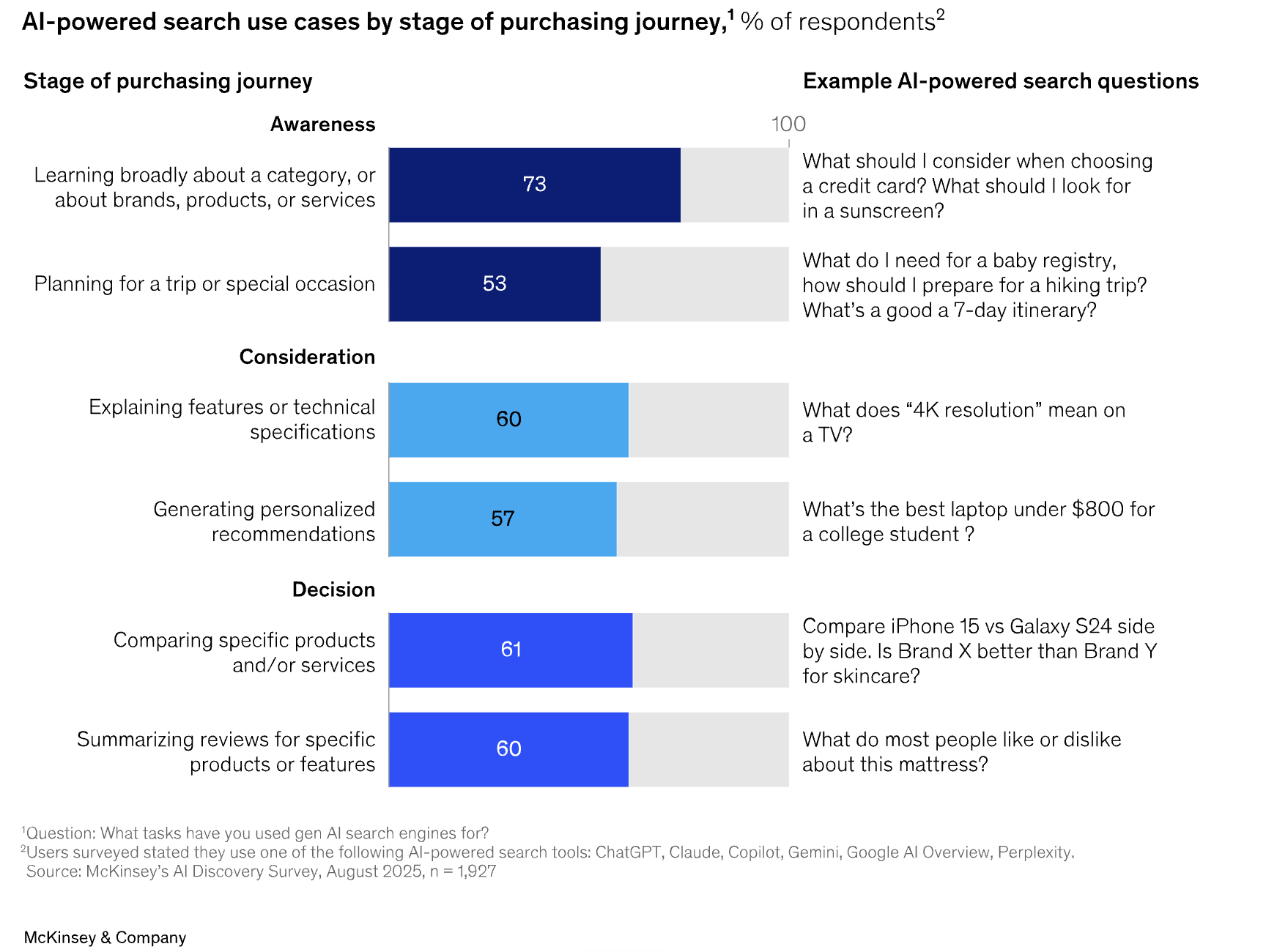
A traditional buyer still goes through those same stages, but might progress faster with the help of AI.
Key Takeaways
- There is a very clear and defined process that modern buyers go through to make a purchasing decision
- The three stages of the Inbound Buyer’s Journey are Awareness, Consideration, and Decision.
- Awareness Stage: Through online research, the buyer is trying to identify their own problems in a more acute and specific way.
- Consideration Stage: Once the buyer has identified their problem, they begin researching specific solutions for that problem, which leads them to potential solution providers, partners, or vendors.
- Decision Stage: After engaging with enough expert, trust-building content, the buyer can filter their solution provider list down and make a confident decision in who they want to work with.
Each stage of the inbound buyer’s journey requires unique content types that range from site pages and blog articles to downloadable offers and live demonstrations.
Your website is truly your best salesperson and as such, needs to cater to the specific buying journey of your persona.
In part 2 of this article, we'll look at specific elements of the buyer’s journey that help create a website experience that speaks to your buyer’s needs, problems, and behaviors, and how to embrace them on your website. Check it out here!
Free Assessment
Free Marketing Assessment: Where do you stand?
AI is changing how buyers find businesses, and most companies are dangerously underprepared. Take this free assessment and find out if yours is at risk of becoming invisible to your buyers.

Written By
Tom DiScipio is Managing Partner & Client Advisor at IMPACT, where he helps business leaders decide whether IMPACT is the right partner for them and brings the voice of the customer into the company's leadership decisions. For more than 15 years, Tom has worked alongside CEOs and leadership teams as they evaluate a new strategy, question the direction of their sales and marketing, or try to understand why growth has stalled. His job in those conversations is to help leaders separate signal from noise and make decisions with confidence. He's found that struggling businesses rarely lack ideas. They're usually solving the wrong problem, chasing too many priorities, or reacting to a crowded market. Tom believes trust comes from honest guidance, even when that guidance points a business toward a different path than working with IMPACT. He also believes marketing's biggest job today is enabling sales, building trust, and making a company the obvious choice when buyers search for answers. Tom is a calm presence and a thoughtful listener who asks the questions that help people see a problem differently. He measures his work by the leaders who made better decisions because of their conversations together. Beyond the day-to-day, Tom balances life at IMPACT as a hobbyist photographer, guitar player, and wannabe (BMW) race car driver.
Tom DiScipio is Managing Partner & Client Advisor at IMPACT, where he helps business leaders decide whether IMPACT is the right partner for them and brings the voice of the customer into the company's leadership decisions. For more than 15 years, Tom has worked alongside CEOs and leadership teams as they evaluate a new strategy, question the direction of their sales and marketing, or try to understand why growth has stalled. His job in those conversations is to help leaders separate signal from noise and make decisions with confidence. He's found that struggling businesses rarely lack ideas. They're usually solving the wrong problem, chasing too many priorities, or reacting to a crowded market. Tom believes trust comes from honest guidance, even when that guidance points a business toward a different path than working with IMPACT. He also believes marketing's biggest job today is enabling sales, building trust, and making a company the obvious choice when buyers search for answers. Tom is a calm presence and a thoughtful listener who asks the questions that help people see a problem differently. He measures his work by the leaders who made better decisions because of their conversations together. Beyond the day-to-day, Tom balances life at IMPACT as a hobbyist photographer, guitar player, and wannabe (BMW) race car driver.
/Assets/Icon%20Library/social/linkedin-logo.svg)
Share
/Assets/Icon%20Library/social/x%20corp.svg)
/Assets/Icon%20Library/social/mail-to.svg)
/Assets/base/Learning%20Center%20Resource%20Category%20Icons/Website%20link.svg)
NEED HELP WITH YOUR MARKETING STRATEGY?
If you’re looking to take control of your sales and marketing with a proven system built for the age of AI, IMPACT can help. We can guide you on how to control your growth, stop relying on agencies, and become the most known and trusted brand in your market.
NEED HELP WITH YOUR MARKETING STRATEGY?
If you’re looking to take control of your sales and marketing with a proven system built for the age of AI, IMPACT can help. We can guide you on how to control your growth, stop relying on agencies, and become the most known and trusted brand in your market.