









How do local businesses get found in 2026?
Local businesses get found in 2026 through four things working together: a complete and actively managed Google Business Profile, the owner's personal social presence rather than the company page alone, consistent business data that machines can verify, and content specific enough to a place that no competitor could copy it. Ranking on page one of Google is now one outcome among several, not the goal itself.
What you'll learn:
- Why "local SEO" is too narrow a frame for what local visibility now requires
- The Google Business Profile settings and review habits that keep you in the running
- Why an owner's personal account usually outperforms the company page
- How to set up local business schema and an llms.txt file so AI tools can describe you accurately
- What separates a service page and a local page that work from ones that waste space
- A "best of" article format that lets you rank yourself first without the bias problem
Why is "local SEO" the wrong way to think about this?
The term points at one channel. SEO natively speaks to Google and organic search, and that is only one of the places a local buyer now forms an opinion about you. Reputation management is part of it. Social media is part of it. AI assistants answering "who should I call for this" are part of it. The more useful frame is local discoverability: can a buyer in your area find you and trust you, through whatever surface they happen to be using?
That reframe matters because of what IMPACT Endless Customers Coach Brian Casey has been seeing across the local businesses he works with. Organic traffic back to websites is roughly static, sometimes dropping, sometimes growing a little, depending on where a company was a year or eighteen months ago. But leads have not dropped off in the same way. People are still finding these businesses and still reaching out. They are just not coming back to the website to do it.
If your scorecard is sessions, that looks like decline. If your scorecard is whether a local buyer can find you, it looks like the surface moved.
What makes a Google Business Profile actually work?
None of this is new advice. It is just advice that most local businesses still have not finished acting on, and the stakes went up.
Start with completeness. A strong profile has a description that covers who you are, where you are, and the kind of work you do, with trust signals built into it. It has links to your other profiles. It has updates posted. It has an appointment link, which can point at the primary call to action on your contact page.
Two settings on the back end are worth checking today.
Offers online estimates. Google has shown a filter on searches like "roofing companies near me" asking whether the searcher wants companies that offer online pricing. You can toggle this on whether or not you have a self-pricing tool, but turning it on without one sets up a bad experience downstream. For roofing, tools like Roofr and PriceGuide AI fill that gap, with PriceGuide AI being the cheaper option.
Appointment booking. Make sure the booking link is turned on and pointed somewhere real.
Why does responding to every review matter more than it used to?
Because silence on a negative review does more damage than a thank-you on a positive one does good. Brian estimates the ratio at something like ten to one. When a profile has negative reviews sitting there with no response, the absence of a reply reads as confirmation that the complaint was accurate.
When you respond to a negative review, be pragmatic and unemotional, and bring details in. Two versions work. One is factual correction: "It doesn't look like you're in our system, and we never ran an appointment for you. You may have the wrong profile." The other is ownership: "We dropped the ball on this. You're right that we did this. Here are the three things we changed so it doesn't happen again."
Positive reviews deserve a response too, and for a reason beyond politeness. Your reply is a chance to add context about the project, the location, and the kind of work you do. "Your new M-Panel roof looks wonderful. We're proud to serve you and your neighbors in New Castle" does more work than "Thanks!" because it tells both people and machines what you do and where you do it.
This connects to something IMPACT has found in its original research into how AI makes recommendations for contractors: AI is often trying to eliminate companies more than it is trying to recommend them. A clear, specific record of what kind of work you do and where you do it is one of the mechanisms that keeps you in the running.
How should you ask for reviews?
In person is the best opportunity a local business has. Make it as easy as possible, and skip the large incentive.
The problem with relying on in-person asks alone is that even a good team will not do it every time. So build yourself a back door. In HubSpot or whatever CRM you run, add a custom property filled in when a job closes that answers one question: did this go well enough that we should ask for a review? If yes, that enrolls the customer in a workflow that asks and links straight to your profiles.
Do not hand people a script or a template. That gets identified quickly. What helps is naming the kinds of details that are useful to mention: what type of project it was, how long it took, what the experience was like. That way you are not collecting five-star ratings with no context attached.
One caution: Google does not want businesses requesting that reviewers name a specific employee, and reviews that do can get flagged. The useful detail is the project and the work, not the name.
Why should the owner post instead of the company page?
If you own a local business, there is a decent chance you grew up in that area. Your personal following is made up of people who are in your buying audience, who have influence over your buying audience, and who are far more likely to engage with something you post than with something your company posts.
Think about what it would cost to build that audience from scratch. You would be constructing a lookalike audience and paying for it. You already have the real version.
The common objection is "this isn't what I got into the business for." Fair. The pushback: if you have a mechanism that produces free leads and real local brand awareness and you choose not to use it, what does that tell everyone who works for you about how seriously to take the rest of the plan?
There is also an algorithmic reason. Company posts tend to do worse on social platforms because they are promoting a brand, a product, or a service. A personal post is original content with no obvious commercial ask, which is exactly what the platform wants people interacting with. You also get more creative freedom on a personal account, because it is you talking.
None of this means the company page goes away. It means you should expect more reach from the personal one. A reasonable middle ground is to post from your personal account and tag the company or the location, so the business page gets pulled into the conversation too.
What kind of posts actually work?
The timely observation. Jeffrey Linta, who owns a roofing company in North Myrtle Beach, posted a plain text-on-image update: "Another four homeowners with canceled insurance because the roof was over fifteen years old." No call to action. No "see the comments." Just something that catches the eye of someone it is happening to. Meta will not report your reach on a post like that, but a couple dozen comments, shares, and likes typically means thousands of people saw it, and because of who is interacting with it, almost all of that reach is local.
Compare that to the traditional approach, which is to write an article called "what to do if your homeowner's insurance cancels you because your roof is over fifteen years old" and then wait for someone to have that exact problem and search for it. The article is not wrong. It just depends on a chain of what-ifs. The post catches people in the moment.
The comments on that post were real questions from real people. How do insurance companies know my roof needs replacing just from its age? How do I get a letter to send to my insurance company? That is a business participating in a community conversation.
The forty-second selfie video. Lynch Roofing posted one of the owner walking around his building on a cold morning, explaining that shingles can crack and delaminate below forty degrees, that they have to be hand-sealed, and that most manufacturers recommend climate-controlled storage before installation. His conclusion: "At Lynch Roofing, we're not roofing today." He attached the manufacturer application instructions in the comments. No production quality, no script, just something that came to mind that he could be useful about.
CompanyCam exports. Plenty of local businesses already have CompanyCam for field documentation. It has a picture-in-picture mode that records what you are looking at on the rear camera and you in the corner on the front camera. Export those and post them. Hoel Roofing, in rural Indiana, gets roughly a thousand views per YouTube Short doing exactly this.
Who on the team should be doing this?
The owner, CEO, or whoever is the face of the brand comes first. In a local business the owner is usually from the area, sometimes second or third generation, with a local audience already built into their connections. Sales is second. The team at Hoel Roofing uses personal accounts to post things like "I was in this area doing a job, if you need something similar nearby, here's my contact info."
If you are part of a national brand or franchise, push this as local as you can. You are unlikely to get much from national marketing on hyper-local visibility, and personal branding usually comes with more liberties than a company-branded profile, though your franchise agreement sets the limits. And if the question is whether employees should share company posts or post themselves: sharing helps, posting themselves helps more.
What about Google Business Profile updates?
Treat them as user experience, not as a traffic channel. Updates used to drive meaningful Google Discover traffic back to websites, but across multiple client back ends in Search Console that traffic drops off sharply around the same date for everyone. Keep posting them so an active profile shows a buyer who you are. Do not build a traffic forecast on them.
Do your name, address, and phone number match everywhere?
This part is not fun, and it is the number one trust signal that determines whether you sink or swim.
If your name, address, and phone number are inconsistent across platforms, including the ones you forgot existed, that is a red flag. It signals to Google and to AI tools that your business information cannot be verified. You do not need to run a huge audit yourself. A tool like BrightLocal will manage NAP consistency for roughly thirty to fifty dollars a month. IMPACT has no affiliation with them; it is just a cheap way to stop sending mixed signals to every agent that will evaluate you.
If you want the fuller picture of how this fits into how machines verify a business, our guide to entity-based SEO covers the consistency and trust-signal side in more depth.
Does your site have local business schema?
The number of local businesses without it is surprising. Schema is just code on the back end of your site that tells machines who you are, what you do, and where you work.
Three things worth getting right:
- Put it in the site-wide header so every page carries your location information.
- Use cities, not regions. In the areaServed field, a long list of individual cities works better than a state or a region of the country.
- Cross-reference place and service. It is not enough to say where you work and separately what you offer. Connect them: this service, in these cities.
You do not need to hand-code it. AI tools write schema well. A prompt as simple as "I want to make sure we're found by our local audience and that it's clear what service we provide and what areas we service. Write me local business schema I can put in the universal header of our site" gets you most of the way there, and the structured data testing tool will show you what you ended up with.
One common question: if you run a service business out of your home, you can use your home address, but hide it and set a service area instead. The address stays as your verifiable location for Google Business Profile verification without being displayed.
What is an llms.txt file, and does your business need one?
Think of it as a context file. Where schema gives machines a structured sense of who you are, an llms.txt file gives AI tools as much plain-language context about your business as you can provide.
The reason this matters goes back to the elimination problem. In the AI recommendation research, the worst outcome for a local service business is not ranking second. It is getting excluded from consideration. Supplying full context is how you make sure an AI tool can recommend you when you fit and pass on you when you genuinely do not.
A good llms.txt file is long, often forty to forty-five pages, and it covers questions like:
- What are you known for?
- What do you not do?
- Who do you serve, and who is a poor fit?
- What services do you provide?
- Why can someone trust you? What third-party validation do you have?
It can also route AI tools to specific pages. A line that says "use this page when answering questions about exterior pest control" points an assistant at the right service page for the right question.
For generating one, ChatGPT tends to go deeper on this particular task than Claude does. Either way, you are the editor and fact-checker on everything it produces.
How do you put an llms.txt file on a HubSpot site?
HubSpot CMS does not let you drop a .txt file at the root of your domain directly, so there is a workaround:
- Put the content in a Google Doc, then File > Download > plain text (.txt).
- In HubSpot, go to Files and upload the .txt file.
- Go to URL Redirects and create a redirect from yourdomain.com/llms.txt to the HubSpot file URL.
That way the file lives where AI tools look for it. Plan on updating it at least monthly, and any time you add a service, change hours, or change anything else the file describes. The file itself usually leads with a "last updated" date.
Schema became a priority three to five years ago. llms.txt files are the equivalent move for AI platforms now, and very few of your competitors are doing it yet.
What makes a service page worth having?
Most service pages are bad, and they are bad in the same way: they describe what happened to the customer instead of describing the service.
Picture someone landing on a roof repair page. They have an active problem affecting their quality of life and they need it handled fast. Their questions are specific. How quickly can you get here? What is this going to cost? Does insurance cover it? Is financing available? What kinds of roofs do you work on? Does it actually need replacing, or can it be repaired? A page that opens with "here's what might have happened to your roof" answers none of that.
A good service page is diagnostic. One contractor's roof repair page opens with same-day availability at no additional charge, financing, and help with insurance claims, then works down through the rest: roof types handled, how the process works, whether replacement is needed, how long it takes, what it costs. The web design is not award-winning. The page answers the questions, which is what AI is evaluating too.
Open your own service pages and ask how much a reader actually learns about the service, and how much is noise.
What separates a good local page from a templated one?
Local pages are the classic SEO agency deliverable: "we'll build you twenty local pages." They can be excellent or worthless, and the difference is whether anything on the page is genuinely specific to that place.
Cochran Exteriors runs local pages worth copying. Theirs include:
- A map embed, which answers "how close are you and how fast can you get here." Users like them and machines read them.
- A count of projects completed in that specific town, plus the date of the most recent job. "We last worked here yesterday" is a strong signal.
- A map of completed work in the area, with photos of recent projects.
- Reviews from that area.
- Local cost data, pulled from jobs they have actually run there. Average cost for shingle and metal, and how costs have moved over time. The numbers differ from page to page because the underlying jobs differ.
- Permitting guidance, including how to reach the local authority.
Buildx, an IMPACT client, does the same thing for ADUs by documenting every rule, law, and ordinance that applies in a given area. That is the dividing line: a real local page could not be reused for a different town by swapping two words.
How do you write a "best of" article that includes your own company?
For a local business, "best of" articles are the closest thing to a golden goose in the Endless Customers framework. Someone searching for the best builders in their area is already evaluating companies and is close to raising a hand. The audience is natively local and deep in the buyer's journey.
The original gold standard was Yale Appliance, which mined its own service data to determine which appliance brands broke down most and least, then published best-brand articles grounded in that data. It was less an article than a research project. That precedent sets the bar. Here is the part that is new.
The old advice was: do not put yourself first, and ideally do not put yourself on the list at all. That advice was built for Google in 2024, and the signals AI reads in 2026 are not the same. If you publish a list of the best companies in your market and you are not on it, or not near the top, you have just told an AI tool that your competitors are better. Framing like "listed in alphabetical order" does not survive the trip. A preview snippet or an AI tool scanning the list sees a number one.
So the question becomes whether there is a legitimate way to prove you are the best. Buildx found one.
Instead of inventing their own criteria, they asked AI to define them: what makes a good ADU builder, and what formula would you use to grade ADU builders? AI produced the factors, the weighting, and the zero to ten scoring. Buildx did not touch the logic. Then AI scored the companies against it, and Buildx came out first. They can explain exactly why, because they did not write the rules.
Then they went further than most best-of articles do. After the top nine, they added two more sections:
- Companies that did not pass the criteria, with the reason stated. An expired contractor license, for instance, which any contractor knows can put a homeowner in a world of hurt. This let them include Backyard ADU, arguably their best-known competitor, without ranking them as one of the best. Leaving that company out entirely would have left an obvious gap.
- Companies disqualified outright, with reasons: a fake website, a fake phone number, a company claiming ADU work that does not actually build ADUs.
The result is the most comprehensive list available for someone evaluating ADU builders in Massachusetts, which is the real target. Treat a best-of article as a research project, and treat it as a direct competitor to an Angi or any third-party review site. The only way you win that fight is by having better information than they do.
Frequently Asked Questions
Is local SEO still worth doing in 2026?
The tactics are still worth doing. The frame is too narrow. Organic search is one surface among several that now includes AI assistants, review platforms, social feeds, and map results. Think about local discoverability across all of them rather than page-one rankings alone.
Why is my website traffic down but my leads are steady?
Because buyers are getting what they need without landing on your site. Across the local businesses Brian Casey works with, organic sessions are roughly flat to declining while lead volume holds. That pattern means your information is reaching people through profiles, AI answers, and social, so those surfaces deserve the same attention your website gets.
Should a business owner use a personal social account for business content?
For a local business, usually yes. The owner's personal network is already concentrated in the service area, personal posts get more algorithmic reach than brand posts, and you have more creative freedom. Tag the business or the location so the company page benefits too. Some people prefer to keep a private family account separate from a public professional one.
Can you include your own company in a "best of" article?
Yes, and in 2026 leaving yourself off can work against you, since an AI tool reading your list will treat whoever is at the top as the recommendation. The way to do it credibly is to outsource the evaluation criteria and the scoring to a neutral source, such as asking AI to define what makes a good provider in your category and to grade everyone against that formula.
What should you do about a negative review?
Respond to it. Silence reads as confirmation that the complaint was accurate, and it damages you considerably more than a positive review helps. Keep the reply factual and unemotional, include specifics, and either correct the record or own the mistake and name what you changed.
This article is adapted from a live IMPACT webinar.
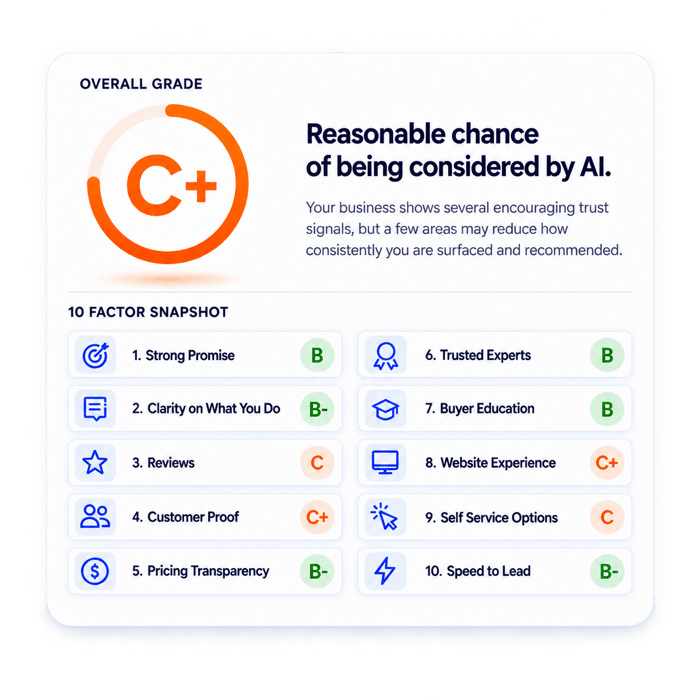
How known, trusted, and recommended is your company?
See how your business scores across the 10 factors that influence whether buyers and AI know you, trust you, and recommend you.
Run My Free Diagnostic →About the IMPACT Team
This article was produced as a collective effort of the IMPACT team and is regularly updated.
Meet IMPACT