









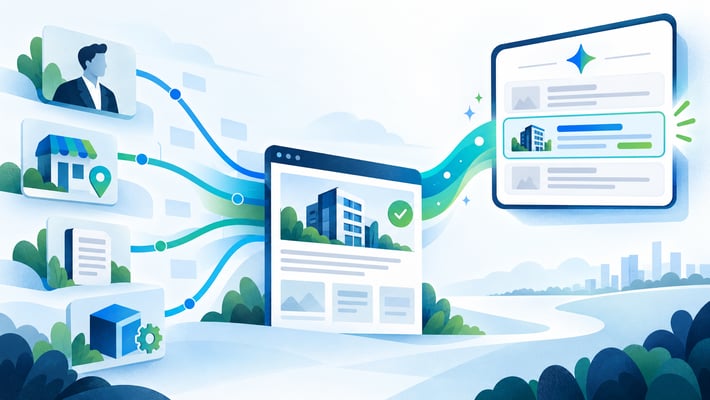
Your website says you've been in business for 25 years. Your LinkedIn page says 18. An industry directory you forgot about says 12.
A buyer skimming those pages probably won't notice, but Google and AI tools will, and every mismatch makes them a little less sure who you are.
That uncertainty costs you. AI tools only recommend companies they're confident about, and confidence comes from facts that line up everywhere they look. As a website strategist at IMPACT, I help companies using the Endless Customers System™ build websites that buyers, search engines, and AI can all understand.
Below, I'll explain what an entity is in plain terms, how Google and AI connect the dots about your business, and the fixes I'd make first.
What is an entity in SEO?
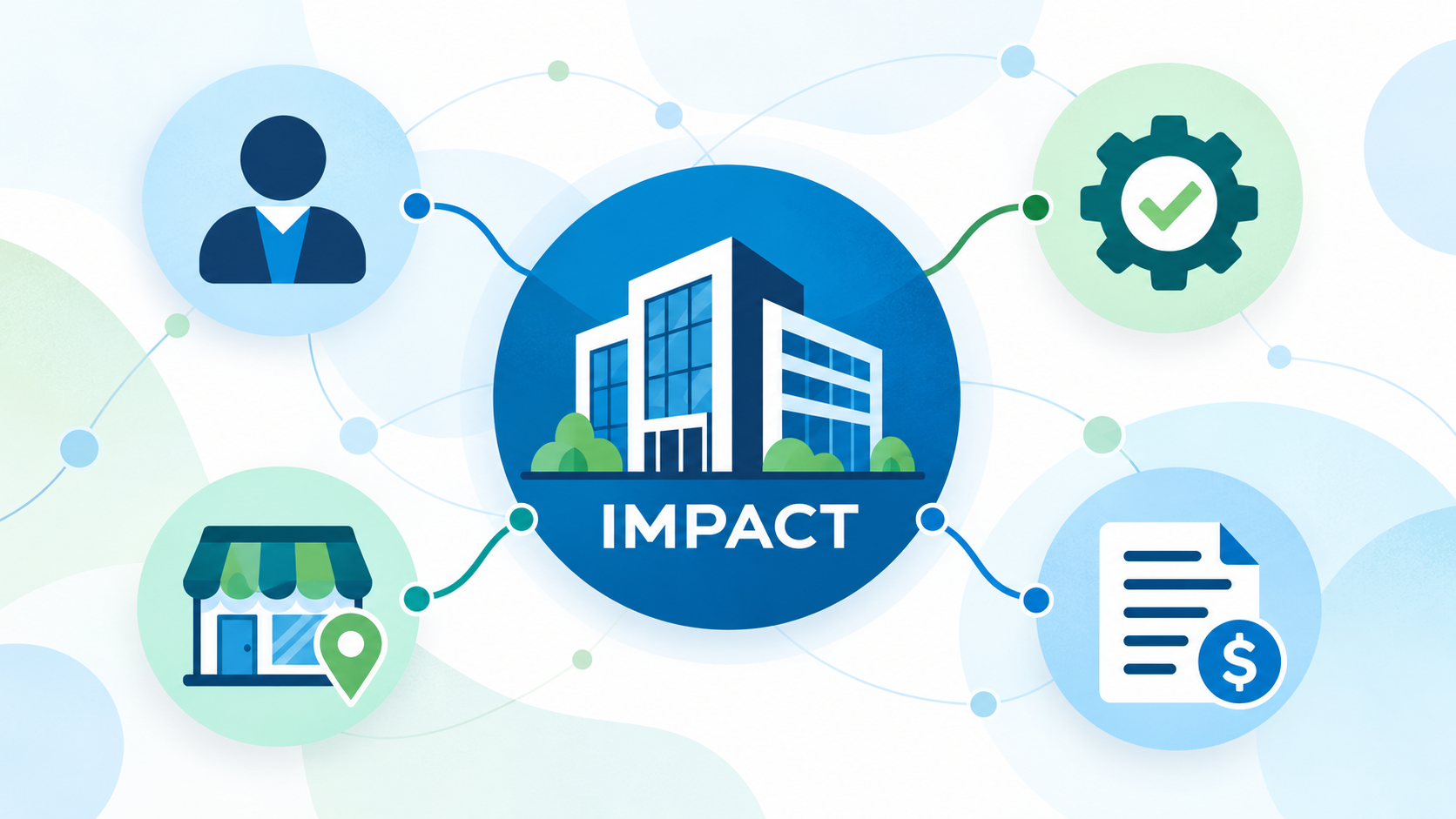
An entity is any recognizable thing: a company, a person, a product, a place, or a body of work like a book or an article. I tell clients to think of the nouns they learned in school. If people can talk about it, review it, or complain about it online, Google and AI treat it as an entity.
Your company is an entity. So is your CEO, your most popular service, your showroom, and the pricing guide on your website.
On their own, those are just names. Meaning comes from how they connect. IMPACT is a company, and I'm a person, so the fact that ties us together is "IMPACT employs Janet Mendez-Latouche."
Google stores billions of connections like that in what it calls the Knowledge Graph, which works like a giant mind map of things and how they relate to each other.
How do Google and AI use entities to describe your business?
Google and AI tools draw on what they know about entities and their connections to build knowledge panels, AI Overviews, AI Mode answers, and chatbot recommendations. Each connection adds meaning to your business, positive or negative. That's why managing your entities matters: you're shaping the raw material AI uses to describe you.
The scale keeps growing. Google reported more than 500 billion facts about 5 billion entities in 2020. By 2024, that number had reached about 1.6 trillion facts across 54 billion entities.
But search didn't always work this way.
Early Google matched keywords, so a page that repeated "best HVAC company Michigan" a thousand times could win. That led to keyword stuffing and spam, and Google got smarter.
Today, search engines and AI look past what you say about yourself and check what everyone else says: reviews, directories, news coverage, and social profiles. They're looking for consistency between your story and the evidence.
How does schema markup help AI understand your business?
Schema markup is code on your website that summarizes a page for search engines and AI in a format they already expect. Instead of reading a long page from top to bottom, a crawler gets a snapshot: this is our company, this person works here, this is what we sell, and this is where we are.
That snapshot matters more than most people expect. AI bots don't absorb a page instantly. They read it a lot like a person would, starting at the top, so a price buried at the bottom of a long page takes time to find. Schema hands them the key facts up front.
The most useful types for a business website:
- Organization tells machines your company name, website, logo, and contact details.
- Person connects your experts to your company and their own profiles.
- Product and Service describe what you sell.
- LocalBusiness confirms where you operate.
- Article ties a piece of content to the expert who wrote it.
- Review marks up what customers say about you.
One property deserves special attention. The "sameAs" field lets you tell Google that your Facebook page, LinkedIn profile, and Google Business Profile all belong to the same company. If you've rebranded, you can use it to connect your old business name to your new one.
Schema has limits. It won't get you cited by tomorrow, and it can only clarify what's already true about you. If the content and reputation behind the markup are thin, there's nothing for it to point to.
Why does inconsistent business information make AI trust you less?
Inconsistent details make AI less sure that two sources describe the same business. If your website, Google Business Profile, Facebook page, and Yelp listing show different names, addresses, phone numbers, or hours, AI can't confirm they belong together. So it discounts what each source says about you, and it won't recommend what it can't confirm.
Think about meeting someone at a conference. I introduce you to Bob, then someone else calls him Robert, and a third person uses a different name entirely. You'd wonder if you had the wrong guy. AI reacts the same way.
IMPACT's own research backs this up. When we studied 100 AI recommendation answers across ChatGPT, Gemini, Perplexity, and Google AI Mode, the most common reason a company got disqualified was that AI couldn't verify it was legitimate. That showed up in 24% of disqualifications. Read the full 2026 AI Visibility Report.
Name changes are where I see this most. Allied Exteriors, a home exteriors company, used to be Allied Siding and Windows. After its new website launched, our team updated the Google Business Profile, the BBB listing, and other profiles with the new name. Now we're running the site through repeated AI tests to find any place where the old name still causes confusion.
Check these details everywhere your company appears:
- Business name, including any former names
- Street address and service area
- Phone number
- Hours
- Services and products
- Years in business
- Leadership names and titles
Which trust signals strengthen your business entity the most?
Some of the strongest trust signals are actually the ones other people create about you: reviews, awards, press coverage, partnerships, and the experts on your team. Your website makes the claim, and the rest of the internet backs it up. Your job is to make that outside evidence easy for AI to find and verify from your own site.
Here's a simple way to picture it. If I walk into a party where nobody knows me, I get a few strange looks. But if I walk in with Michael B. Jordan...everyone assumes I must be someone worth knowing. Relationships transfer trust, and that's exactly how entities work.
Don't try to trick the AI. Just fix the evidence.
Bring your reviews home
Some AI tools can't always reach every review platform, so a dedicated reviews page on your site acts as a verifier. Home Hero Roofing does this well: its reviews page gathers ratings from Google, Thumbtack, BBB, and Yelp in one place and links back to each source.
For more, see Reviews and the Reputation Graph: How AI Evaluates Your Business.
Give awards and certifications their own page
List every award and certification near the top of one page, and link to the organization that gave it. When that organization links back to you, the connection runs both ways, and AI has far less reason to doubt it.
Put real names on your expertise
If your blog posts still say "admin," AI has no expert to attribute that knowledge to. Name the author. Build a bio page for each expert with their credentials, years of experience, articles, speaking engagements, and podcast appearances, and link it to their LinkedIn profile.
Trailstone Insurance Group, an IMPACT client with a large team of insurance agents, is building 50 to 60 personal bio videos so each agent becomes a recognizable expert tied to the agency.
| Trust signal | What to build on your site | What it connects to |
|---|---|---|
| Reviews | A dedicated reviews page | Google, Yelp, BBB, and industry review sites |
| Awards and certifications | An awards page with links to each source | The organizations that gave them |
| Experts | Bio pages with Person schema | LinkedIn, speaking pages, podcasts, bylines |
| Social profiles | sameAs links in Organization schema | Facebook, LinkedIn, Google Business Profile |
| Locations | Location pages with LocalBusiness schema | Google Business Profile and directory listings |
Where should you start with entity SEO?
Start by asking AI what it already knows about you. Run the same prompt in ChatGPT, Gemini, Perplexity, and Google AI Mode, then compare each answer with your website. Answers change from one session to the next, so run the test many times, and list every gap or contradiction you find.
I'd run it at least 50 times, and you can have an AI tool run the test for you. Try a prompt like this: "If someone asked you to find the best [industry] in [city], how would you screen, filter, and select a company? Who would you recommend?" Then ask what it knows about your company and which sources it used.
From there, work in this order:
- Make your website clear. Answer the questions your buyers ask, and say plainly what you do, who you serve, and where.
- Add schema markup, starting with Organization, Person, and LocalBusiness.
- Make your name, address, phone number, and hours match everywhere.
- Build pages for your proof: reviews, awards, and expert bios.
- Make asking for reviews and applying for awards part of your regular workflow.
Skip the shortcuts. Every time search changes, someone sells a hack, and it stops working once everyone copies it.
Editing your own Wikipedia page tends to backfire. Paying $1,000 for an award your buyers have never heard of wastes money. If a tactic wouldn't matter to your buyer, it won't matter to AI for long either.
How this plays out with real clients
I walked through all of this with Bob Ruffolo on the Endless Customers podcast, including how we're managing the Allied Exteriors name change and why we test AI answers again and again. Watch or listen to the full episode: "How Entities and Trust Signals Help AI Understand Your Business" on the Endless Customers podcast.
Make your business easy to recommend
Entity SEO comes down to one goal: make your business easy for Google and AI to understand, trust, and verify.
An entity is any person, place, or thing, and its connections give it meaning. Schema markup makes your website easy to read, consistent details make you easy to confirm, and reviews, awards, and credited experts give AI the outside evidence it needs. Testing what AI already says shows you where to start.
At IMPACT, we've helped more than 300 companies implement the Endless Customers System and become the most known, trusted, and recommended company in their market. If you want to see where your marketing stands with AI today, take our free instant diagnostic.
Frequently asked questions
How long does entity SEO take to work?
Expect it to take months. Fixing your website and listings is fast, but Google and AI tools need time to recrawl your site and notice the changes. Keep testing and refining as you go.
Do I need a Wikipedia page to show up in Google's Knowledge Graph?
You don't. Most small and mid-sized businesses don't meet Wikipedia's notability standards, and editing your own page can backfire. A clear website with schema, consistent listings, and strong reviews will do more for you.
Is schema markup enough on its own?
It isn't. Schema helps machines read what's already on your site and across the web. Without good content, real reviews, and consistent profiles behind it, the markup has little to point to.
Do I need to be on every review site?
Focus on the platforms your buyers already use. If competitors in your industry get reviewed on Yelp and Google, start there. A busy Facebook page matters less if nobody in your space has one.
Related reading
- 19 AI Trust Signals: The full list of signals AI looks for before it recommends a company.
- 6 Website Pages That Increase AI Visibility & How to Build Them: The pages that give AI the evidence this article describes.
- How to Build Search Signals That Strengthen Your Brand in AI and Zero-Click Search: How to build brand signals beyond your own website.
- Can Endless Customers Help Me Get Recommended by AI?: How the Endless Customers System connects to AI recommendations.

Written By
As a Web Strategist, Janet runs hands-on strategy sessions with clients to build easy-to-manage websites that not only align with their business goals but also drive real sales. She empowers her clients with the knowledge and tools they need to take ownership of their websites, ensuring they can manage and optimize them long after the launch. Janet brings a wealth of experience in project management and client relations. Her unique skill set allows her to guide clients through the complexities of web design and marketing, ensuring they achieve bottom-line results.
As a Web Strategist, Janet runs hands-on strategy sessions with clients to build easy-to-manage websites that not only align with their business goals but also drive real sales. She empowers her clients with the knowledge and tools they need to take ownership of their websites, ensuring they can manage and optimize them long after the launch. Janet brings a wealth of experience in project management and client relations. Her unique skill set allows her to guide clients through the complexities of web design and marketing, ensuring they achieve bottom-line results.

Share


READY TO IMPLEMENT ENDLESS CUSTOMERS™ IN YOUR BUSINESS?
You’ve learned the philosophy. Now it’s time to put it into action. Our coaches will help you apply the Endless Customers System™ to your sales and marketing so you can build trust faster, close deals sooner, and create a steady flow of new customers.