









How do you know if your website is still doing its job?
Score it honestly across five areas: clarity, trust and proof, self-selection, conversion paths, and AI readiness. A site that only explains the basics has already been replaced by AI. The sites that still work are the ones giving a buyer enough specificity and proof to feel confident moving forward.
What you'll learn:
- Why zero-click search hurts top-of-funnel pages far more than decision-stage ones
- The Web Optimization Scorecard, question by question
- What AI is latching onto hardest right now, and what it ignores
- How to structure a page so it can be lifted into an AI answer
- A five-item 90-day plan you can build from your own score
This is not about button colors or page speed. It is about how buyers who are more skeptical than they have ever been evaluate a website in an AI-first, zero-click world, and what happens if you lead with the wrong signals.
IMPACT Lead Website Strategist Mary Brown walked an audience through a scorecard for exactly that, then had them build a short 90-day plan from their own results. Here is the whole thing.
Are websites actually dying?
Three numbers set the scene.
- Forrester's 2026 Buyers' Journey Survey of 18,000 global business buyers found 94% used AI during their most recent purchase, up from 89% the year before.
- SparkToro found 68.01% of US Google searches ended without a click in the first four months of 2026, up from 60.45% in 2024. That is the fastest two-year jump SparkToro has ever tracked.
- 85% of brand mentions in AI search come from third-party pages rather than the brand's own site: trade press, review sites, comparison articles, analyst mentions.
So, the end of websites? No. Not yet.
That zero-click number hides a large gap by intent. Informational searches, the "what is this" and "how does that work" questions, run at around 74% zero-click. That is the number scaring everyone. Transactional searches, where someone is deciding whether to buy, run closer to 31%.
The zero-click problem is real and it is concentrated at the top of the funnel, where a results page can fully answer the question. It has not eaten the moment a buyer makes a decision. People are still visiting websites for mid and bottom funnel research.
What has changed is how much is riding on each visit. The average B2B vendor shortlist has contracted from 3.2 names to roughly 2.5. Fewer spots, more weight on each one. If you make that list, your site has to convert better than it ever had to before.
What is a modern buyer actually doing?
Four things, all of them before you hear from them:
- Researching with AI before they ever find you
- Deciding who is still in the running before your sales team gets a call
- Narrowing to two or three names, not ten
- Trusting what other people say about you more than what you say about yourself
By the time they land on your site, they are not asking "what is this." They are asking why they should trust you over anyone else.
That is the shift. They Ask, You Answer still holds, because websites have always needed to answer customer questions. What changed is where buyers get the basic answers. If your site only explains the basics, AI has already handled that and your page is interchangeable. Accurate information is no longer enough on its own. You need clarity, specificity, and proof.
What are the five areas to score?
- Trust: proof, transparency, clarity
- Self-selection: tools, pricing, filters
- Conversion paths: intent-based CTAs, blogs
- Strategic journey: guiding people forward on a path that makes sense, not just assembling pages
- AI visibility: structured, scannable content
Look at that list and ask what is actually new. Trust is not new. Self-selection has been on the table for years. Conversion paths and journey mapping are not new. AI visibility is the new one. What is new is needing all five at once.
The scorecard below runs on yes, somewhat, and no. This only works if you answer honestly. Nobody else sees your score.
Clarity: can a stranger tell what you do?
Can a first-time homepage visitor clearly answer what you do, who you help, and how you are different?
That third one is where most sites fail. The answer comes back the same every time: we're trustworthy, we're proven, we've been around a long time. Not good enough. Doing the thing someone wants is not a reason to pick you over the other company that also does it.
Some companies get this right by leading with something concrete: a thirty-day money back guarantee or a warranty that no competitor offers, stated right in the homepage hero.
Does your homepage focus on the customer rather than your company? Is it we, we, we all the way home, or are you saying you? The prospect is the hero of the story. You are the guide.
Is there a clear primary call to action in the navigation? A persistent global button for your main bottom-of-funnel action. It is still common in 2026 to find a site with nothing in the nav, or nothing but "Contact." If you have one but it is weak, that is a "somewhat."
One caution on labeling. If the button says "Schedule a Meeting," clicking it should open a scheduler where someone picks a date and a time. If it opens a form, call it "Request an Appointment." The nav CTA is right. The label has to be honest about what happens next.
Trust and credibility: can you prove any of it?
Do you openly address pricing, and can people find it in one or two clicks? A range or a flat number both work. If it is $250 a month, say $250 a month. It does not have to be on the homepage, but it cannot be buried.
Do you explain what drives cost up and down? This is how you talk about value. A price alone is a good start. Explaining the factors lets someone understand why their situation might land above or below the number on the screen.
Do you say who is a good fit and who is a bad fit? Of everything on this list, fit information is what AI is latching onto hardest right now, and it will favor a company that addresses it over one that does not. Let people disqualify themselves before they reach you. It is fine, and useful, for someone not to be right for you.
Can visitors see real photos of your team? People recognize stock photography. A balance across the site is fine. Your About page and team page are not the place for it.
Do you publish real customer stories with specifics? AI is actively looking for stories concrete enough to match to a situation: this area, this job type, this problem. Specificity is what makes a story findable.
Do you have proof of results? Case studies work particularly well because they follow a format AI can extract cleanly: the problem, your solution, the results. The results need a quantifiable number wherever you can get one.
Would a skeptical buyer trust you more after visiting your site? Or is something there eroding trust? The most common offender is the word "trust" itself. Saying it forty times on a page prompts the opposite reaction. The word is not the proof.
Self-selection: can buyers do the work themselves?
Can buyers get every question in their journey answered before contacting you?
Here is the obvious objection: if 85% of AI mentions come from third-party pages and top-of-funnel content is not earning clicks, why keep writing it?
Because that is where those third parties get their information. When someone writes a best-of article and includes you, they are pulling from your site. The content still has to exist and still has to be crawlable. What changed is that it is sourced rather than visited.
Can buyers compare options on their own, or do they have to talk to you first?
Can they get a price estimate? If you publish a range and explain what moves it, can someone pull those levers themselves and get a number closer to their own situation?
Do you have any of these five self-service tools?
- Self-assessment: helps me understand where I stand today
- Self-selection: helps me pick the option that fits me
- Self-configurator: for configurable products
- Self-scheduling: real date and time selection
- Self-pricing: an estimator
Zero is a no. One or two is a somewhat. Three to five is a yes.
Can people get pricing, process, comparisons, and timelines without filling out a form? Forms are not the problem. Gatekeeping is, and it still happens constantly. Timelines get gatekept almost as often as pricing, usually because the exact answer varies. Give a rough timeline. A process page with an honest range beats silence.
Conversion paths: where does each page send people?
Do different pages have different CTAs based on intent? If buyers arrive mid or late in their research, your paths have to be tight. Plenty of sites get built without anyone asking what the next logical step is from a given page. Someone finishing a service page probably wants pricing next. Someone finishing pricing wants something else again.
This is harder than it sounds because of the curse of knowledge. Teams who know how everything works struggle to step back and ask what questions a buyer has right now, what objections need answering, and what fears, worries, and concerns are live at this exact moment.
FAQs are good for humans and great for search engines and LLMs, which is a rare win for everyone. Two rules for writing them now:
- Make every question stand alone. "What does it cost?" What does what cost? Nobody types that into Claude. Look at how long and specific real AI prompts are and write questions at that level.
- Make the answer an actual answer, not a setup for one.
Do your conversion landing pages set expectations? How and when you will make contact, and who from. Say it plainly.
Are your landing pages qualifying? Someone clicking your CTA is not the end of the job. Qualifying does not mean forty form fields. It means enough fields to give your team a real conversation. For a local business, a location field helps both sides: the buyer sees whether they are in your service area, and your team knows which crew handles Bristol, Connecticut. Ideally that is not the first time they learn you are in a different state. Budget works the same way when your lines are firm.
What should you be tracking?
- CTA clicks. HubSpot CTAs are one way. Custom events in GA4 or another tool work too.
- Form conversion rates.
- Traffic sources, with an asterisk. Analytics platforms are trying harder to bucket AI traffic correctly, but attribution is not perfectly clean yet.
- AI referrals by platform. How are you doing in Gemini versus ChatGPT versus Claude, and is that share growing?
- Prompt-level visibility. This is the next level. Your AI visibility can grow without growing for anything you care about. A tool that tracks specific prompts, such as HubSpot's AEO tool, tells you which.
- Scroll depth and attention. Microsoft Clarity is the pick here: free, comparable to paid heat mapping tools, with AI insight features that are decent. No affiliation, it is just the one worth learning.
- Drop-off points. Where are you losing people?
Websites get built on well-educated guesses. There is a lot of gray area, because if there were one correct way to build a given page, everyone would build it that way. What you have is good data feeding good hypotheses, and then the obligation to check whether they held.
AI and search readiness: can a machine read your page?
Do your pages answer real buyer questions? Real ones, not the ones you assume. Ask your LLM what people ask it about your product or service. Use People Also Ask. Use Ahrefs or Semrush.
For mid and bottom funnel questions there is a better source, and it is one of the most useful habits going right now: if you record sales calls, point an AI tool at the transcripts and ask what questions come up, whether you answer them on your site, and how. One company that did this found the real questions were gold, and found several they were not answering at all.
Are your headings clear? This one has a story attached.
Comparing a bathroom remodeling company's local page against a competitor's, Claude was asked which was stronger. Both pages had a bathroom gallery section. The competitor put the location name in the H2. The other company had the location name on the page, but in an eyebrow line above the heading and in the body text, not in the coded H2. Claude concluded that the second company did not have local galleries. Pushed on it, it said it had only scanned the H2s.
That is human behavior, which makes sense, since AI was built on how humans read. People skim H2s. The difference is that a human reviewer knew to push back. Most users will not. Put the relevant terms in the actual headings.
Have you cut the fluff? AI has no use for it. No more opening an article with a reverie about lying in the grass watching clouds. If your article starts with a question, answer it immediately. Context can come later. You are not only writing for humans now.
Could AI accurately summarize your services, your pricing, and who you are best for? If someone asks for four roofing companies near them and your pricing is not published, you are not in the four. It is not that you ranked low. The information was not there to surface.
Do you use schema markup? Yes, use it. But know that AI and search engines are not reading it the same way. Search engines like the structured code on the back end. For AI, the same information needs to exist on the front end where it can be read: an author on the blog post, an author bio, a publish date, an updated date.
What does AI-ready formatting look like?
Two patterns, both illustrative rather than real data.
For an AI answer, an H2 reading "Average cost of roof replacement," followed by a paragraph that repeats the question in the answer: "The average roof replacement costs $8,000 to $15,000 for a 2,000 square foot home. Pricing depends on materials, roof pitch, labor costs, and geographic location." Then an H3 for "Cost by roofing material." Note the directness. Not "well, it depends," but a range, with the factors named.
For a zero-click search, an H2 reading "Signs you need a roof replacement," followed by a tight numbered list: missing shingles, a sagging roof deck, water stains on ceilings. Concise enough that AI can lift it whole. The searcher may never click, but your site is the one cited, and people do see citations.
What goes in your 90-day plan?
Before anything else, write down two things: the biggest thing holding your website back, and one important buyer question you are not currently answering. Not the reasons you cannot answer it. Just the question.
Then pick five commitments.
1. One thing to kill. The word "trust" used forty-seven times on the homepage. The stock photography on the About page. Anything vague, weak, or confusing.
2. One thing to clarify. Where can you add specifics and authority? Twenty-five years in business is a real trust point. So is a thirty-day money back guarantee, an award, a licensed or credentialed team member. And whenever you make a claim, back it up. Every business makes claims. Look at yours and ask how you prove each one. Imagine Claude asking: so what? Prove it. Why should I pick you?
3. One path to improve. Maybe you have pricing but strand people there with no sensible next step. Maybe your service pages jump straight to "talk to us" without passing through pricing. Pick one path and fix it.
4. One self-service tool to build. Not tomorrow. But which of the five makes sense for you, and which could realistically exist in ninety days? For a lot of businesses the answer is self-scheduling. Then test it.
5. One question to finally answer publicly. The most common objection here is that every package is unique, so pricing cannot be published, and anyway people will be scared off before they talk to sales. There is a way around it.
The standard has changed, and it is not about a better-looking website or more traffic. It is whether your site helps AI recommend you and helps a buyer feel confident enough to move forward. Whatever confusion or hesitation came up while you scored your own site is what buyers experience daily. You just do not see it, because you have a different vantage point.
The good news is that most of this does not require a redesign or a six-month project. It requires clarity. Clarity is king.
The companies that win are not the ones with the most traffic. They are the ones that make it easiest for a buyer to say yes. Do not make a list of twenty things. Do the one you wrote down, this week.
Frequently Asked Questions
Is top-of-funnel content still worth writing if nobody clicks?
Yes, because it is being sourced rather than visited. Around 85% of brand mentions in AI search come from third-party pages, and those pages get their facts about you from your site. If a best-of article includes you, someone crawled your content to write it. The content still has to exist and still has to be reachable.
Why does zero-click search sound so much worse than it feels?
Because the headline number averages two very different behaviors. Informational searches run around 74% zero-click. Transactional searches, where someone is actually deciding, run closer to 31%. The damage is concentrated at the top of the funnel, which is exactly where you would expect an AI answer to be sufficient.
Do keywords still matter?
For bottom-of-funnel search, yes. Search engines have understood context for years now, so cost calculator, pricing calculator, and price calculator are read as the same thing. What changed is the top of the funnel, where those short queries have moved into AI as long, specific prompts. You need to be found in both places, which means writing for conversational questions as well as keywords.
Does schema markup still help with AI?
It is still worth having, but AI and search engines do not read it the same way. Search engines use the structured markup on the back end. AI reads the page. So whatever lives in your schema should also appear in the visible content: author name, author bio, publish date, updated date.
What is the single highest-impact fix for most websites?
Saying clearly who you are a good fit for and who you are not. It is what AI is latching onto most right now, and it does more for buyer confidence than another paragraph about how trustworthy you are. It also tends to be the cheapest thing on the list to implement.
This article is adapted from a live IMPACT webinar.
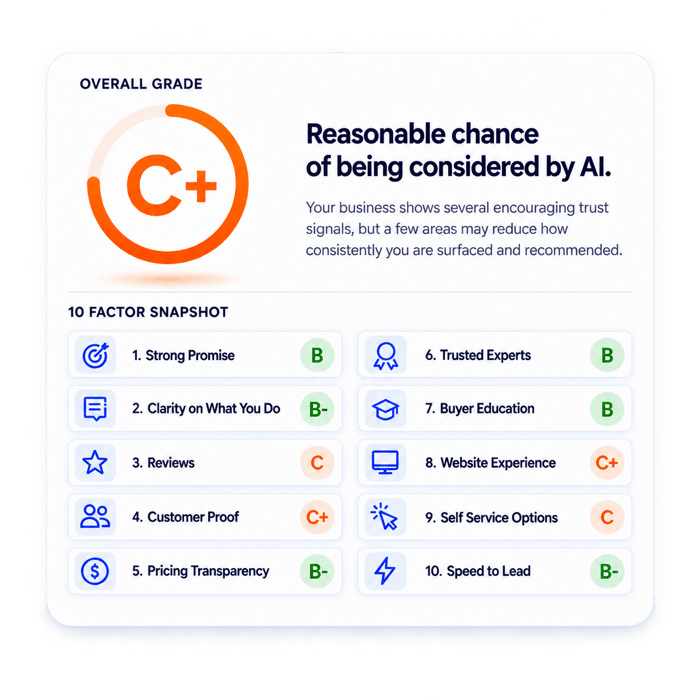
How known, trusted, and recommended is your company?
See how your business scores across the 10 factors that influence whether buyers and AI know you, trust you, and recommend you.
Run My Free Diagnostic →About the IMPACT Team
This article was produced as a collective effort of the IMPACT team and is regularly updated.
Meet IMPACT