
/Assets/arrow-facing-left--black-01.svg)
/Assets/navigation-global--close-symbol-black-01-1.svg)
/Assets/Icon%20Library/social/facebook-logo.svg)

/Assets/Icon%20Library/social/instagram-logo.svg)
/Assets/Icon%20Library/social/youtube-logo.svg)





Creating high-quality and high-converting content requires a lot of moving parts: There’s building out a content calendar, juggling interviews with subject-matter experts (SMEs), writing the content, optimizing it for search, publishing it, and sharing the content on social media.
And if that doesn’t sound like enough work to keep content marketers busy, there is also a long list of planning, implementation, and communication tasks in between.
With all these steps to track, if you don’t have an efficient content marketing process in place, publishing on a consistent schedule can be difficult because you’re often left wasting time figuring out which step to tackle next.
We have worked with hundreds of clients and find that having a simple, well-thought-out content creation process is essential to publishing at least three new articles per week, which is the publishing cadence we’ve found generates the best results.
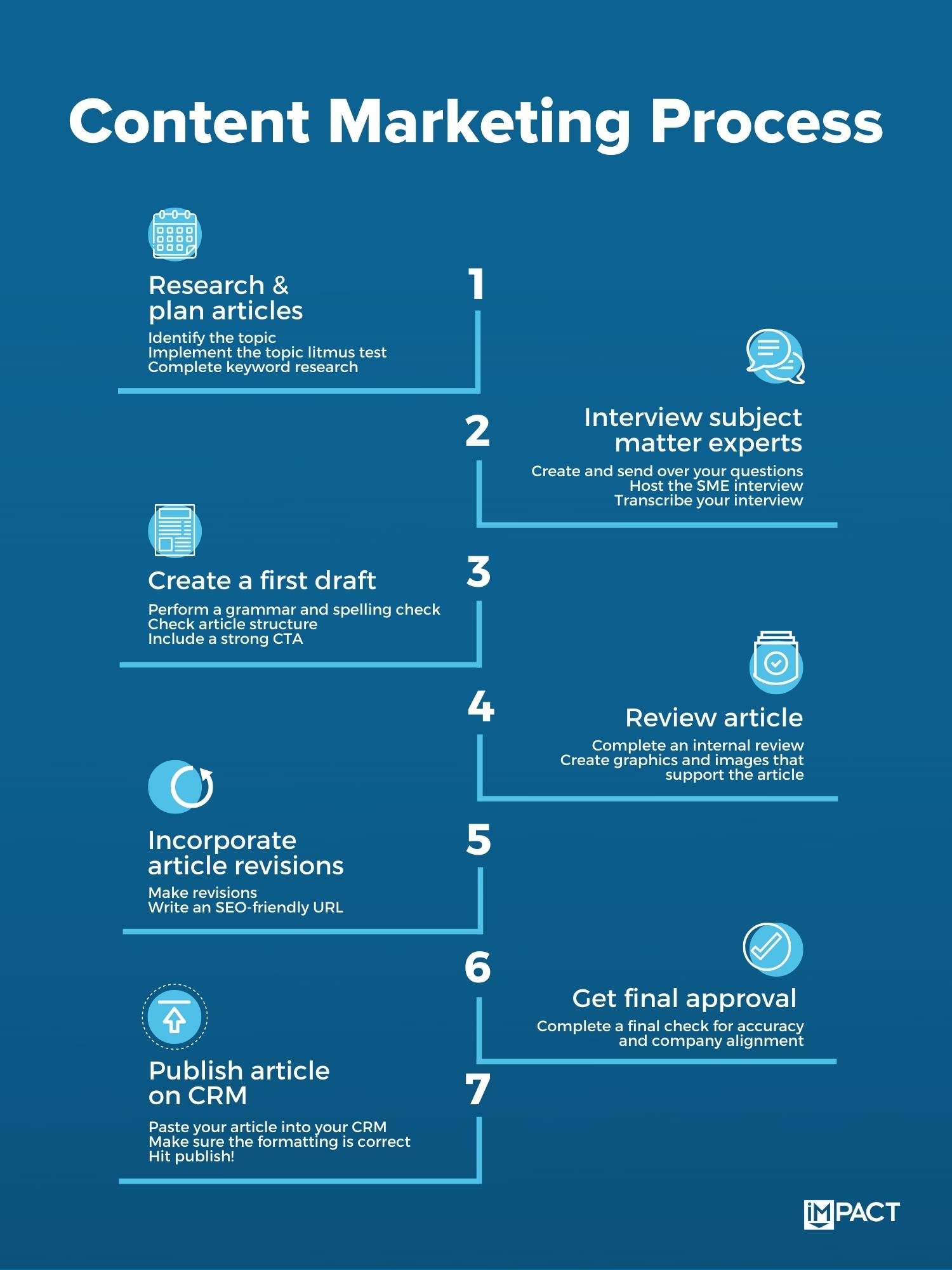
In this article, we’re sharing with you the seven-step content creation process we teach our clients, including:
- Which steps you need to take and why they’re helpful.
- How much time you should plan for each step.
- Helpful resources you can refer to for extra information along the way.
These steps will help you eliminate all the time-consuming, confusing guesswork many content creators struggle with and keep you focused on creating a successful content marketing strategy.
Ready to streamline your content creation and make it easier to produce high-quality articles that convert?
Here’s what to do.
1. Research and plan articles
The first step in creating content should come as no surprise: You need to complete your research and plan the articles so you end up with a solid outline. You’ll know you’ve completed this step thoroughly when you have all the pertinent information at hand and feel like you’re ready to write.
There are a lot of ways to move through the research and planning stage. It's still important, even if you use AI tools, to understand and go through this process to make sure that you're getting the best outputs on the content that you create. The good news is that AI can help you move faster by creating repeatable workflows with tools like Projects (in Claude) and custom GPTs (in ChatGPT).
This phase should take about one to two days, depending on your workflow, and includes the following actions:
Identify topics that your buyers are searching for
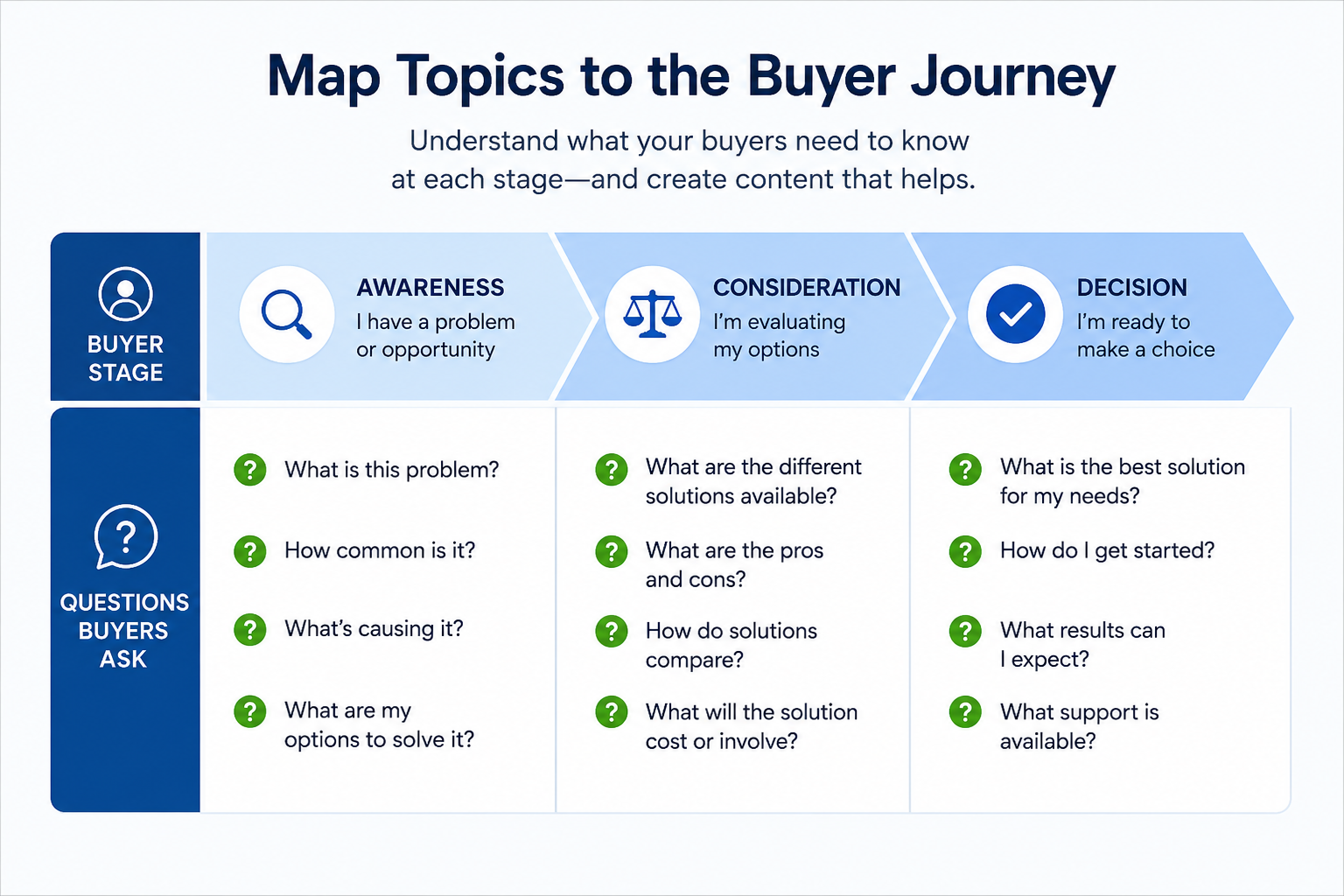
To create content, the first step is identifying the topics you need to cover. Consider drafting a content map, where you map out your customers’ typical buyer’s journey and list all the types of content that would benefit your buyers at each phase.
This way, you can quickly see which topics you need to cover at all stages, and it’s easy to fill in any of the gaps in your buyer’s knowledge.
Talk to your sales team for additional input on what type of feedback they are hearing from prospects. Are there common questions that need to be covered? Are there objections that buyers have to your product or service? If so, then you're already headed in the right direction.
Finally, pressure-test your list inside an AI platform. Get feedback and ask if you have any blind spots or opportunities that could have been missed.
Implement the topic litmus test
After compiling a list of topics, and once you understand where each one might fall along the buyer’s journey, see if a given topic can pass the topic litmus test (TLT), which is a series of questions that helps you determine which articles will move your sales needle the most.
To do this, ask yourself the following:
- Is this topic relevant to your target audience?
- Is it clear when someone would need this information?
- Do you know exactly how a buyer would search or ask for this information?
- Is a blog post the best format for this information for your buyers?
If you can’t definitively answer “yes” to each of these, you might want to wait to address the topic — at least for a while — and direct your attention to more timely content marketing pieces that your buyers need more immediately.

Book time for interviews, internal review, and approval
The goal is always to create original content, even if you use AI to help you get there.
That's where SMEs (subject matter experts) come in clutch.
These are the people in your company who know these topics inside and out. They might be people on your sales team or your product developers, such as designers or engineers. Their expertise and authority are what will give your content the most value.
This will save you from having to scramble last-minute to meet with them or force you to shift your schedule around if someone isn’t available to interview in time.
As you plan out interviews, consider bundling two or three into the same meeting. If you know you have a few upcoming pieces that fall into the same bucket, you might knock out a few interviews in one meeting with the SME.
Just remember to schedule these in advance so you can continue to hit your fast-approaching publish dates.
Complete keyword and topic research
If you're following the Endless Customers™ methodology, you're already creating high-converting, sales-oriented content. But to drive the right traffic, every piece still needs to be discoverable, and in 2026, that means optimizing for both traditional search engines and AI answer engines.
Start with classic keyword research to confirm the language your buyers actually use and the relative demand for each topic. Tools like Semrush, Ahrefs, and Moz Keyword Research are still the workhorses here, and don't disqualify a topic just because search volume is low. A sales-driving Big 5 topic (cost, problems, comparisons, reviews, best-in-class) often converts at a far higher rate than something generic with high search volume.
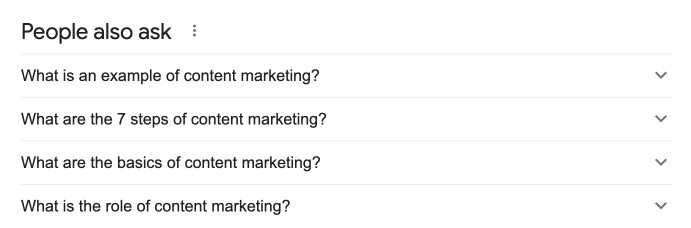
To double-check search intent, drop your topic on Google and study the page: the format of the ranking content, the "People also ask" box, and what now appears in AI Overviews. If your planned angle doesn't match what's being surfaced, adjust before you write.
Create a content cover sheet
The next two things you'll create are meant to help you stay focus and on target as you interview SME's and start writing. This will help you make sure that your writing stays true to the message and doesn't veer off-track and lose value.
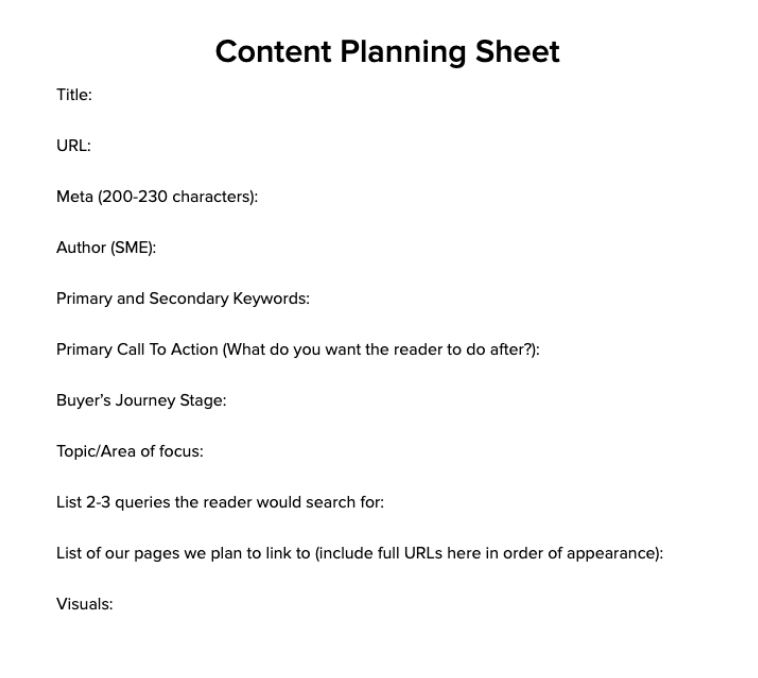
A content cover sheet is a run-down of the technical pieces that make up your content. It covers the basics like:
- Article title
- Meta description
- Word count
- SME
- Your keywords
Here's an example content cover sheet, but you may choose to include additional details on your own if it helps your process.
Complete the content outline or "skeleton"
Once you have your cover sheet filled out, you should have what you need to start your outline.
Typically, a strong outline that makes it easier to create content will include:
- A section to plan your introduction that lists why you are helping the reader and how.
- Three to four main sections of the body that include the information promised in the introduction.
- A conclusion that recaps what you’ve covered and includes a strong call to action (CTA).
In your outline, include all your planned headers and any talking points you will elaborate on in your draft. You might want to also plan which statistics to refer to, sources to note, and images you may need.
This is a great place to utilize AI to help you structure your ideas that you've collected so far. Here's an example prompt you could use to build the outline to your article:
"We're a [type of company] following the principles of They Ask, You Answer, and Endless Customers. I want you to write me a skeleton outline for an article titled "[article title]." Consider SEO and what type of questions buyers in this position might ask, the intent of the searcher, and make the outline comprehensive. The outline should be formatted in proper SEO structure."
You can refine the outline the results to better fit your brand voice and remove any AI tells like em dashes or common AI phrasing.
And great news! This outline and AI can help you with the next step of the process.
2. Interview subject matter experts
The next step when creating engaging content should be conducting the SME interview (unless you’re completing the research on your own).
We typically recommend slating 30-60 minutes for your interview, and as long as you’ve done the proper preparation outlined in Step 1, this part of the process should be pretty seamless.
If you haven’t done enough of the content preparation in Step 1 of this process, you might find yourself needing to interview your SME again (thereby taking up more of their time than you need to) or doing extra work researching on your own.
In short, do what you can in Step 1 to prepare for your interview as much as possible so you can truly make use of your SME’s insight.
Create and send over your questions
Use your outline to craft your interview questions. You can use that same thread in your preferred AI platform to ask for a list of questions to ask an expert on that particular topic.
Then, send your SME the questions in advance of your interview so they have time to prepare their answers. By reducing the friction for your teammates and SMEs, you make it easier to rely on them in the content marketing process.
Use video recording software such as Vidyard to send a note explaining what you’ll be asking and going over your idea for the content. Slack also has a great video feature you can use directly in the app.
Send the video to your SME along with your questions. It’s a great way to personalize your message and explain your questions a bit further.
This will help you make the most of your time with the SME and give them a chance to send over feedback before your interview, if necessary.
Host the SME interview
Next, it’s time to host the interview with your SME — and be sure to hit record!
You already have your questions in hand, so ask away. It’s helpful to first be sure your SME agrees with the information you’re planning to include, and always give them the opportunity to address something you might have missed.
It also helps to prevent any distractions, such as closing the door on your pets or hiding the image of yourself on Zoom, so you can be fully present. This will help you listen more intently and ask better questions.
Keep a notebook handy and jot down things that need clarification as the SME speaks. This will help keep you from having to interrupt your SME or lose track of the questions you have, so that you can ask these lingering questions when your SME finishes their thoughts.
Finding out what works for you and your content marketing team takes lots of practice, but at the end of the day, it’s about asking great questions and making the most use of your SME’s time and expertise in a way that helps your prospects learn how to solve their problems.
Utilizing AI for notes and transcripts
Use an AI note taker or recording software (it's built into Zoom or use a third party app like Fellow) because that transcript is like gold. Save the transcript and use it during your drafting phase both for yourself and AI to ensure your output is original source material, not a generic AI-generated response.
3. Create the first draft
After your interview and transcription are complete, you should feel like you have all the relevant information to write your article. Any writer will tell you that the hardest part of creating content is getting started on your first draft, but the preparation you’ve done so far will help you create remarkable content more easily.
This is where you take all the information you’ve gathered — from your outline, research, and interview — and start filling in the blanks. You should already have the sections in place, so now it’s a matter of taking that text you’ve gathered and making it helpful to your readers.
As much as AI can do well, it's important that you understand how great content is structured, so that you can identify and push AI to create high-value outputs.
For example, in your introduction, use the PEP (pain, expertise, promise) method so your reader knows immediately the value they are going to get from the article:
- Are you addressing your buyer’s pain points?
- Does the intro demonstrate your expertise?
- Are you clear in the promise you’re making that the article will deliver?
And a strong conclusion should include the four R’s:
- Provide a resolution and clarity around what it is they came to learn.
- Remind them about the problem the article is helping them solve.
- Show them the relevant next steps.
- Reintroduce who is writing the article and why they can help them solve their problems.
Perform a spelling and grammar check
When you’ve completed your first draft, take some time to perform a spelling and grammar check to be sure the text is free from errors — especially egregious ones.
Tools such as Grammarly and Hemingway are great to use, but keep a close eye on the recommendations you receive from these tools, as they aren’t always correct.
It can help to read your article outloud to identify awkward phrasing, repetitive patterns, or run-on sentences that can be common when using AI to generate written work.
It can also help to put the draft down for a day, but if you’re on a tight deadline, even setting it down for a few hours can help. When you go back to it, you’ll have fresh eyes and can catch the errors more easily.
Check article headings and structure
Once your article is drafted and you’ve completed the spelling and grammar check, give the article a quick blink test to be sure the structure makes sense, especially heading-wise:
- Are the headings easy to understand?
- Would you say they could stand alone in context?
- Do they use relevant keywords and main points important to the article?
- Does it follow a logical format and flow?
This is where you make sure that if a reader stumbles upon your article online, they are able to quickly and easily understand if it will be helpful to them and what they might learn.
Optimize for AEO and GEO
Search behavior has shifted. A growing share of your buyers ask ChatGPT, Claude, Perplexity, Gemini, or Google's AI Overviews before they ever click a blue link. Answer Engine Optimization (AEO) and Generative Engine Optimization (GEO) are the disciplines of making your content the source those engines cite.
The goal? Write so that an AI can lift a self-contained, accurate answer from your page and credit you for it. That means:
- Leading each section with a direct, one- or two-sentence answer before you expand
- Using clear, question-based H2s and H3s (the way buyers actually ask)
- Building out FAQ sections and adding schema markup
- Citing original data, naming your sources, and including expert quotes
- Naming entities (people, products, places) clearly and consistently across your content
The good news: the two disciplines overlap. Content that's well-structured, genuinely helpful, and grounded in real expertise tends to win in both. The Endless Customers framework (answering the questions your buyers actually ask) is already an excellent foundation for AEO and GEO. The update is mostly about how you structure each answer and where you measure success.
Make sure the article includes a strong CTA
Strong CTAs should always close out your content and are an element of your articles that should never be missed. Your readers will need to know which steps to take next, or you risk having prospects read your article and leaving your site without gathering their information or giving them the opportunity to engage further with your brand.
It also helps to include this CTA in your first draft so it can be reviewed by whoever is giving you feedback or signing off. We often see people wait to include the CTA for a later draft, which can cause confusion and wasted time in the reviewing process.
When you’re determining which CTAs to use, choose ones that are helpful to your reader and match where they are in their buyer’s journey. For example, articles you write about pricing are meant for bottom-of-the-funnel prospects that are closer to making a purchase. An appropriate CTA might read something like, “Try our services free,” or “Have more questions? Speak to an advisor.”
In this case, it would be any CTA that connects them with a sales representative or signs them up for your services.
4. Review your article
During the review stage of the content marketing process, you will have the SME read your content and leave feedback. You might need to have members of leadership look it over as well. Try to determine who really needs to be included in the process, because if you have too many people involved, it can cause your content to get stuck in a feedback bottleneck.
In short, the fewer people who need to review your content, the better.
What your SME should look for
When your SME reviews your content, they should be making sure that all the information provided is accurate and that there’s nothing missing.
They should have the option to make revisions, especially if it will be published under their name, but they can also make comments and notes to improve the article and make it more helpful to your audience.
What your content manager/writer should look for
This step will help you make sure the article follows the Endless Customers methodology and that it has the best chance possible at ranking and converting well.
This list of questions will make sure the content is strategic:
- Is the article easy to understand and written in your buyer’s language?
- Is the article optimized for organic search?
- Is the article unbiased and educational?
- Does the introduction follow the PEP method?
- Does the conclusion include the four R’s?
- Does the article include lots of helpful internal and external links?
- Is the topic covered completely?
These questions will ensure your content marketing efforts provide the expertise and information your buyers are looking for. They will also give the article the best possible chance to rank well in search engines and convert more leads (and better leads) to sales.
What your leadership team should look for
When your leadership team reviews the article, they should be making sure the overall messaging and positioning match up with the company’s goals.
Do the tone and language properly demonstrate the voice of your brand? Are you making promises you can fulfill? Does the article help your audience learn more about your offerings and how you can help your buyers solve their problems?
These are the overarching themes your leadership team will have a better understanding of and can speak to.
Create graphics and images that support the article
This is the part of the process when you want to create visual content for your article since you have the complete picture. It’s difficult to create images too early on when you don’t have the full scope and all the details of what the article will include.
You might need charts or screenshots, whatever images you can pull that help illustrate your information and make it easier for your readers to understand the material you’re presenting.
5. Incorporate article revisions
All right — you’ve gotten this far, and you have all your feedback. You’ve checked your article for all the important information, and it’s technically sound, but now you have lots of feedback to address.
This step should take about an hour or so, depending on the number of revisions you need to make and how extensive they are. If you’ve done your due diligence up to this point, your revisions should be minimal.
This is also a great time to create your meta description (which should entice people to click on your article) and write an SEO-friendly URL (which should be a version of your title without articles and unimportant, non-keyword terms).
When you copy and paste your article into your CMS, just make sure to use your own customized meta description and URL. Many software programs will populate them for you, but you want them to be tailored to the specific article for even stronger optimization.
6. Get final approval
After you make revisions, the leadership and SME players who get the final say should review the article one last time, but this can be customized according to your team dynamic and needs.
For example, here at IMPACT, this step happens after revisions have been made and the article is staged (ready to publish and uploaded to the CMS).
At this point, whoever is completing the final read-through should have few things to note. It should be a final check for accuracy and company alignment, but the article should be ready.
7. Publish the article on your CMS
Your article is complete and approved — and it’s time to hit publish!
The actions you take in this process will depend on your CMS, as all publishing software functions differently, but in general, you will need to:
- Copy and paste your article, title, subtitle, metadata, and URL into your CMS platform.
- Check all CTAs for relevance and accuracy.
- Make sure all images are properly named, sized, and optimized.
- Make sure all formatting and styles look correct.
- Schedule the article for publication (you can set it to publish at a later date).
- Schedule and create all social media posts.
- Determine if any existing articles should link to this article, and add the links.
Once all these steps are completed, you are ready to publish your article and make it available to the world.
Create your streamlined content marketing process today
Now that you have everything you need to know about creating an efficient content creation process, it’s time to start implementing these steps in your organization.
You’ll no longer be fumbling over which actions to take next, and you’ll also be able to wrangle all the moving parts more efficiently.
Once you get your process up and running, you will be able to have several articles rolling along at different stages. For example, once you get the process chugging along at the pace you need it to be, you could have one article in the interview phase at the same time another is being drafted and a third is publishing.
This is how you will get to publishing a solid three articles per week — and the more you hone this process, the more efficient it gets.
If you have any questions about the information we’ve provided, schedule a call with one of our advisors who can share with you more information about implementing a better content creation process at your company. Also, check out our Endless Customers Coaching Program to learn more about working with us to meet your content creation needs.
The content creation process, while simple, isn’t always easy to implement on your own — and there’s an entire team of coaches and trainers here at IMPACT waiting to help your business succeed.

Written By
Justine Timoteo Thomas is Director of Digital Curriculum at IMPACT, where she leads the creation of all educational content for the Endless Customers Academy, IMPACT's coaching and training platform for businesses implementing the Endless Customers System. Justine has been with IMPACT for 10 years and in the industry for 16. She started in client work as an account executive, moved into team lead and management roles, and spent most of her career in operations, eventually overseeing IMPACT's coaching and training team from the operations side. In January 2026, she moved into her current role. Justine now combines her hands-on client experience with the Endless Customers System, years of managing coaches and trainers, and an operator's eye for process to build the courses, guides, and coaching materials in the Endless Customers Academy. She holds an Executive Coaching Certificate from the Center for Executive Coaching and is an ICF Associate Certified Coach (ACC). When she's not building curriculum, Justine is out exploring Cleveland, Ohio, with her husband and two kids.
Justine Timoteo Thomas is Director of Digital Curriculum at IMPACT, where she leads the creation of all educational content for the Endless Customers Academy, IMPACT's coaching and training platform for businesses implementing the Endless Customers System. Justine has been with IMPACT for 10 years and in the industry for 16. She started in client work as an account executive, moved into team lead and management roles, and spent most of her career in operations, eventually overseeing IMPACT's coaching and training team from the operations side. In January 2026, she moved into her current role. Justine now combines her hands-on client experience with the Endless Customers System, years of managing coaches and trainers, and an operator's eye for process to build the courses, guides, and coaching materials in the Endless Customers Academy. She holds an Executive Coaching Certificate from the Center for Executive Coaching and is an ICF Associate Certified Coach (ACC). When she's not building curriculum, Justine is out exploring Cleveland, Ohio, with her husband and two kids.
/Assets/Icon%20Library/social/linkedin-logo.svg)
Share
/Assets/Icon%20Library/social/x%20corp.svg)
/Assets/Icon%20Library/social/facebook-logo.svg)
/Assets/Icon%20Library/social/mail-to.svg)
/Assets/base/Learning%20Center%20Resource%20Category%20Icons/Website%20link.svg)
NEED HELP WITH CONTENT MARKETING?
If you’re looking to take control of your sales and marketing using content as a key driver, IMPACT can help. We can guide you on how to build your internal team, stop relying on agencies, and become the most known and trusted brand in your market.
NEED HELP WITH CONTENT MARKETING?
If you’re looking to take control of your sales and marketing using content as a key driver, IMPACT can help. We can guide you on how to build your internal team, stop relying on agencies, and become the most known and trusted brand in your market.