









When I planned a cross-country camping trip this year, I didn't open Google once. I told Claude and ChatGPT which state I'd be in, what I wanted to see, and where I needed to sleep that night. Each time, the AI came back with two or three options, and I picked one.
Now think about the campground or the family-owned hotel that never made that short list. The owner has no idea I was looking, and no idea why they didn't make the cut. That's where a lot of small, family-owned businesses are right now, as AI starts doing their buyers' research for them.
At IMPACT, I coach marketing teams, sales teams, and leadership teams on the Endless Customers System™, and how AI is changing marketing has become one of the first things we talk about. In this article, I'll explain what agentic buying is, why your traffic numbers look the way they do, and how to find out whether AI is recommending your company. Then we'll cover what to change on your website, and what to leave to a developer.
What is agentic buying?
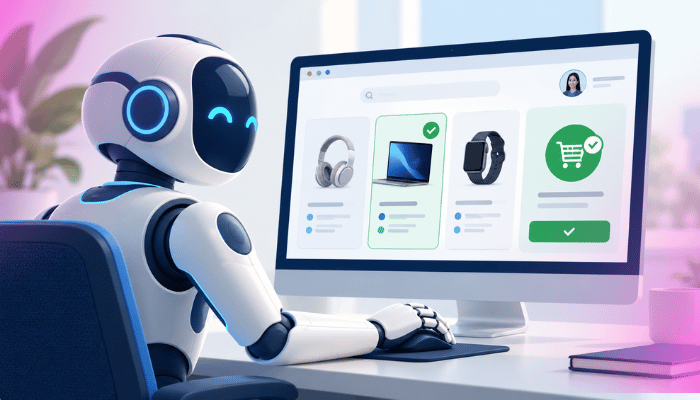
Agentic buying is the practice of an AI agent doing a buyer's research, comparison, and eventually their purchasing. Today, the agent narrows the field to a few companies, and a human makes the final call. Soon, buyers will connect a payment method and let the agent complete the purchase with little or no human input.
Right now we're kind of in an in-between stage. You have to satisfy the robots (AI agents, Google's algorithm, social platforms) so they'll show you to people. Then you still have to connect with those people using the same honest messaging that has always worked.
Doing both at once is hard, and most of the companies I coach feel that tension.
How close are we to AI making purchases for buyers?
AI agents can already complete some purchases with permission, mostly in e-commerce, and the practice is starting to show up in B2B. My estimate is that we're about 18 months from widespread everyday use. Large purchases will take longer, because few homeowners will let an agent spend $20,000 on a new roof without oversight.
Browser connectors already let ChatGPT or Claude operate a web browser and move through a checkout, and billions of dollars are going into this technology.
For at least the next year, your goal is to be one of the two or three companies an agent suggests. After that, it's to be the one it picks.
Why is your website traffic dropping, and should you worry?
Your traffic is likely dropping because AI answers many questions before the searcher ever clicks. Similarweb found that the share of Google searches ending without a click rose from 56% to 69% after AI Overviews launched. Imperva's 2025 Bad Bot Report found that automated traffic made up 51% of all web traffic in 2024.
Zero-click searches tend to be early, top-of-funnel questions. Somebody who wants to know what an HVAC system is may be a high school student doing homework. That person was never going to buy from you.
So here's the test I give clients. If your traffic and click-through rates are falling but sales aren't falling with them, you're probably fine. The clicks that remain are concentrated on bottom-of-funnel pages, like "where do I buy this" or a specific brand name, and those visitors are far more likely to contact you or buy.
Check out this podcast episode on what marketing metrics actually matter for more insights into what's worth tracking, and what's not.
Some of your traffic has also become invisible. AI traffic is finicky and hard to track.
How can you tell whether AI is recommending your business?
The simplest way to find out is to ask. Open ChatGPT, Claude, or Google in an incognito window and type the question your buyer would type. Ask it to recommend the best company for that need. Then see whether you show up, whether a competitor shows up instead, and whether the information about you is correct.
For example, you might type: "I'm a homeowner who needs a new roof in Western Kentucky. Who should I hire?"
If you don't appear, follow up with this: "I heard about ABC Roofing. Why didn't you recommend them?" The AI will tell you. Then ask one more question: "What would ABC Roofing need to do for you to recommend them?"
When I've run this with clients, two answers come up most often:
- A single bad review sits on some obscure review site, with no other reviews there to balance it.
- The website blocks AI crawlers through its robots.txt file or another setting, and the owner didn't know because an agency built the site.
People expect a complicated answer when I suggest this test. There isn't one. You're experiencing your business the way your buyer does.
What AI weighs also varies by market. One roofer's recommendations might hinge on a chamber of commerce directory, while a roofer five towns over gets judged on a review site you've never heard of.
If AI isn't recommending you, just ask it why. We did.
Check out our AI Visibility Study to see how we tested what exact AI is looking for across over 20 industries and 4 different AI platforms.
What makes a website easy for AI agents to read and trust?
AI agents favor websites that make answers cheap to find. Clear headings, direct answers near the top of each page, honest detail, and strong trust signals all reduce the work an AI does to understand you. The less effort it takes to pull a correct answer from your site, the more likely you are to be recommended.
My view is that AI companies are under pressure to lower the cost of every answer, so pages that bury the answer get skipped.
What your team can fix this month
Business owners and marketers can do much more of this than they think. Start with on-page work:
- Give each page one H1, then break it down with H2s and H3s.
- Answer the question directly in the first line after the heading. If an article is titled "How much does X cost?" and never gives a number, AI will pass it over.
- Add images and helpful links that support the answer.
- Be as honest and specific as you can. The first of the Four Pillars of a Known and Trusted Brand reads: "Say what others in your space aren't willing to say. Address the hard questions: cost, problems, comparisons, reviews. Do that openly and without hesitation."
- Show strong E-E-A-T signals. E-E-A-T stands for experience, expertise, authoritativeness, and trustworthiness, and it's how Google describes the qualities it looks for in content.
- Add schema. AI tools will write the schema markup for you, and adding it is mostly a copy-and-paste job.
What needs a developer
Some changes carry too much risk to handle on your own. Editing robots.txt and other site-level files, building machine-readable resource files, and changing back-end code or metadata all fall here. If you get these a little wrong, you can create a problem that's hard to trace back to its cause.
If you own an established, mid-size company, even the on-page work usually belongs with your team, so your time goes to vision and leadership.
How much of AI's decision happens off your website?
A large share of it does. Reddit threads, Facebook group recommendations, review sites, and influencer videos all tell AI whether other people trust you. Google and AI treat these as authority signals, and they're hard to fake, because you can't create your own authority alone.
You can list your certifications and education on your site, and you should. But it's a much stronger signal when people unrelated to you vouch for you. When 30 of the 50 replies in a local Facebook group recommend the same roofer, AI picks up on that pattern the same way a person would.
Running a good business still matters most here. Treat people well, earn reviews on the platforms your buyers use, and your reputation will keep supporting you even where your website falls short. For more on how that works, read Reviews and the Reputation Graph: How AI Evaluates Your Business.
What does a website built for AI agents look like?
A website built for AI agents includes clean structure, direct answers, clear good fit/bad fit criteria, public pricing, and a few technical additions that make your business easier to understand.
One of those things is a page written especially for AI agents. Honest Fix, an HVAC company I've worked with across a couple of businesses, has one, and it says so right at the top. A person who stumbles on it will think it's odd and leave. An AI agent gets exactly what it needs.
The page includes:
- The exact business name, location, phone number, and owner
- The language they want AI to use when describing them
- Their guarantees and what each one covers
- Their pricing
- A packet of machine-readable resources, including schema
You can see how the rest of the Honest Fix website is built in How Do You Optimize Your Website for AI Search?
I don't think websites are going away, because buyers at the end of a big decision still want to confirm they've picked a legitimate company. Sites will likely get simpler, though. An AI agent doesn't need hundreds of service, location, and blog pages to understand what you do.
I walked through the AI recommendation test and the Honest Fix example with Bob Ruffolo. Watch or listen to the full episode: "Agentic Buying: How to Prepare Your Website for AI" on the Endless Customers podcast.
Frequently asked questions
Is agentic buying only happening in e-commerce?
E-commerce is furthest along, since agents can already present products and help complete checkout. B2B use is starting to grow. Larger, higher-risk purchases, like a roof replacement or a major service contract, will likely keep a person in the loop for longer.
How often should I check what AI says about my business?
Check every few months, and check more than one platform. The sources AI relies on shift over time, and ChatGPT, Claude, and Google's AI results can each give you a different answer and a different reason.
Should I stop publishing top-of-funnel content if it no longer gets clicks?
No. Early-stage content still teaches AI about your brand and keeps you in the answers buyers see. Judge it by whether sales and bottom-of-funnel visits stay steady, rather than by raw traffic.
Get your website ready for the agent doing your buyer's research
Agentic buying means an AI agent is already doing much of your buyer's research, and soon it will do some of their buying too. Your website has to be easy for that agent to read, understand, and trust.
Falling traffic isn't a crisis if sales are steady. Ask AI why it didn't recommend you, fix your page structure and answers, hand back-end changes to a developer, and keep earning the reviews no website can create on its own.
At IMPACT, we've coached 300+ companies through the same system, and preparing websites for AI is now part of that work every week. If you're wondering how that system connects to AI recommendations, start with Can Endless Customers Help Me Get Recommended by AI?
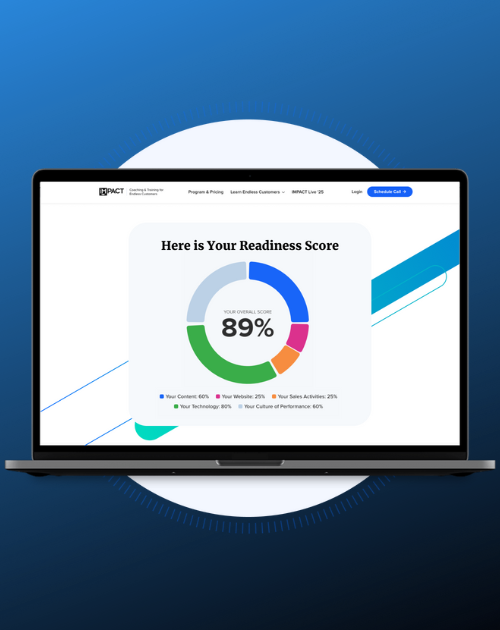
If you want to know where your own marketing stands, take the free AI Marketing Assessment. It's a quick way to see what AI sees when it looks at your business.
Free Assessment
Free Marketing Assessment: Where do you stand?
AI is changing how buyers find businesses, and most companies are dangerously underprepared. Take this free assessment and find out if yours is at risk of becoming invisible to your buyers.
Related reading
- AI for Marketing in 2026: What To Use, What To Skip, and What To Watch Next: the full guide to where AI fits in your marketing.
- How Do You Optimize Your Website for AI Search?: How to structure a website so AI tools recommend you.
- 19 AI Trust Signals: A checklist of the signals AI uses to decide which businesses to trust.
- Reviews and the Reputation Graph: How AI Evaluates Your Business: How reviews and third-party mentions shape what AI says about you.
- Can Endless Customers Help Me Get Recommended by AI?: How the Endless Customers System connects to AI recommendations.

Written By
Mandy York is an Endless Customers Coach who has spent four years coaching IMPACT clients across video, written content, EEAT, and leadership. Before IMPACT, she led a vocational school and earned a master's degree in organizational leadership, a background that shapes how she coaches companies to build real structure around their marketing and content, not just produce more of it. Mandy has coached companies of every size at IMPACT, but she does her best work with smaller, founder-led businesses, especially in blue-collar trades and education. She's worked with clients including CustomBuilt, A&E Heating, Plumbing & Air, Bill Ragan Roofing, Floor Concepts, Options for Learning, and National Van Lines.
Mandy York is an Endless Customers Coach who has spent four years coaching IMPACT clients across video, written content, EEAT, and leadership. Before IMPACT, she led a vocational school and earned a master's degree in organizational leadership, a background that shapes how she coaches companies to build real structure around their marketing and content, not just produce more of it. Mandy has coached companies of every size at IMPACT, but she does her best work with smaller, founder-led businesses, especially in blue-collar trades and education. She's worked with clients including CustomBuilt, A&E Heating, Plumbing & Air, Bill Ragan Roofing, Floor Concepts, Options for Learning, and National Van Lines.

Share


NEED HELP WITH AI FOR MARKETING?
If you’re looking to take control of your sales and marketing with a proven system built for the age of AI, IMPACT can help. We can guide you on how to control your growth, stop relying on agencies, and become the most known and trusted brand in your market.
NEED HELP WITH AI FOR MARKETING?
If you’re looking to take control of your sales and marketing with a proven system built for the age of AI, IMPACT can help. We can guide you on how to control your growth, stop relying on agencies, and become the most known and trusted brand in your market.