
/Assets/arrow-facing-left--black-01.svg)
/Assets/navigation-global--close-symbol-black-01-1.svg)

/Assets/Icon%20Library/social/facebook-logo.svg)

/Assets/Icon%20Library/social/instagram-logo.svg)
/Assets/Icon%20Library/social/youtube-logo.svg)





A team member sends you a draft of the new service page, and it looks polished.
The headings are clean, the grammar is perfect, and AI wrote it in minutes. That feels like a win.
You read it twice and still can't say whether it's good, because nothing in it is technically wrong, but nothing in it sounds like your company either.
Approving it risks a website full of pages any competitor could have published. Sending it back slows down the team you gave AI to speed up. Without a way to judge the work, the choice comes down to whichever risk feels smaller that day.
At IMPACT, we coach business owners to become the most known, trusted, and recommended company in their market with the Endless Customers System™, and more and more of that work now runs with the help of AI. We've seen what separates AI output that earns buyer trust from AI output that fills a site with pages nobody reads.
Below are six checks for judging what it hands back, so you can tell good work from bad and know what to fix.
💾 Save for later: Check out our full guide on AI for Marketing to learn where AI fits and doesn't fit in your marketing strategy.
1. Does it meet a standard you already trust?
AI output is good when it meets a consistent standard, so create one before the AI writes anything. Think about: a page checklist, a brand voice guide, or an editorial checklist designed to match your company. Have AI score each draft item by item, marking every requirement present or missing.
At IMPACT, this looks like a brand voice guide that defines what we do and don't say, and common AI-isms that we avoid. We also use scoring guides (currently Claude skills) for articles and email subject lines. The scores help us improve both the content and the skills themselves.
If a skill keeps flagging something we're comfortable with or misses something we'd want to fix, we refine its instructions. This gives a consistent benchmark for reviewing our work, while keeping our team's judgment at the center of what earns a passing score
If you have no standard for service pages, articles, or emails yet, give AI some of your best (and worst) work to start building your publication standards.
2. Could a competitor publish the same page?
If a competitor could publish the page with only the company name changed, the page fails. Good AI output includes details only your business knows: your actual prices, your timelines, your service area, and the results you've delivered. Google's guidance asks whether content provides “original information, reporting, research, or analysis.”
Run the swap test. Put a competitor's name over yours. If the page still makes sense, send it back and supply what's missing: a real price range, a project you completed, a rule of thumb your team applies on every job.
Both questions come from Google Search Central's “Creating helpful, reliable, people-first content” (updated October 2026), which also asks whether content “clearly demonstrate[s] first-hand expertise and a depth of knowledge.”
Our articles on creating content AI can't replicate and creating human content while using AI show how to get those details into the draft in the first place.
Bonus tool: Check out this article from Search Engine Land. It includes a GitHub link that you can use in your AI tool of choice to identify "non-commodity" content opportunities — essentially the things that you can have on your service pages that your competitors can't, therefore giving you the advantage in search results.
3. Does it answer a real buyer question in plain language?
Good AI output answers a question a real buyer would type into a search bar or ask an AI assistant, and it gives the answer in the first sentence. Check that each page opens with that answer, uses plain words, and shows who is and isn't a good fit for your business. A page that makes buyers hunt for the answer fails.
Buyers search for the answers they hesitate to ask a salesperson, like what something costs and what can go wrong. Read the first sentence under each heading. If it only introduces the topic, rewrite it as the answer.
Then list the terms a first-time visitor wouldn't know and confirm each one is defined in a sentence or linked to a definition.
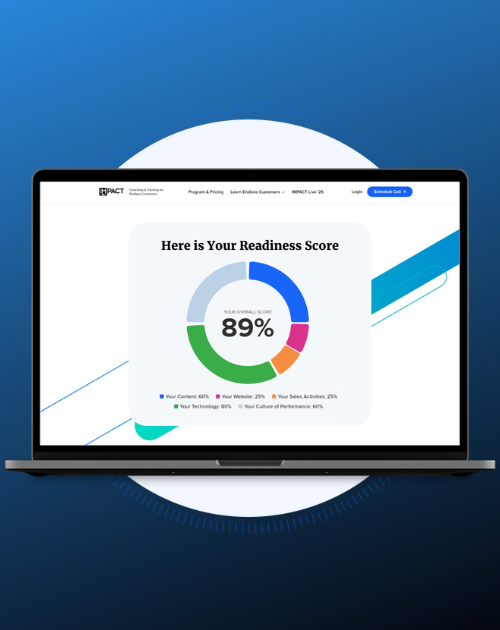
Free Assessment
Free Marketing Assessment: Where do you stand?
AI is changing how buyers find businesses, and most companies are dangerously underprepared. Take this free assessment and find out if yours is at risk of becoming invisible to your buyers.
4. Has a person verified every fact, number, and claim?
A person has to verify every fact, number, and claim in AI output against a source before the page publishes. Google Search Central tells site owners to “manually fact-check and review all AI-generated content for accuracy and trustworthiness before publishing,” because generative AI outputs “may contain inaccuracies (also known as hallucinations).”
Volume makes the problem worse. We once loaded an editorial calendar of about 100 articles into an AI agent and asked it to write them. About two hours later it had produced 200. It felt awesome, but we couldn't use any of them. They were short, awkward to read, and none were good enough to publish.
That failure was obvious on sight. A wrong price or an invented guarantee is harder to catch in a skim, so the reviewer checks facts line by line and confirms that:
- Every price, date, and statistic matches a source you can point to.
- Every claim about your company is true today.
- Every person, product, and place mentioned exists and is spelled correctly.
- The page is long and specific enough to answer the question it targets.
5. Does the technical build work?
AI-built pages need a technical check, because polished copy can sit on a broken page. Confirm that every link works and that Google can find and index each page. Free tools like Google Search Console report indexing problems and errors, so you don't have to rely on the AI's word that the site works.
Run a site audit on a fixed schedule instead of once at launch. An audit tool crawls every page, flags broken links and missing titles, and gives the site a score you can track week to week.
Our guide to optimizing your website for AI search covers what else AI tools look for.
6. How do you measure whether your AI content is working?
Measure AI content by whether the right buyers find it and arrive ready to buy, because total traffic can fall while the quality of visitors rises. Your analytics tools show where visitors come from and what they search for, and your sales team can tell you whether the people who reach them are informed.
HubSpot's AEO tool tracks the prompts that you choose, so you can watch how your company shows up in AI answers. Traffic sources in HubSpot shows whether AI referrals are growing. Google Search Console can show which keywords and phrases your pages rank for.
Treat total visits as a secondary signal, since they may drop as more buyers get answers from AI tools.
What does this review look like on a real website?
It looks like a short review sheet applied to every page before it publishes and again every week after. Use the table below as that sheet. Each row names a check, what to look for, and what a passing page looks like.
|
Check |
What to look for |
What a passing page looks like |
|
1. Written standard |
Every item on your checklist marked present or missing |
A pricing page scored item by item, with the missing items on a fix list |
|
2. Competitor swap |
Details only your company would know |
A service page with your price range, timeline, and service area in place of “affordable, high-quality work” |
|
3. Buyer question |
A heading a buyer would type, answered in the first sentence |
“How long does a kitchen remodel take?” answered with a range in the first sentence |
|
4. Fact check |
Every number, name, and claim traced to a source |
A reviewer confirms each price, date, and guarantee against your own records before publishing |
|
5. Technical build |
Working links, indexed pages, and a site audit score |
A weekly audit report with zero broken links and every new page indexed |
|
6. Measure performance |
Rankings, traffic, and leads from tools the AI doesn't control |
A weekly report where leads traced to the page rise over time |
How one pool company applied these checks to a 600-page website
Scott Payne owns Scott Payne Custom Pools, a design and build outdoor construction company in the Philadelphia market. He describes himself as not tech-savvy, and he used an AI agent called Manus to build a 600-page website for under $1,000.
He built his pricing page from IMPACT's 16-item checklist and scores it 15 of 16, with only the video missing. His site has a page for every affluent ZIP code within 50 miles, and when his designer searched for zoning setback rules in Dresher, PA, Scott's own site came back as the top response.
Every draft goes to Scott to proof, and every Friday around 6 AM Manus pulls rankings for 300 tracked keywords. Within the first two to three weeks, his site score reached the mid-90s, measured with Google Search Console and SE Ranking. Organic search now accounts for about half of his incoming leads.
Scott also ships before a page is perfect. Of his first estimator tool, he said, “Was it the best it can be? No. But tell you what, it was 100% better than what was on there now, which was zero.”
How do you start checking AI outputs today?
You can only spot good AI output when you know what good looks like. Without that standard, polished copy passes review, and generic pages end up on your website.
Start by creating the standard. Make a scoring guide for each type of content you publish, such as service pages and emails, and score every AI draft against it before anything goes live. A written standard also gives the AI something specific to work toward, so the next draft arrives closer to what you need.
A proven system raises the floor even further. The Endless Customers System™ gives your team a standard for the content buyers trust, and AI works better when it starts from that standard instead of a blank prompt. The result is output that’s higher quality, more consistent, and better equipped to drive results.
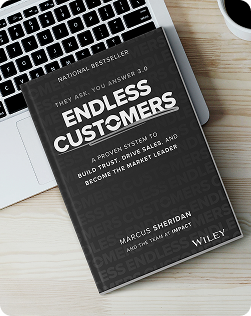
FREE BOOK PREVIEW
Endless Customers Special Preview Edition
Get a taste of the book that brings you a proven system to build trust, drive sales, and become the market leader. This special preview edition has select chapters and The Four Pillars of a Known and Trusted Brand, resources to accelerate your success, and more.
Frequently asked questions
Can AI-generated content hurt your search rankings?
It can. Google Search Central's guidance on using generative AI content (updated October 2026) warns that using it to “generate many pages without adding value for users may violate Google's spam policy on scaled content abuse.” Pages that pass the six checks above add value for buyers. Pages that fail them put your rankings at risk.
How much does it cost to build a website with AI?
Scott Payne, a pool company owner, built a 600-page website for under $1,000 in AI credits. Review time costs extra, because every page still needs a person to read it and verify the facts.
Keep learning
- Using AI for Marketing: Where AI fits across your marketing.
- How to Create Content AI Can't Replicate (and is Worth Citing): Original content built from your team's experience.
- How to Create Human Content While Using AI: A six-step process for drafting with AI in your own voice.
- How Do You Optimize Your Website for AI Search?: Making your site easy for AI search tools to find and cite.

Written By
Bob Ruffolo founded IMPACT in 2009 and has led it as CEO ever since. What started as a simple web design company has grown into a business coaching and training company that helps leaders and their teams get better at sales, marketing, communication, and leadership. IMPACT has been a HubSpot partner since 2011, one of HubSpot's first, and today is a HubSpot Diamond Solutions Partner, twice named HubSpot Partner of the Year and a four-time Inc. 5000 honoree (2018 to 2021). Bob himself has been recognized as a 40 Under 40 winner and named to Glassdoor's Best CEO for Small Businesses list. Bob is the co-creator of the Endless Customers System with Marcus Sheridan, the methodology behind IMPACT's coaching, the USA Today bestselling book, the Endless Customers podcast, and the annual Endless Customers Live conference. It teaches companies to build marketing and sales capability in-house rather than outsourcing it indefinitely. In recent years Bob has led IMPACT's shift to an AI-first company and become a go-to voice for leaders trying to understand what AI means for marketing, sales, and the workforce.
Bob Ruffolo founded IMPACT in 2009 and has led it as CEO ever since. What started as a simple web design company has grown into a business coaching and training company that helps leaders and their teams get better at sales, marketing, communication, and leadership. IMPACT has been a HubSpot partner since 2011, one of HubSpot's first, and today is a HubSpot Diamond Solutions Partner, twice named HubSpot Partner of the Year and a four-time Inc. 5000 honoree (2018 to 2021). Bob himself has been recognized as a 40 Under 40 winner and named to Glassdoor's Best CEO for Small Businesses list. Bob is the co-creator of the Endless Customers System with Marcus Sheridan, the methodology behind IMPACT's coaching, the USA Today bestselling book, the Endless Customers podcast, and the annual Endless Customers Live conference. It teaches companies to build marketing and sales capability in-house rather than outsourcing it indefinitely. In recent years Bob has led IMPACT's shift to an AI-first company and become a go-to voice for leaders trying to understand what AI means for marketing, sales, and the workforce.
/Assets/Icon%20Library/social/linkedin-logo.svg)
Share
/Assets/Icon%20Library/social/x%20corp.svg)
/Assets/Icon%20Library/social/mail-to.svg)
/Assets/base/Learning%20Center%20Resource%20Category%20Icons/Website%20link.svg)
NEED HELP WITH AI FOR MARKETING?
If you’re looking to take control of your sales and marketing with a proven system built for the age of AI, IMPACT can help. We can guide you on how to control your growth, stop relying on agencies, and become the most known and trusted brand in your market.
NEED HELP WITH AI FOR MARKETING?
If you’re looking to take control of your sales and marketing with a proven system built for the age of AI, IMPACT can help. We can guide you on how to control your growth, stop relying on agencies, and become the most known and trusted brand in your market.